

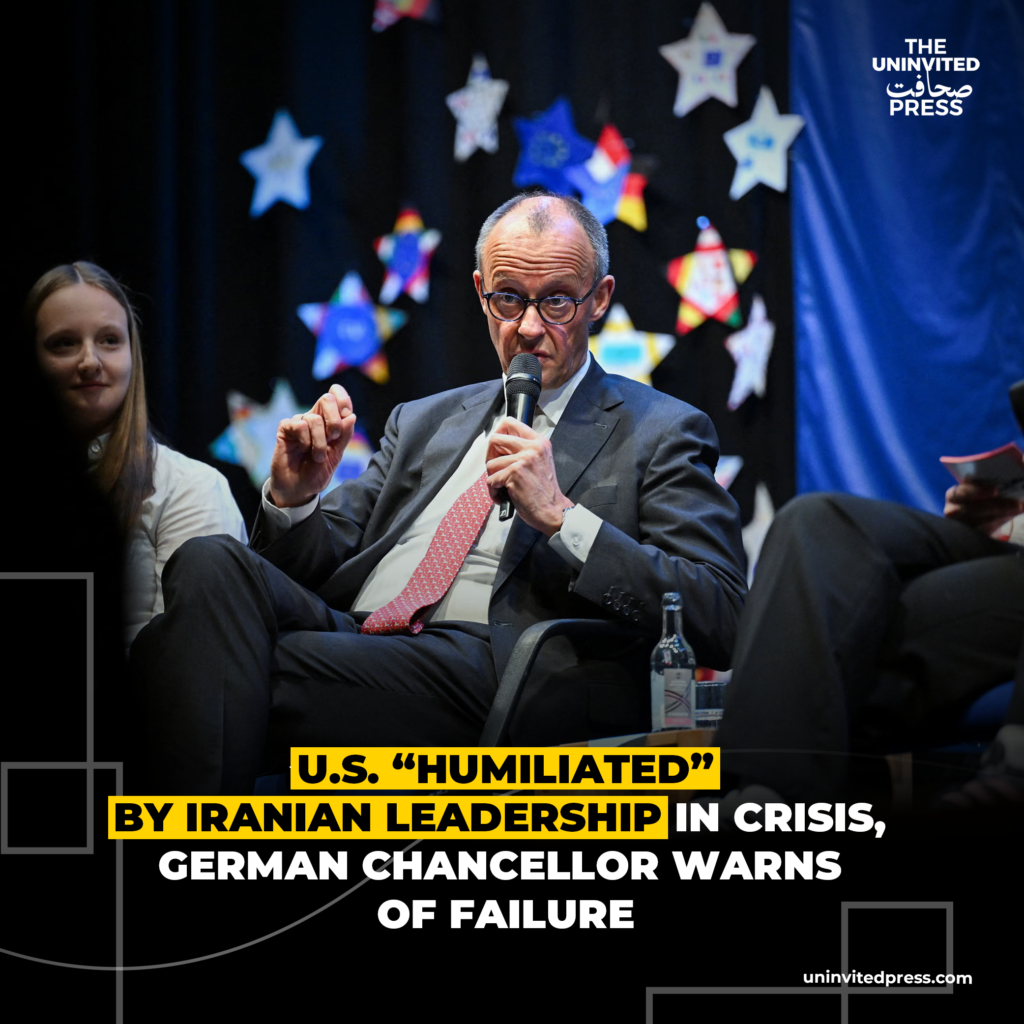
Friedrich Merz criticises Trump administration’s strategy in Iran conflict, saying Tehran is outmanoeuvring Washington and that the US risks another prolonged quagmire with no clear exit.
German Chancellor Friedrich Merz has delivered unusually sharp criticism of the United States, declaring that the country is being “humiliated” by Iran’s leadership in the ongoing war and warning that Washington lacks a viable strategy to end the conflict.
Speaking to students in the western German town of Marsberg on Monday, Merz said Iranian officials were negotiating “very skilfully-or rather, very skilfully not negotiating,” citing instances where US envoys were sent to Pakistan only to return without results.
“An entire nation is being humiliated by the Iranian leadership, especially by these so-called Revolutionary Guards,” Merz said, adding that Iran appeared “clearly stronger than one thought.”
European Concerns Over US Strategy and Prolonged Conflict:
The chancellor expressed deep concern over the absence of a convincing US plan to extricate itself from the conflict, now in its eighth week, drawing parallels with past American military engagements.
“I cannot see what strategic exit the Americans are now opting for,” he said, warning of the risk of becoming bogged down in another prolonged conflict similar to those in Iraq and Afghanistan.
Merz’s remarks reflect growing European frustration with the war’s economic fallout, particularly disruptions to energy supplies caused by Iran’s actions in the Strait of Hormuz, which have driven up global oil prices and threatened European economies.
Growing Rift Among Allies Over Iran Crisis:
The comments mark a notable distancing by a key US ally at a time of heightened tensions in the Middle East. Germany, along with other European nations, has been urging diplomatic efforts to de-escalate the conflict between the US, Israel and Iran.
Merz’s intervention comes amid stalled backchannel talks and repeated failed attempts to broker a ceasefire. Iranian officials have been accused by Western governments of dragging out negotiations while maintaining pressure through restrictions on shipping and missile capabilities.
Analysts say the chancellor’s blunt language highlights divisions within the Western alliance over how to handle Tehran and the broader consequences of military confrontation in the region.
The conflict has already led to heavy casualties, widespread damage to key infrastructure in Iran, and growing fears of a broader regional escalation. European leaders have consistently urged restraint and renewed diplomacy, cautioning that continued instability could carry serious global consequences.
As fighting persists and diplomatic efforts stall, criticism from Friedrich Merz highlights increasing frustration in Europe over the direction of the United States approach, along with the rising human and economic toll.