

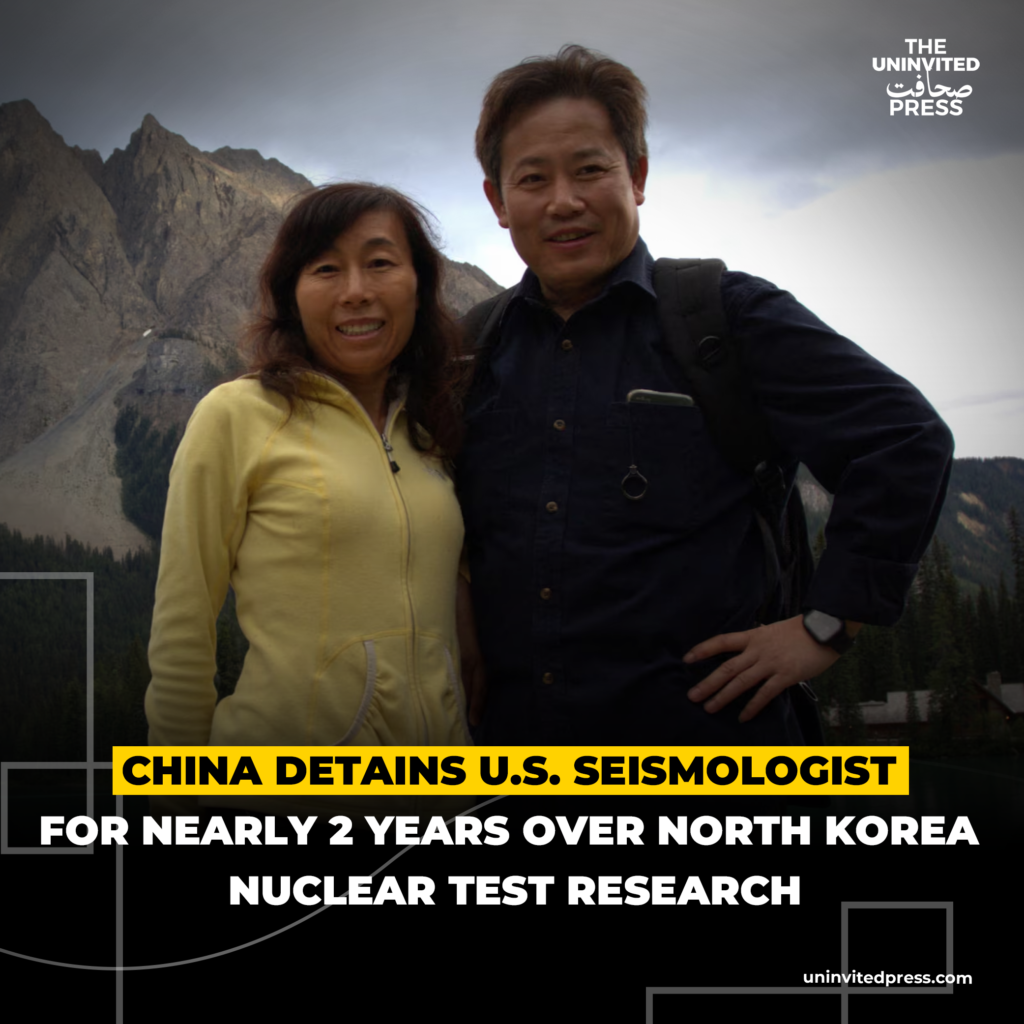
Case of Youlin Chen highlights growing tensions in US-China relations as Beijing accuses scientist of espionage amid sensitive nuclear monitoring work.
A Chinese-born American seismologist has been held in China for nearly two years on espionage charges linked to his research on detecting North Korean nuclear tests, according to his family, US officials and advocacy groups.
Youlin Chen, 54, a US citizen based in Boston, was detained by Chinese state security officers at Beijing International Airport in November 2024 as he prepared to return home after visiting family and delivering academic lectures.
His wife, Yufang Rong, said Chen has endured harsh conditions, including prolonged interrogations-more than 100 times-focused on his seismographic work, which was funded by US government agencies and relied on publicly available data.
Espionage charges and closed-door trial:
Chen faces trial on spying charges in a case that has only recently come to public attention. US Secretary of State Marco Rubio designated him as “wrongfully detained” in March 2026, making his release a priority for Washington.
The detention adds another layer of strain to already tense US-China relations. President Donald Trump reportedly raised Chen’s case with Chinese President Xi Jinping during a visit to Beijing, with Xi promising to look into the matter, though no resolution has been announced.
Chen’s research specialised in analysing seismic signatures of underground nuclear explosions, particularly those conducted by North Korea. Experts say such work is crucial for international monitoring of Pyongyang’s nuclear programme but is viewed with extreme sensitivity by Beijing, which maintains close ties with its neighbour.
Scientist's Trial Draws Global Attention:
Hostage advocacy groups and US lawmakers have expressed concern over the lack of transparency and the conditions of Chen’s detention. His wife described him being forced to sit for long periods without access to reading materials, exercise, or adequate medical care for his diabetes and other conditions.
The case echoes previous instances where China has detained foreign or dual nationals on national security grounds, often amid broader geopolitical frictions. Critics argue such detentions are sometimes used as leverage in diplomatic disputes.
As Chen’s closed-door trial proceeds, his family and supporters continue to call for his immediate release, emphasising that his scientific work was conducted openly and contributed to global efforts to monitor nuclear proliferation.
The incident comes as Washington and Beijing attempt to manage a complex relationship involving trade, technology rivalry, and regional security issues, including tensions on the Korean Peninsula.