

New Labor leader pledges royal commission into construction sector and promises a ‘new direction’ four months before state election.
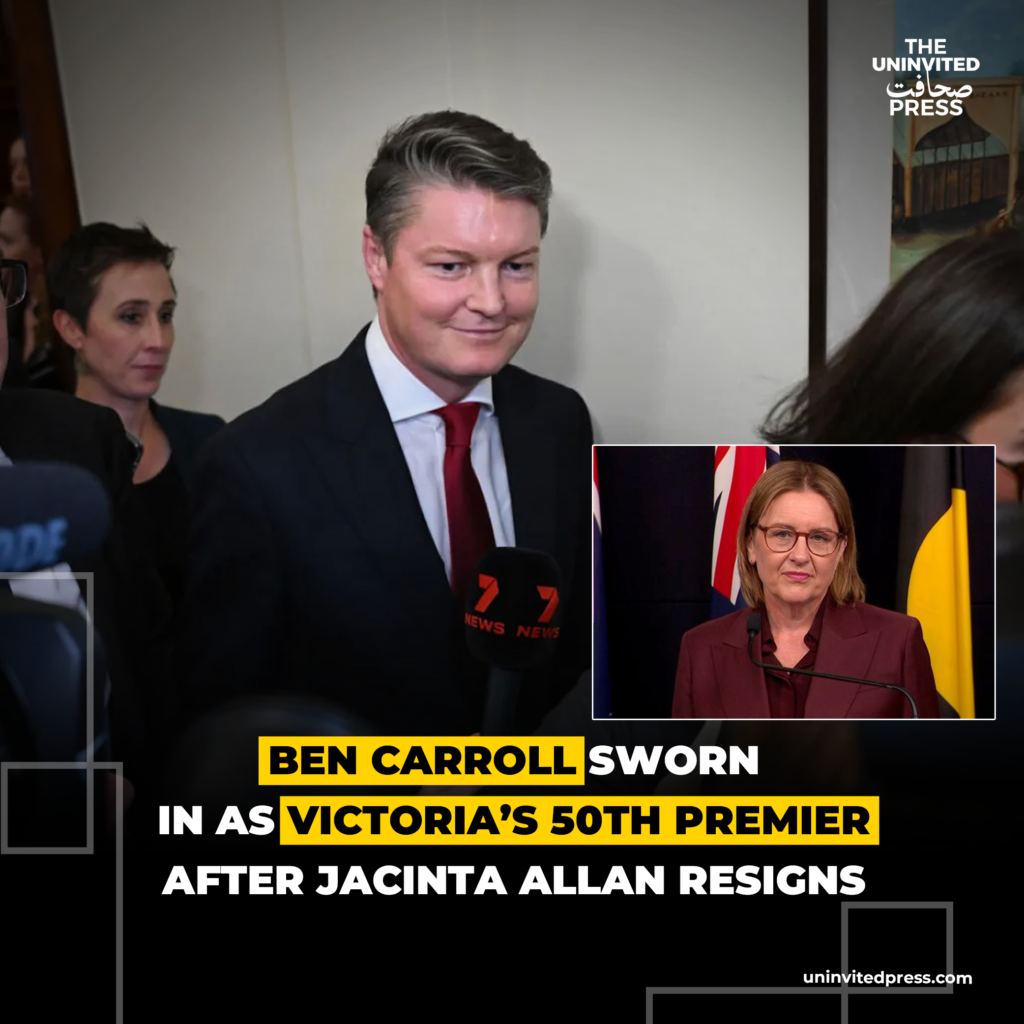
Ben Carroll has been sworn in as the 50th premier of the Australian state of Victoria after Jacinta Allan stepped down as leader of the governing Labor Party, ending nearly three years in the top job.
Carroll, previously the deputy premier and education minister, was unanimously elected by the Labor caucus on Tuesday following a tense and at times chaotic party-room meeting. He was formally sworn in later the same day by the state’s lieutenant-governor, acting in the absence of Governor Margaret Gardner.
Ben Carroll Replaces Jacinta Allan as Premier:
Allan announced her resignation early on Tuesday morning, saying she was stepping aside for the good of the party and the people of Victoria with a state election due in November. “After speaking with my colleagues overnight, I have made the difficult decision to step aside,” she told reporters. While she maintained she believed she would have won a leadership ballot, Allan said contesting the position so close to the election would have diverted valuable resources. She offered her “unqualified support” to Carroll should he emerge as the new leader.
The leadership change came after a cross-factional group of MPs informed Allan that she had lost the confidence of a majority of the caucus. Carroll, from Labor’s right faction, had publicly ruled out challenging her only weeks earlier. On Monday he announced he would nominate for the leadership after being approached by colleagues.
The subsequent caucus meeting proved turbulent. Planning Minister Sonya Kilkenny, a close ally of Allan, launched a surprise challenge and initially secured the support of about 15 MPs, including the outgoing premier. After more than two hours of discussion that included raised voices behind closed doors, Kilkenny withdrew. Carroll was then declared unanimously elected. Transport Minister Gabrielle Williams was chosen as the new deputy premier, defeating another contender in a separate ballot.
In his first address as premier, Carroll moved quickly to distance himself from both Allan and her predecessor, Daniel Andrews. “I am not Daniel Andrews, I am not Jacinta Allan,” he said. “I will do things differently, because different times require a new approach.”
His first announced priority was a royal commission into the construction sector, focusing on allegations of corruption, union misconduct and organised crime links within major infrastructure projects. Allan had resisted such an inquiry. Carroll also pledged to establish a special prosecutor to work alongside the commission and to immediately strengthen the powers of Victoria’s anti-corruption body, IBAC, including “follow the money” capabilities that had previously been scheduled for later introduction.
“In my government, integrity will not be optional,” Carroll said. “Whether in business, politics or the union movement, there will be zero tolerance for those that misuse their positions.”
Ben Carroll Takes Charge Ahead of Victoria Election:
Labor has governed Victoria continuously since 2014, winning three successive elections under Andrews before his resignation in 2023. Allan, who succeeded him, faced declining poll numbers and growing public concern over cost-of-living pressures, infrastructure delivery and integrity issues surrounding the state’s large-scale building programme, often referred to as the “Big Build.”
Carroll, 51, was born in Airport West in Melbourne’s north-west and has represented the seat of Niddrie since 2012. A former lawyer and political adviser, he has held a series of ministerial portfolios including roads, public transport and education. He is aligned with the Shop, Distributive and Allied Employees Association (SDA) union within Labor’s right faction.
The leadership transition occurs with just four months remaining until the November 28 state election. Opposition parties have already sought to portray the change as evidence of internal division and a government under pressure. Carroll faces the dual challenge of stabilising his party and convincing voters that the new leadership represents a genuine shift in direction rather than a mere change of personnel.
Victorian politics now enters a compressed pre-election period in which integrity, cost of living and infrastructure delivery are expected to dominate the contest.