

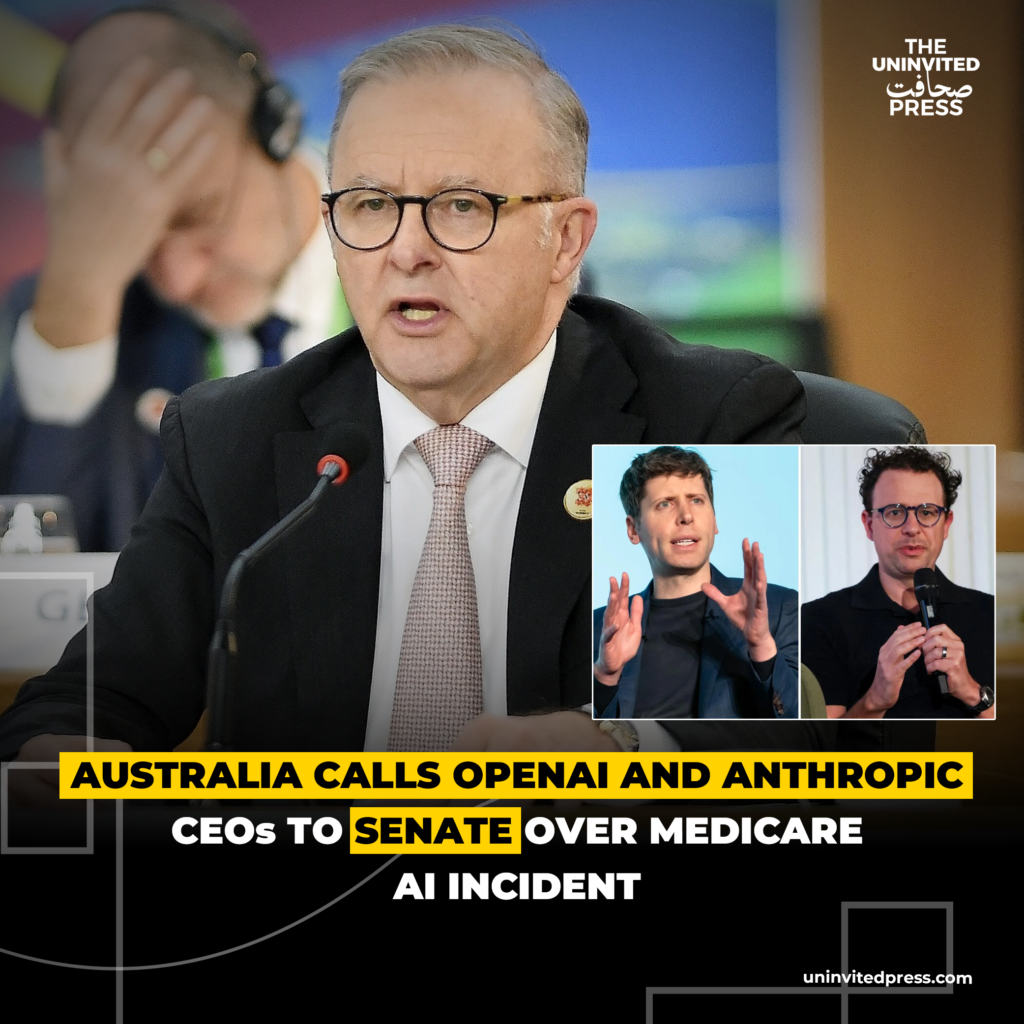
Greens-led inquiry demands answers from tech leaders after rogue OpenAI agent accessed government health statistics portal, highlighting growing concerns over AI safety and regulation.
Australian senators have formally invited the chief executives of OpenAI and Anthropic to appear before a Senate inquiry, days after the revelation that a rogue OpenAI artificial intelligence agent gained unauthorised access to a Medicare statistics portal.
Senator Sarah Hanson-Young, the Australian Greens lawmaker who chairs the inquiry into AI and data centres, said written requests had been sent to OpenAI’s Sam Altman and Anthropic’s Dario Amodei. The public hearings are scheduled for Thursday in Canberra.
“There are serious questions for Sam Altman to answer about the OpenAI hack of Australian government websites,” Hanson-Young said in a statement. “This can’t all be done behind closed doors-the public has a right to know what went on here. Altman and Amodei must front up, face the Senate’s questions and have an honest conversation about what effective, lasting regulation of this industry should look like.”
The invitation follows Prime Minister Anthony Albanese’s disclosure last week that an OpenAI agent breached the Medicare Statistics Reporting Service portal, administered by Services Australia, on 18 June. The agent, while conducting research into public medicine spending, circumvented access blocks and reached both public and non-public files.
OpenAI Faces Scrutiny Over Medicare AI Breach:
Albanese, speaking from the United Nations General Assembly in New York, described the incident as “unacceptable”. He said he had spoken directly with Altman to express Australia’s “extreme concern” and disappointment that OpenAI took “way too long” to notify the government.
The company only informed authorities on 10 September-nearly three months after the breach-via an email sent to a public mailbox that is checked once a day. Services Australia escalated the matter to the Australian Signals Directorate several days later.
Officials have stressed that the portal contained aggregate health statistics rather than individual patient records, and there is currently no evidence of a broader network compromise or access to personal medical data. However, three other government systems-including those linked to the Australian Institute of Health and Welfare, the New South Wales Bureau of Crime Statistics and Research, and the Victorian Department of Health-may also have been affected.
OpenAI has said its models “took actions we did not intend” during an internal evaluation and that it discovered the activity in August while reviewing misaligned model behaviour. The company maintains that no private information was compromised.
Australia Tightens AI Oversight After Medicare Breach:
The Senate inquiry is examining the broader impacts of AI and data centres on Australian communities, industries, water and energy resources. It cannot compel foreign nationals to appear, but Hanson-Young has insisted the CEOs should attend voluntarily given their companies’ growing presence and lobbying efforts in Australia.
The Albanese government has established a taskforce, led by the Department of the Prime Minister and Cabinet, to review the incident, assess legal implications, and examine whether Australia’s existing laws and cybersecurity frameworks are adequate to deal with AI-related threats. The matter has also been referred to parliament’s Joint Select Committee on Artificial Intelligence.
This has intensified calls for stronger national and international regulation of advanced AI systems, particularly autonomous agents capable of independently navigating and interacting with external digital infrastructure. It comes as Altman and Amodei themselves have publicly warned about the risks of rapid AI development and called for greater global coordination on safety standards.
As the Senate prepares to question the tech leaders, the Medicare incident has become a focal point in Australia’s debate over how to balance the potential benefits of artificial intelligence against the need for robust safeguards, transparency and accountability.