

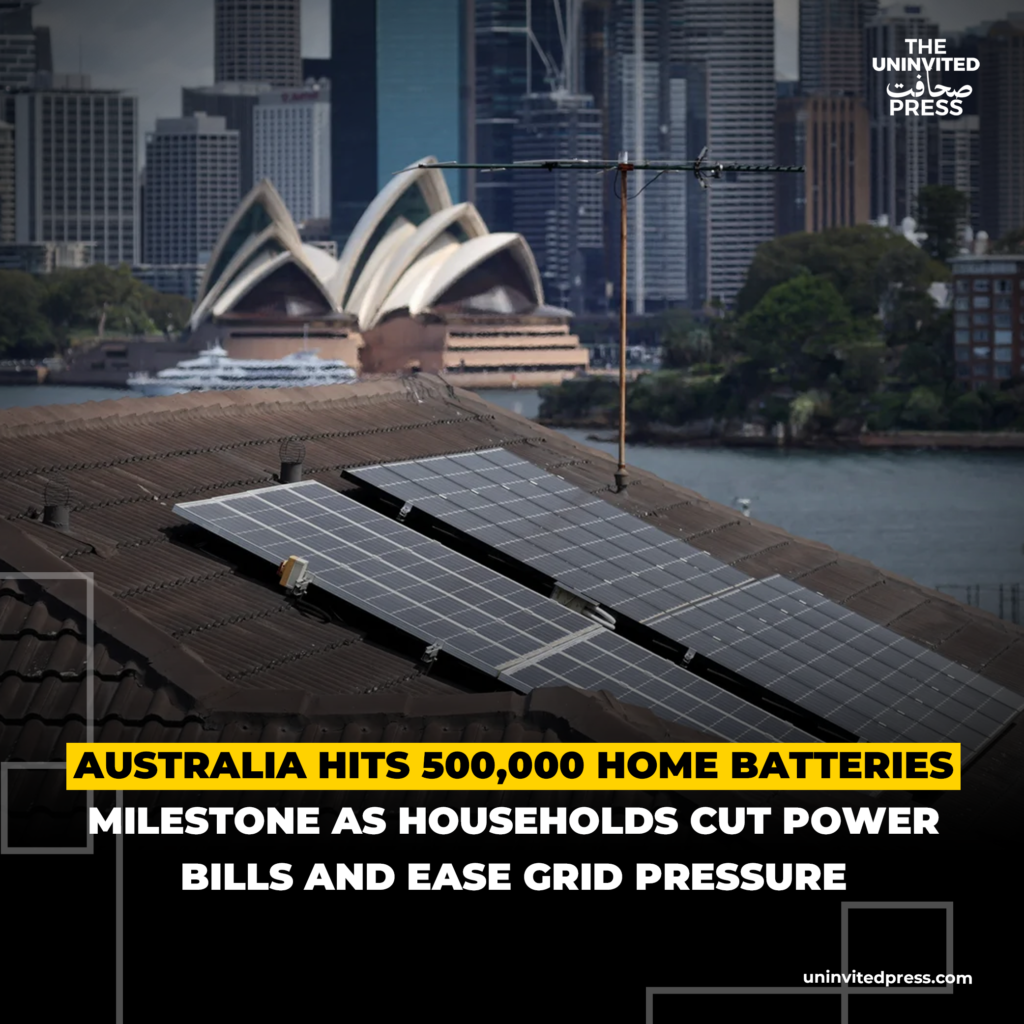
Government rebate scheme drives rapid uptake of residential storage, outpacing expectations and transforming the country’s electricity system.
Australia has surpassed half a million home and business battery installations under a federal rebate programme, marking a major acceleration in the country’s shift towards distributed renewable energy. The milestone, announced on Friday by Prime Minister Anthony Albanese and Energy Minister Chris Bowen in Sydney, reflects more than 507,000 systems installed since the Cheaper Home Batteries Program launched on 1 July 2025.
Australia’s Home Battery Boom Slashes Bills:
The programme offers roughly a 30 percent discount on the upfront cost of small-scale battery systems connected to new or existing rooftop solar, funded at an estimated A$7.2 billion over four years. Installations have averaged around 2,000 systems per day nationwide, far exceeding initial projections. The original target of one million batteries by 2030 now appears likely to be surpassed well ahead of schedule, with officials expecting more than two million systems and around 40 gigawatt-hours of additional storage capacity by the end of the decade.
Earlier figures showed the programme had already delivered about 13 gigawatt-hours of behind-the-meter storage by late July, exceeding the entire residential battery capacity of the United States at that time. The collective storage allows households to store excess solar power generated during the day for use in the evening peak, reducing reliance on the grid when demand and prices are highest.
“This is a testament to Australian households taking energy independence into their own hands,” said David McElrea, chief executive of the Smart Energy Council. “A few years ago, home batteries were a niche technology. Today, they are a mainstream, essential component of how Australians power their lives, save money on electricity bills and build a cleaner energy grid.”
The benefits extend beyond individual households. By soaking up surplus rooftop solar and discharging during evening peaks, the batteries help stabilise the national electricity market, lower wholesale prices and reduce the need for gas-fired generation. Analysts note that the aggregated capacity is already influencing demand patterns and contributing to downward pressure on electricity prices for all consumers, not only those with batteries.
Uptake has been particularly strong in outer suburban and regional areas. Bowen highlighted electorates such as Hume, Mitchell, Greenway and Macquarie in New South Wales, Wright in Queensland and Mayo in South Australia, where more than 10 percent of homes in some areas now have subsidised batteries. “Mainly, it’s an outer suburban, regional story,” he said.
Australia’s Home Battery Revolution Accelerates:
Public support remains high. A YouGov poll conducted for the Smart Energy Council found that 75 percent of Australians back the programme, with two-thirds viewing government assistance for home batteries as a good use of public funds. The scheme has also boosted skilled employment, with the number of accredited battery installers roughly doubling and thousands of new apprentices entering the clean energy workforce.
Yet challenges remain. Experts point out that the current rebate primarily benefits homeowners with suitable rooftops, leaving many renters and apartment dwellers unable to access the savings. Climate Energy Finance director Tim Buckley noted that younger Australians, who are more likely to rent or live in multi-unit buildings, remain among the most exposed to cost-of-living pressures. Calls are growing for future policy expansions that could include community batteries or targeted support for those currently excluded.
Australia already leads the world in residential solar, with panels on more than one in three homes. The rapid pairing of batteries with that existing solar fleet is turning millions of households into active participants in the energy system. As more systems come online, the country’s electricity grid is shifting from a centralised, fossil-fuel-dominated model towards one that is more decentralised, flexible and renewable.
The half-million mark represents more than a statistical milestone. It signals a tangible transfer of power-both electrical and economic-into the hands of ordinary households, while delivering broader benefits for grid reliability and the transition away from coal and gas. With installations continuing at a high rate, the full impact of this distributed storage boom is only beginning to be felt.