

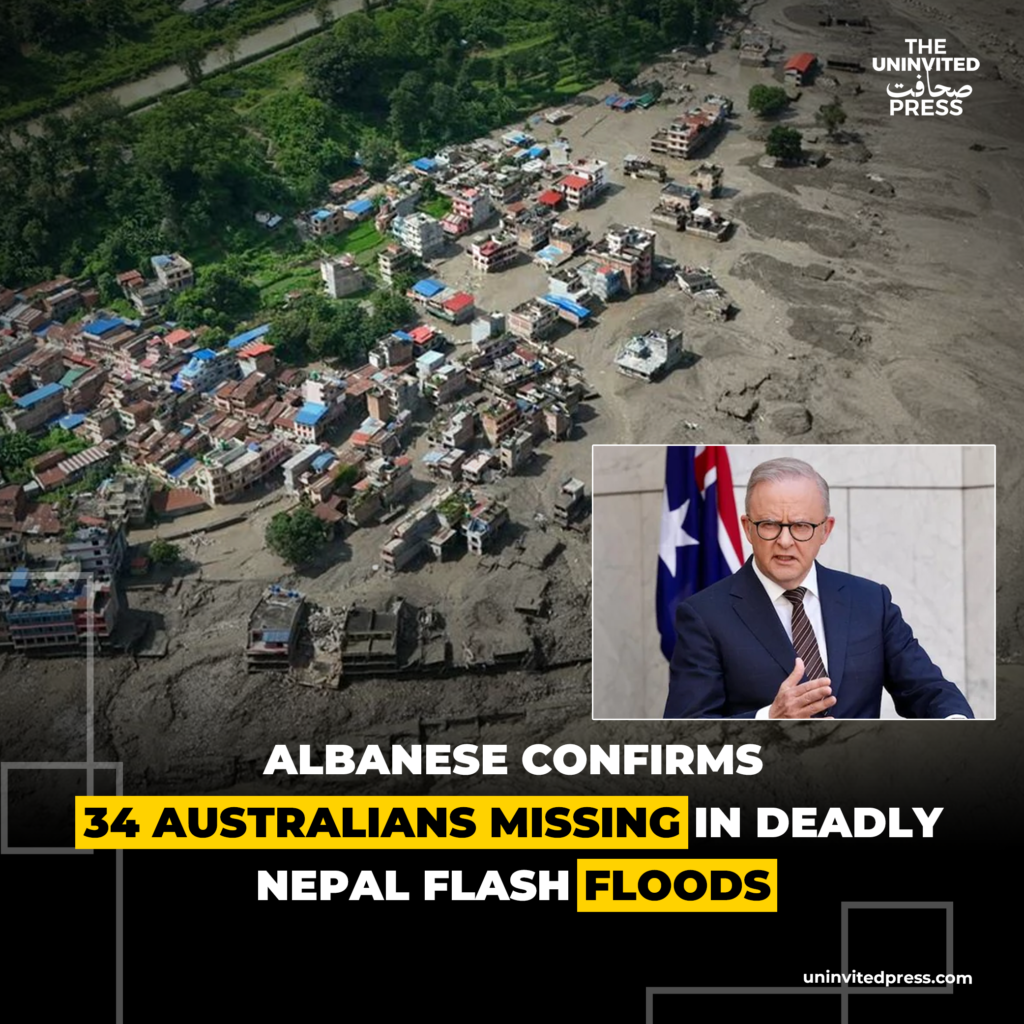
Prime minister describes ‘truly horrific’ disaster as death toll exceeds 160 and hundreds remain unaccounted for along Nepal-Tibet border.
Australian Prime Minister Anthony Albanese has confirmed that 34 Australian citizens are among the hundreds reported missing following catastrophic flash floods that struck the Nepal-Tibet border region on Wednesday.
Speaking on Thursday, Albanese described the disaster as a “truly horrific event,” noting the challenges of obtaining reliable information from the affected area. “At this point, Nepal is a developing country. It doesn’t have the resources that an event like that would have in Australia, so information is difficult,” he said. Officials from the Department of Foreign Affairs and Trade are working urgently with Nepali authorities and tour operators to establish the welfare and whereabouts of the missing Australians.
Foreign Minister Penny Wong later reiterated that access and information remain “very limited” given the scale of the destruction. She said the Australians were part of separate pilgrimage and tour groups and that additional crisis response personnel were being deployed to the region. “We are urgently seeking to confirm the welfare and whereabouts of Australians,” Wong told reporters.
Avalanche triggers wall of mud and water:
The floods began early on Wednesday when a large volume of mud, rock and possibly ice collapsed into a Himalayan river system near the border, sending a surge of water through valleys and towns. Footage and reports from the scene showed entire settlements, roads and bridges swept away in minutes. Areas including Syabrubesi, the gateway to the popular Langtang Valley trek, and stretches of the Trishuli and Bhote Koshi river corridors were among the worst hit.
Nepali police have recovered at least 157 to 162 bodies so far, with Chinese authorities confirming additional fatalities on the Tibetan side. The overall death toll stands at around 160 and is expected to rise. More than 400 tourists were initially reported missing, the vast majority of them foreign nationals. Among them were approximately 133 Indians, 47 Americans, 34 Australians, 33 Britons and 24 Canadians, according to Nepal’s tourism board. Broader estimates later put the total number of people unaccounted for across Nepal and Tibet in the hundreds, with some reports citing more than 1,000.
Many of those missing were travellers and pilgrims heading towards Mount Kailash and Lake Manasarovar in Tibet, sites sacred to Hindus, Buddhists and Jains. One US-based operator, Himalayan Glacier, confirmed it had lost contact with a group of 47 people that included 15 Australians-most of Indian origin-ranging in age from 11 to 64. The company’s chief executive, who flew over the devastated zone by helicopter, described the landscape as completely flattened, with little sign of human settlement remaining.
Difficult Terrain Hampers Rescue Efforts:
Rescue teams have been struggling to reach isolated areas amid thick mud, destroyed infrastructure and difficult mountain conditions. Helicopters have been limited in their ability to land, and survivors have described being airlifted from partially submerged buildings. Local officials and international aid groups, including the International Federation of Red Cross and Red Crescent Societies, reported that entire villages and market areas had been wiped out.
Australian consular staff are coordinating with Nepali counterparts and other governments whose citizens are affected. Albanese extended the government’s deepest sympathies to all those impacted and urged Australians still in the region to follow local authorities’ advice. The Department of Foreign Affairs and Trade has activated its consular emergency centre for families seeking information.
The disaster highlights the vulnerability of remote Himalayan communities and the growing risks posed by extreme weather and glacial activity in the region. As search and recovery operations continue, the focus remains on locating the missing and providing support to survivors and bereaved families on both sides of the border.