

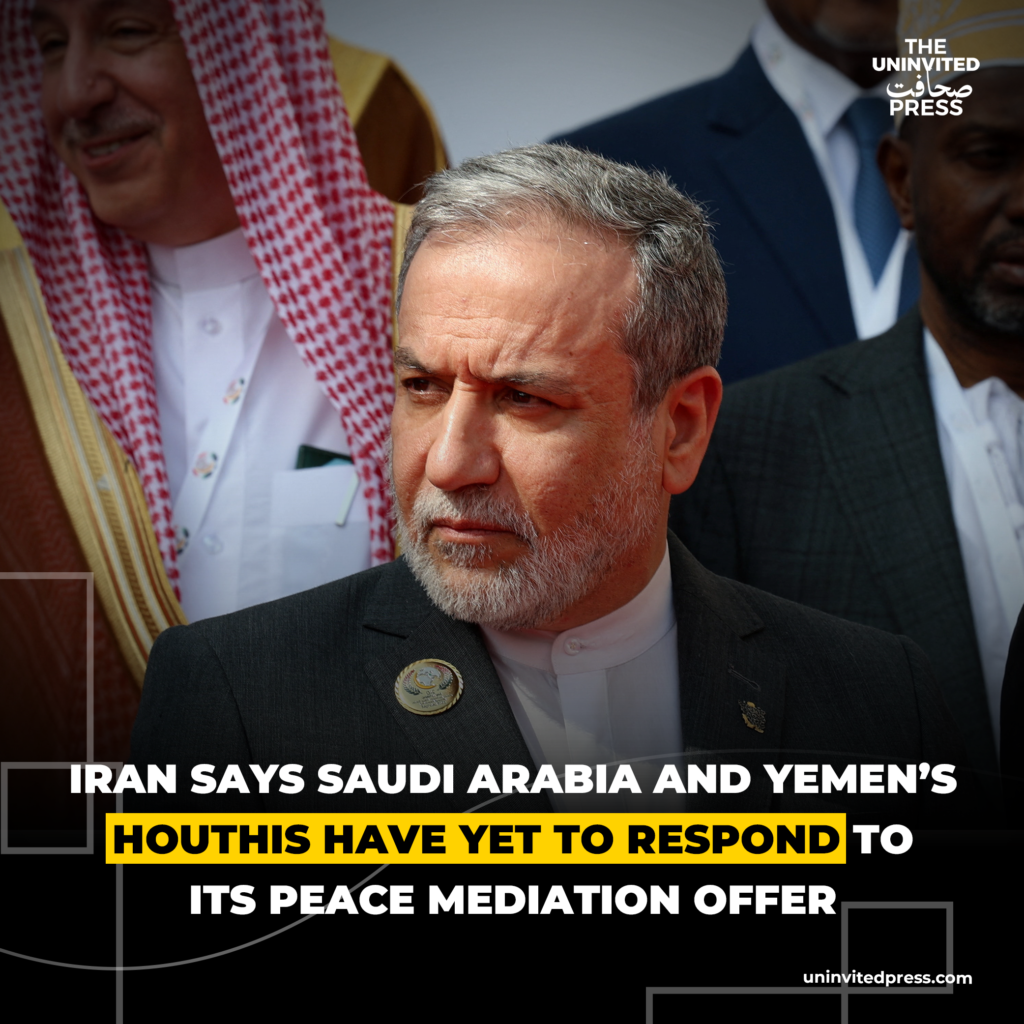
Foreign minister Abbas Araqchi says Tehran has received no reply from either side as regional tensions rise over Yemen conflict and potential Egyptian involvement.
Iran has not received a response from Saudi Arabia or Yemen’s Houthi movement to its offer to help mediate an end to the fighting between them, Iranian Foreign Minister Abbas Araqchi said in a television interview aired on Tuesday.
Speaking to Iraq’s Al Ekhbariya television, Araqchi said Tehran had put forward the proposal to facilitate dialogue after the Iran-aligned Houthis intensified strikes on Saudi Arabia earlier this month. The offer came amid a sharp escalation that included a deadly attack on Riyadh’s main airport, which killed more than a dozen people and injured hundreds.
Iran Offers to Mediate Saudi-Houthi Talks on Yemen Conflict:
The Iranian foreign minister first raised the mediation proposal in a telephone call with his Saudi counterpart, Prince Faisal bin Farhan, around mid-October. At the time, Araqchi stressed that regional crises had “no military solutions” and that insisting on a military approach while ignoring political avenues would only further complicate the situation. Iran said it stood ready to provide any assistance needed to start talks between Riyadh and Yemen and help reach a political settlement.
Neither Saudi Arabia nor the Houthis have publicly accepted or rejected the Iranian initiative, according to Araqchi’s latest comments. Saudi officials confirmed the earlier call with Araqchi but made no direct reference to the mediation offer in their statements.
The exchange takes place against the backdrop of a long-running conflict in Yemen, where the Houthis control large parts of the country, including the capital Sanaa, and have repeatedly targeted Saudi territory with missiles and drones. Saudi Arabia has led a military coalition intervening in Yemen since 2015 in support of the internationally recognised government.
Araqchi also addressed reports that Egypt could become more involved in supporting Saudi Arabia against the Houthis. “Any foreign intervention would complicate matters,” he said, adding that Cairo had previously told Tehran it would “not directly” interfere in the Yemeni conflict.
Iran’s Mediation Offer Faces Uncertainty as Egypt Weighs Yemen Role:
Egypt has stated it is prepared to provide Saudi Arabia with the support needed to defend its security. A vote in the Egyptian parliament on a possible military role against the Houthis, one of the Arab world’s largest armed forces, has been delayed until 26 October.
Iran has long maintained close ties with the Houthis, also known as Ansar Allah, while denying direct operational control over their military actions. Tehran has consistently called for a political resolution to the Yemen war and has positioned itself as a potential facilitator of dialogue, particularly after restoring formal diplomatic relations with Saudi Arabia in recent years.
The lack of response to Iran’s mediation offer leaves the immediate path to de-escalation unclear as both sides continue military activity and regional powers weigh their options. Analysts note that any meaningful talks would need to address core issues including the humanitarian crisis in Yemen, security guarantees for Saudi Arabia, and the political future of the war-torn country.
As the region grapples with multiple overlapping conflicts, Araqchi’s comments underline Tehran’s preference for diplomacy while highlighting the difficulties of translating offers into actual negotiations between long-standing adversaries.