

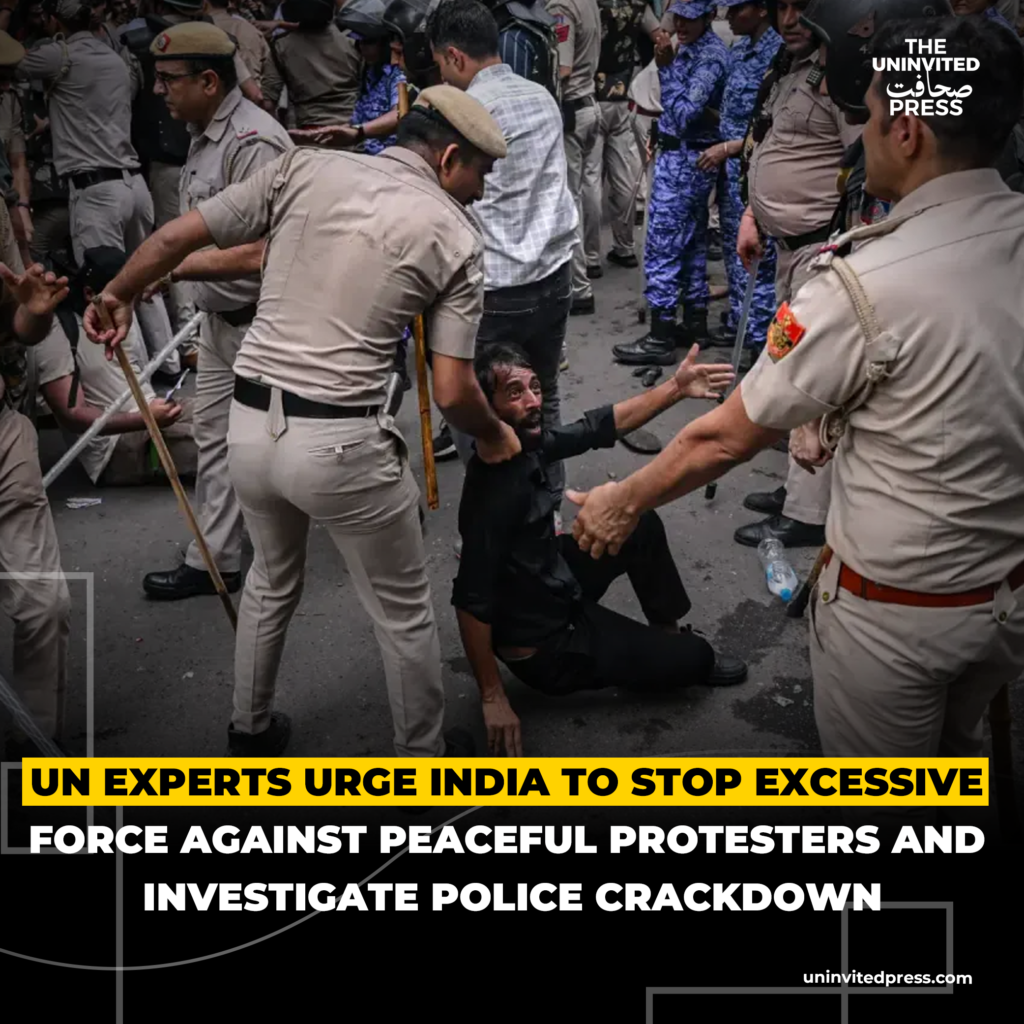
Independent human rights specialists call for impartial investigation into police crackdown on student and opposition demonstrations, citing injuries, mass detentions and reports of ill-treatment.
United Nations human rights experts have called on the Indian government to immediately halt the use of excessive force against peaceful protesters and to launch an independent investigation into a recent police crackdown on demonstrations.
In a statement issued on Tuesday, about two dozen independent experts appointed by the UN Human Rights Council expressed alarm over what they described as a “heavy-handed” response to youth-led and student protests in New Delhi and other parts of India over the past three months. They said demonstrators had sustained injuries, with some reporting ill-treatment, and raised particular concern about allegations of sexual violence and other forms of gender-based abuse during protests and related detentions.
“Despite the non-violent nature of the assemblies, law enforcement agencies have reportedly deployed force against unarmed students including by means of police so-called lathi charges, and have prevented thousands from joining the protests,” the experts said. Lathi charges refer to coordinated baton assaults used by police to disperse crowds.
The experts urged authorities to “immediately cease the use of excessive force, rescind blanket assembly bans, and refrain from the misuse of digital surveillance, including through biometrics, and internet disruptions.” They also called for a prompt, impartial and thorough investigation into the conduct of law enforcement personnel to ensure accountability, justice and reparations for victims.
UN Condemns India’s Protest Crackdown:
According to the statement, more than 7,000 people-including young people, journalists, human rights defenders, lawyers and political party members-were recently detained in New Delhi and taken to remote detention centres. Most were released after about 24 hours. Phones of those detained were allegedly seized and protest-related material deleted.
The protests have focused on government decisions affecting the education system and, more recently, a large-scale revision of electoral rolls. Opposition groups and student organisations claim the revision removed the names of around 130 million people, disproportionately affecting Muslims, Scheduled Castes and Scheduled Tribes. India’s Election Commission has said the exercise aims to remove duplicate, deceased, shifted or otherwise ineligible voters, and that those excluded in error can appeal.
The UN experts described the crackdown as part of a “broader, troubling pattern,” noting they had repeatedly raised concerns with Indian authorities about undue restrictions on peaceful assembly, excessive force, arbitrary detentions, enforced disappearances and the targeting of student activists.
“These actions violate India’s core international legal obligations, including the rights to freedom of peaceful assembly, freedom of expression, liberty, security of the person, and the right to defend human rights,” the statement said.
UN Experts Press India for Accountability Over Protest Crackdown:
Signatories included the Special Rapporteur on the rights to freedom of peaceful assembly and association, the Special Rapporteur on the promotion and protection of the right to freedom of opinion and expression, the Special Rapporteur on the situation of human rights defenders, the Special Rapporteur on torture, and the Special Rapporteur on violence against women and girls, among others.
Indian authorities had not immediately responded to the statement. The government has previously rejected similar UN criticism of its handling of protests, characterising such interventions as interference in internal affairs.
The experts’ intervention comes amid heightened political tensions in India, with opposition parties and student groups continuing to mobilise against what they view as threats to democratic participation and institutional integrity. The UN specialists stressed that any restrictions on the right to protest must be lawful, necessary and proportionate under international human rights standards.