

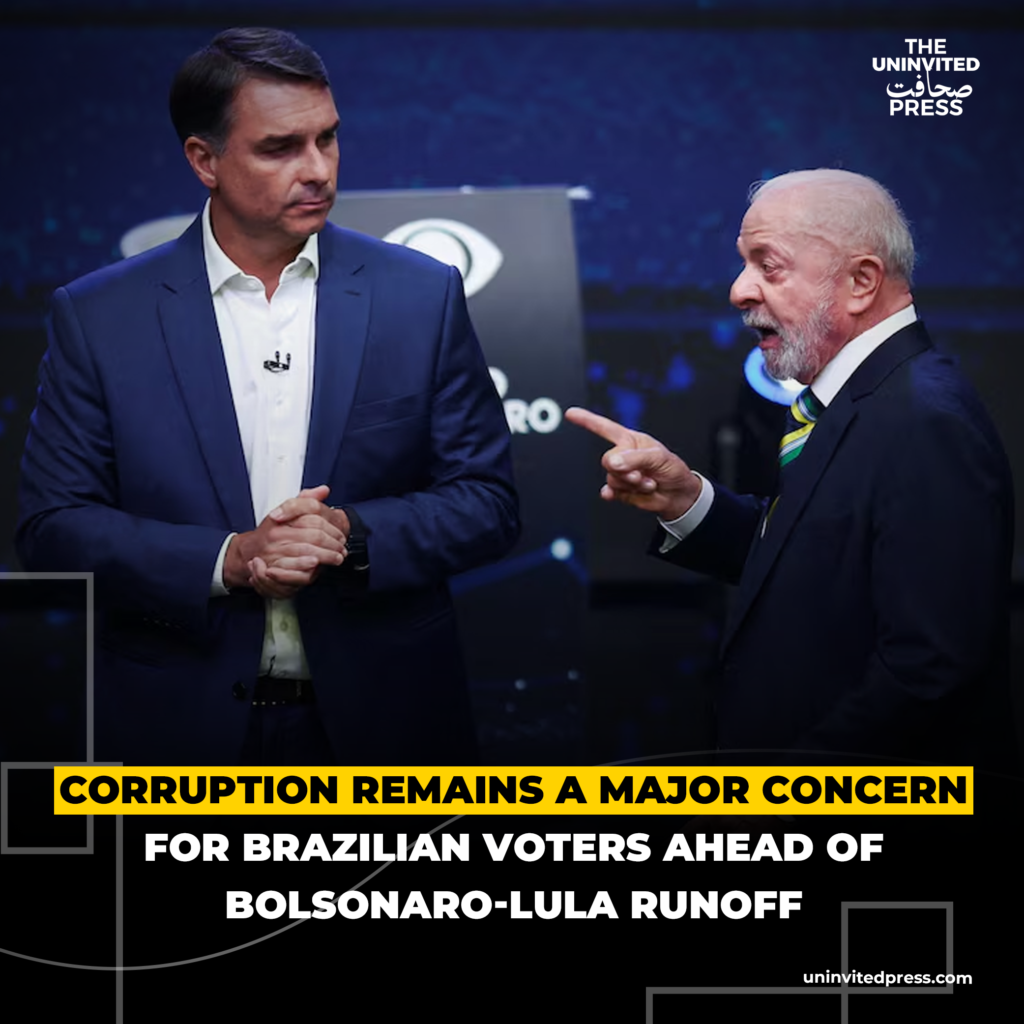
Perceptions of graft involving both candidates risk driving higher abstention as Flávio Bolsonaro and President Luiz Inácio Lula da Silva prepare for the October 25 second round.
Corruption has emerged as one of the top concerns for Brazilian voters ahead of the presidential runoff on 25 October between far-right Senator Flávio Bolsonaro and left-leaning incumbent President Luiz Inácio Lula da Silva, according to analysts and recent reporting. Experts caution, however, that its greatest effect may not be shifting support between the two candidates but rather increasing voter abstention and anti-incumbency sentiment.
In the first round on 4 October, Flávio Bolsonaro, the eldest son of imprisoned former President Jair Bolsonaro, secured about 47 percent of the valid vote, while Lula took roughly 45 percent. Neither reached the 50 percent threshold needed for an outright victory, setting up the runoff. More than 33 million eligible voters-about 21 percent of the electorate-did not cast ballots in the first round, the highest abstention rate in a Brazilian general election first round since 1998.
Corruption Scandals Dominate Brazil’s Election Debate:
Both leading candidates carry associations with corruption in the public mind. Flávio Bolsonaro is under investigation for alleged corruption, money laundering and tax evasion linked to the collapse of Banco Master, a mid-sized lender at the centre of a multibillion-real fraud case involving fake loans. Court documents and reports have connected him to requests for substantial financing-reportedly around 134 million reais (about $26 million)-from the bank’s former owner, Daniel Vorcaro, to fund a biopic about his father. Bolsonaro has denied wrongdoing and said the money was intended for the film.
Lula, for his part, spent 19 months in prison on corruption and money-laundering charges stemming from the earlier Operation Car Wash investigation; those convictions were later annulled by the Supreme Court. More recent scrutiny has focused on a pension-system fraud scheme linked to one of his sons and on the broader Banco Master scandal, which has also implicated Supreme Court Justice Alexandre de Moraes-who presided over Jair Bolsonaro’s coup-related trial-through alleged contacts and a multimillion-real contract held by a law firm connected to Moraes’s family. Moraes has denied any impropriety.
The Banco Master affair has dominated headlines for months, drawing in politicians, judges and business figures across the political spectrum. It has revived memories of past mega-scandals such as the mensalão vote-buying scheme and the Petrobras kickback investigations that defined earlier periods of Brazilian politics. Polls and surveys conducted around the campaign have repeatedly ranked corruption among voters’ leading worries, often second only to violence or the cost of living.
Corruption Scandals Cloud Brazil’s Presidential Runoff:
Political scientists note that while core supporters of each camp tend to dismiss allegations against their preferred candidate, a generalised sense that “both sides are corrupt” can deepen cynicism. “People become disenchanted with politics,” one analyst observed. “They have less motivation to really choose between one of these two camps.” Such disillusionment could depress turnout further or tilt the balance toward the challenger by amplifying anti-incumbent feeling.
The runoff comes at a moment of deep polarisation. Flávio Bolsonaro has campaigned on change, law-and-order themes, and closer alignment with conservative currents regionally and internationally. Lula has emphasised continuity of social programmes, poverty reduction and institutional stability. Yet the persistent shadow of corruption scandals risks overshadowing policy debates in the final week of campaigning, including televised debates in which the candidates have already traded accusations of graft.
As Brazilians prepare to vote again on 25 October, the outcome will determine the direction of Latin America’s largest democracy and economy for the next four years. Whether concerns over corruption ultimately suppress participation or reshape the narrow contest between the two polarising figures remains one of the central uncertainties hanging over the runoff.