

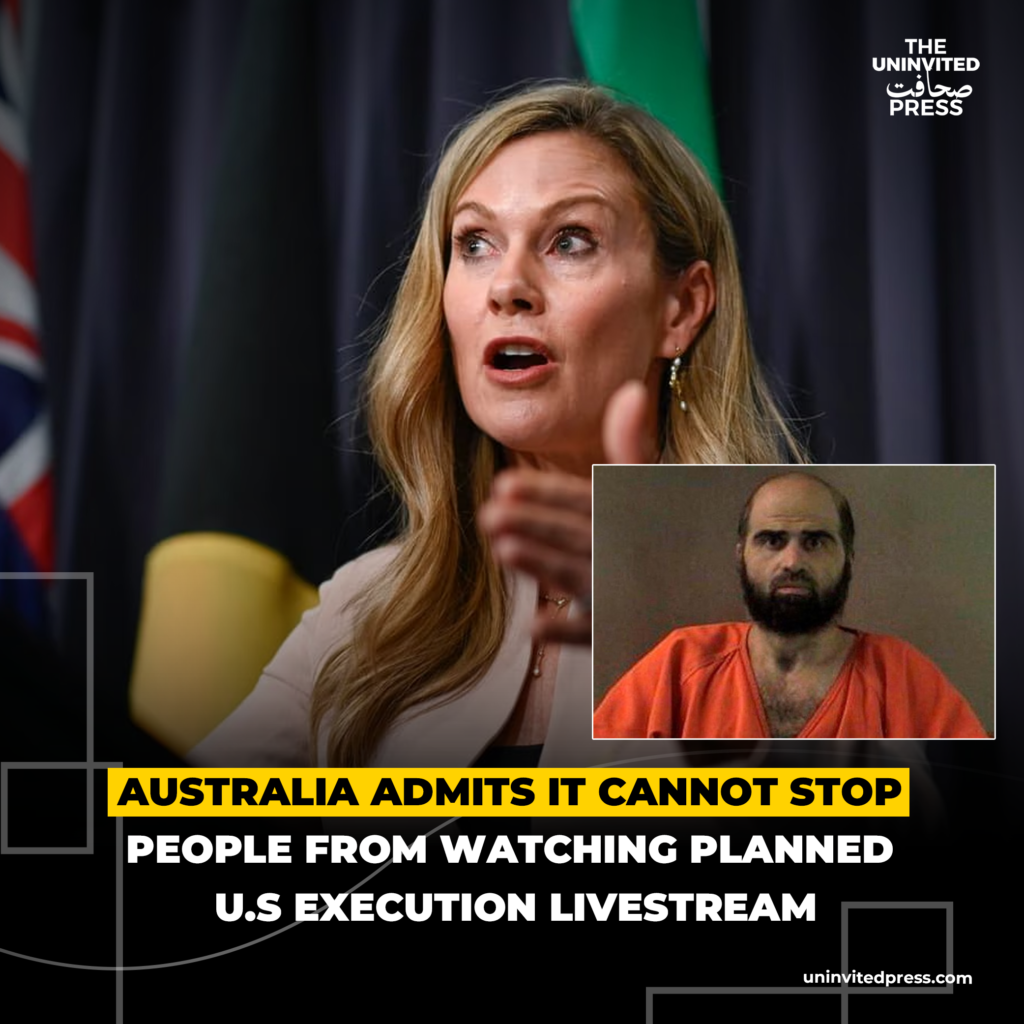
eSafety regulator and government say they lack powers to block broadcast of Nidal Hasan firing squad as platforms urged to act.
The Australian government and its online safety regulator have conceded they do not have the legal power to prevent Australians from accessing a planned livestream of a United States military execution, placing the onus on social media platforms to restrict the footage.
The execution of Nidal Malik Hasan, a former US Army major and physician convicted of killing 13 people and wounding dozens more in a 2009 shooting at Fort Hood military base in Texas, is scheduled for 3 December. US Defence Secretary Pete Hegseth has said the event-to be carried out by firing squad, the first such military execution in the United States since the Second World War-would be made publicly available online. US President Donald Trump has indicated he is still considering whether to proceed with the livestream.
Australia Says It Cannot Block Execution Livestreams:
Australia’s eSafety Commissioner, Julie Inman Grant, stated that the regulator “does not have powers to proactively prevent a live stream from occurring online.” A spokesperson added that online services have responsibilities under Australia’s online safety framework to protect users from harmful material, and that eSafety would continue to monitor the situation and consider action as appropriate.
Communications Minister Anika Wells has acknowledged there is no clear legislative basis to block the livestream from reaching Australian viewers. Prime Minister Anthony Albanese said the government would do “whatever it can” and insisted social media platforms have a “social responsibility” not to broadcast the execution. “I do not know why anybody would want themselves to watch such an event, let alone sit back and allow potentially kids and families to get access to this,” Albanese said.
A government spokesperson described vision of an execution being livestreamed as “deeply distressing to many Australians,” particularly younger people, and said platforms were expected to ensure such content does not appear on users’ screens or feeds.
Australia Faces Limits in Blocking Planned Execution Livestream:
The planned broadcast has drawn rare cross-party condemnation in Australia. The Greens have called it “barbaric” and “obscene,” urging the eSafety commissioner and the government to take all possible steps to prevent access, including potential fines for platforms that fail to act. Other politicians across the spectrum have described the idea of a public livestream as reminiscent of “Roman amphitheatre” spectacles.
While eSafety can issue takedown notices for certain “refused classification” or abhorrent violent content after it appears, preventing a livestream in real time falls outside its current powers. Experts note that even if restrictions are imposed, virtual private networks (VPNs) could allow determined viewers to bypass geo-blocks. Broadcasters remain bound by existing rules on violent and distressing material.
Australia has long opposed the death penalty and maintains a firm stance against capital punishment. The episode has highlighted the limits of national regulation in the face of global online content controlled by foreign governments and technology companies, raising questions about how democracies can shield citizens from extreme violence disseminated across borders. As the December date approaches, Australian authorities continue to press platforms to exercise editorial control while acknowledging that complete prevention may prove impossible.