

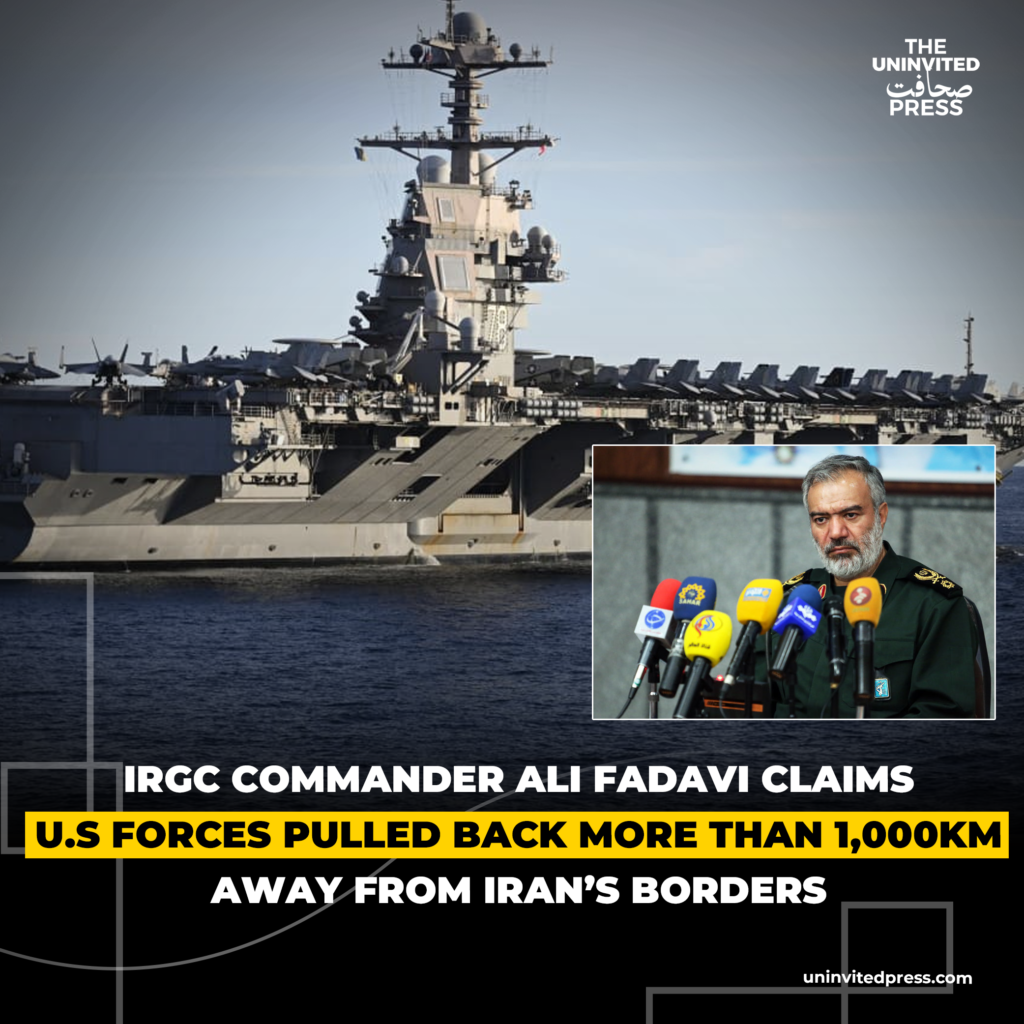
Rear Admiral Ali Fadavi attributes the reported withdrawal to Iranian military strength and says no American vessels remain in the Persian Gulf or nearby waters.
A senior Iranian military official has claimed that United States forces have withdrawn more than 1,000 kilometres from Iran’s borders, describing the move as a forced retreat driven by the strength of the Islamic Republic and the Islamic Revolutionary Guard Corps (IRGC).
Rear Admiral Ali Fadavi, a senior adviser to the IRGC commander-in-chief and former commander of the IRGC Navy, made the remarks in a televised interview broadcast on Sunday night, 4 October 2026. “The Americans fled and moved more than 1,000 kilometres away from our borders. This was not their choice; it was due to the authority of the Islamic Republic and the authority of the IRGC Ground Force,” Fadavi said, according to Iranian state media, including Press TV.
Fadavi Claims U.S. Naval Pullback From Iran Waters:
Fadavi asserted that, for the first time, no American vessels are present in the Persian Gulf, the Strait of Hormuz, the Sea of Oman or even the northern Indian Ocean. He said the Strait of Hormuz has remained under Iranian control for many months and that the United States has failed to achieve any of its objectives in the ongoing conflict.
He further claimed that US warships are “100 percent vulnerable” to IRGC forces and that previous attempts to enter the Strait of Hormuz had been met with responses from the IRGC Navy and Aerospace Force. Fadavi noted that commercial ship captains using the southern route through the strait have raised formal objections over security concerns but continue to transit due to insurance, financial and liability pressures.
Iranian officials have repeatedly framed the conflict as a successful defence against what they call aggression by the “Great Satan” and its allies, while stressing that Tehran has used only a fraction of its military capabilities.
Fadavi’s statements align with a pattern of Iranian messaging that highlights perceived setbacks for US forces in the region, including earlier claims of American withdrawals from bases and reductions in naval presence. Similar assertions have been made by other IRGC figures throughout the conflict.
Independent verification of the precise locations of US naval assets or the claimed 1,000km pullback was not immediately available. The United States has not publicly confirmed or denied the specific claims in the hours following Fadavi’s interview. Washington has previously emphasised that its forces retain the ability to operate and strike from longer distances, including from bases further afield and from the continental United States.
Iran Claims Control Over Strait of Hormuz Amid U.S. Tensions:
The Strait of Hormuz remains one of the world’s most critical maritime chokepoints for oil and gas shipments. Iranian control claims over the waterway, whether fully realised or not, continue to influence global energy markets and shipping insurance costs. Commercial traffic has continued, though volumes and routing have been affected by the wider conflict.
Fadavi also warned that any US military base or vessel in the region could become a target and urged neighbouring states to resist American pressure. He argued that the United States had previously failed to achieve lasting objectives in Afghanistan and Iraq.
As the conflict continues with intermittent escalations and diplomatic efforts, Iranian officials have presented statements such as Fadavi’s as evidence of strategic success. Western and regional analysts, however, typically treat such claims as part of ongoing information warfare, noting the difficulty of independently confirming precise force dispositions in a highly contested theatre.