

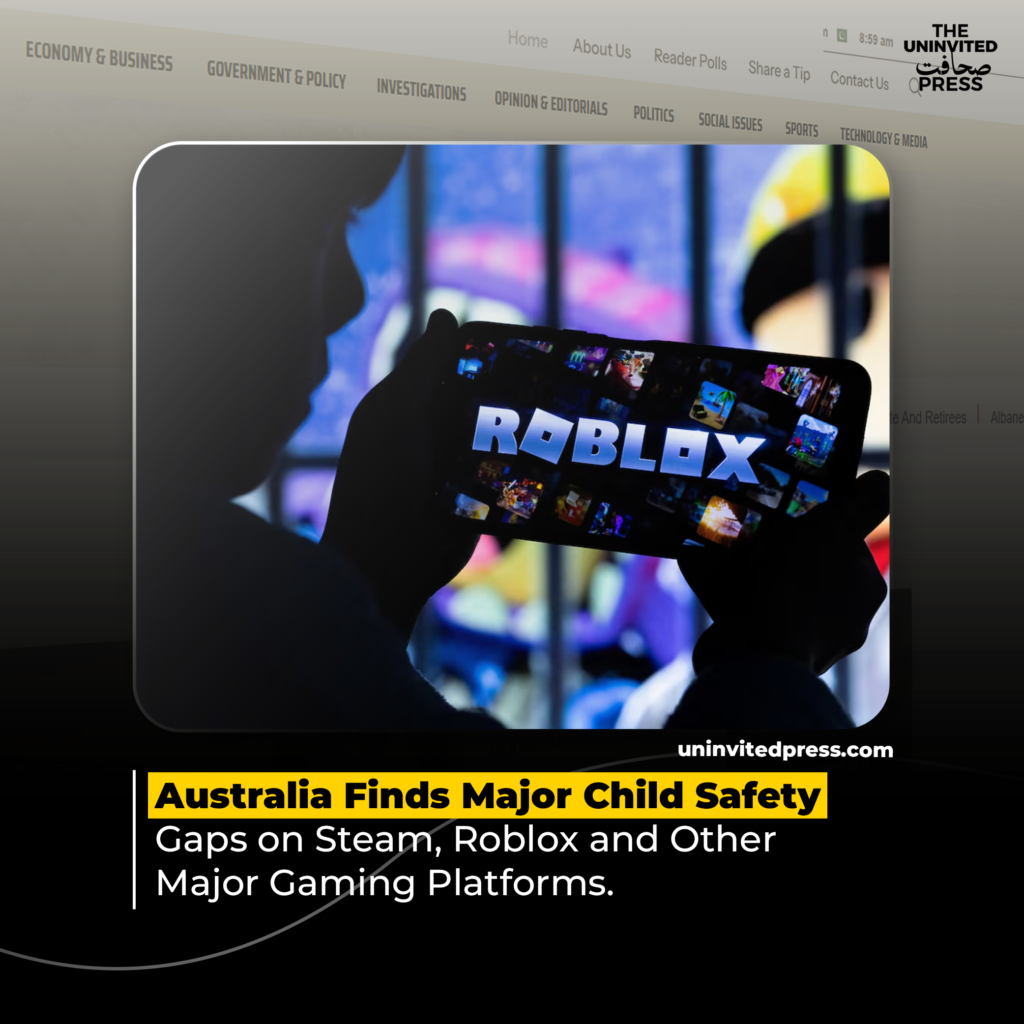
eSafety Commissioner’s report highlights inconsistent protections against exploitation, grooming and violent content on popular services used by nine in 10 Australian children.
Australia’s online safety regulator has identified significant shortcomings in how major gaming platforms protect children from sexual exploitation, grooming and violent extremist material, according to a new transparency report.
The eSafety Commissioner’s report, released on 2 October 2026, examined safety measures on Roblox, Fortnite, Minecraft and Steam, including Steam Chat. It followed compulsory information notices issued to the companies covering the period from 1 October 2025 to 31 March 2026. Research cited in the report shows that nine out of 10 Australian children aged 8 to 17 play online games.
eSafety Report Raises Online Safety Concerns:
eSafety Commissioner Julie Inman Grant said Australian children have a right to play online without exposure to predators, sexual extortionists, violent extremist content or other harmful material. “We expect these services to lift their game to identify and combat serious harms,” she stated.
The report found wide variation in approaches. Valve, the US company behind Steam and Steam Chat, stood out for weaker protections. It was the only provider that did not use hash-matching technology, a widely adopted industry tool that detects and removes known child sexual abuse material by comparing content against databases of previously identified harmful images. Valve also did not proactively deploy tools to detect child sexual exploitation or violent material in chats, including Steam Community group chats. Its systems mainly relied on a URL detection tool that primarily blocked scams, leaving conversations with limited safeguards.
Steam and Steam Chat relied on users self-declaring their age during the reporting period and collected no further age-related information for verification. The platform has since introduced credit-card age checks for certain R18+ games in Australia, and eSafety is seeking commitments for additional age assurance options. Valve also took minimal steps to track whether users banned for child sexual exploitation or violent material were re-registering with new accounts, unlike the multiple indicators used by operators of Roblox, Minecraft and Fortnite.
Roblox, which is particularly popular among younger children, introduced stronger age assurance measures from December 2025 following earlier engagement with eSafety under Australia’s Online Safety Act. These include restricting some higher-risk features for Australian users verified as 18 or older. However, the report noted that both Roblox and Valve relied solely on internal data to train language detection systems and did not regularly retrain them. Roblox’s image auto-moderation tool for detecting violence and child sexual abuse material had a recall rate of only 51 percent, indicating potential under-enforcement.
Gaming Platforms Face Pressure Over Child Safety:
Minecraft and Fortnite generally allow users to self-declare their age, enabling anyone claiming adult status to access higher-risk communication features. Minecraft relies partly on user reports and scanning for high-risk third-party servers, while Fortnite conducts more comprehensive pre-publication reviews of user-created content. Both platforms participate in some industry initiatives to combat child sexual exploitation, whereas Valve did not engage in certain cross-industry information-sharing efforts during the period.
Several providers introduced additional safety improvements after receiving the notices, but the report concluded that significant gaps remain in preventing and responding to serious harms. Gaming platforms can serve as entry points for predators and for the spread of material that promotes or instructs violence, given their large child user bases.
The findings build on previous regulatory action, including a court-enforceable undertaking accepted from Roblox earlier in 2026 to strengthen measures against grooming and sexual exploitation. eSafety has emphasised Safety by Design principles, urging companies to assess risks upfront rather than treating safety as an afterthought.
With online gaming deeply embedded in children’s daily lives, the report places pressure on the industry to close the identified gaps. Parents, educators and policymakers are likely to watch closely how Steam, Roblox and the other platforms respond to the call for stronger, more consistent protections.