

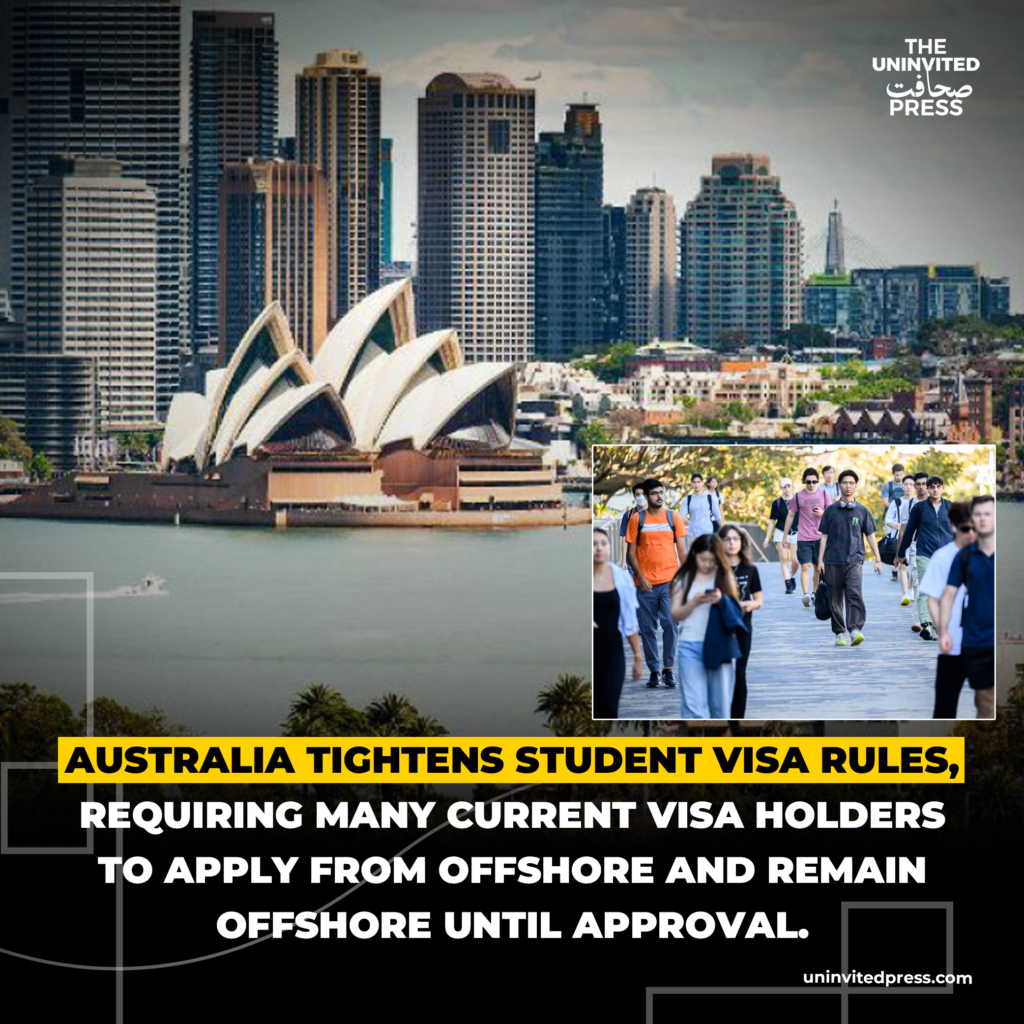
New measures require most current student visa holders and other temporary visa holders to apply from outside the country and remain offshore until approval, as government targets visa hopping.
Australia has introduced significant changes to its student visa system, requiring many people already in the country to leave and apply for a new student visa from overseas, remaining outside Australia until a decision is made.
Australia Tightens Student Visa Rules:
The reforms, which took effect on 2 October 2026, form part of a broader effort by the Albanese government to strengthen the integrity of the international education sector and curb what officials describe as the misuse of student visas to prolong stays in Australia. Under the new rules, most holders of a Subclass 500 Student visa who wish to apply for a further student visa must now lodge their application from outside Australia. They must also be outside the country at the time the visa is granted, unless they qualify for limited exemptions.
Exemptions include Defence students, Foreign Affairs students, school students, doctoral candidates, those progressing to a higher-level course under the Australian Qualifications Framework, students needing extra time to complete their current course within 12 months, and those affected by provider default. Secondary visa holders seeking to become primary applicants are generally subject to the same offshore requirement.
The changes also expand the list of temporary visa holders barred from applying for a student visa while onshore. Holders of visas including Working Holiday (417), Work and Holiday (462), Temporary Graduate (485), Skills in Demand and Temporary Skill Shortage (482), Training (407), Temporary Activity (408), and various visitor, medical treatment and other temporary visas must now apply from outside Australia. Applications lodged onshore by those required to apply offshore will be considered invalid.
New Rules for International Students:
Government officials have framed the measures as necessary to reinforce the student visa’s core purpose as a temporary pathway for genuine study rather than a route to extended residence. Assistant Minister Julian Hill has highlighted the need to stop “visa hopping,” where individuals switch between temporary visas or courses after arriving in Australia for other purposes. The reforms also tighten rules around including family members in student visa applications, with most students no longer able to bring partners or children except in limited cases such as certain scholarships, PhD studies or applicants from Pacific and ASEAN countries.
International education remains one of Australia’s largest export industries, supporting universities, vocational providers and local economies. Critics of the previous system argued that onshore pathways allowed some applicants to extend stays without strong study intentions, contributing to higher net migration figures that the government is seeking to reduce toward a target of 225,000 by 2028. Education providers and migration agents have been urged to advise students carefully, as the changes do not affect existing visas but will shape future applications and enrolments.
Students already holding a valid Subclass 500 visa can continue studying under their current conditions. However, those needing a further visa or switching pathways face the new offshore requirement, which may involve travel costs, time away from studies and uncertainty while applications are processed. Applications lodged before 2 October continue under the previous rules.
The Department of Home Affairs has published guidance urging affected individuals to check their eligibility before making travel or enrolment plans. As the reforms take hold, education institutions are adjusting recruitment strategies, while many current and prospective international students weigh the practical and financial implications of applying from outside Australia.