

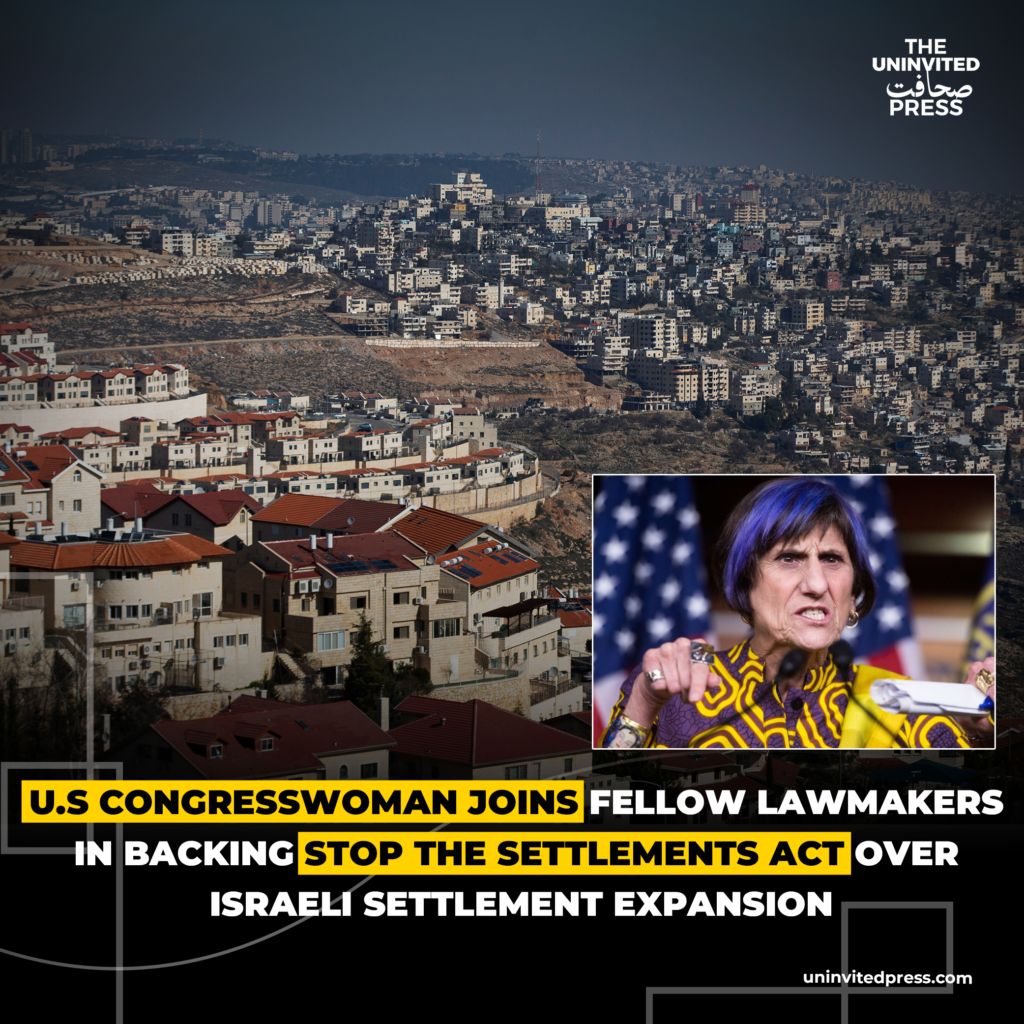
Legislation aims to impose sanctions on entities facilitating settlement growth in the occupied West Bank and Gaza, as lawmakers warn of threat to two-state solution.
A group of US House Democrats, including several congresswomen, has introduced legislation targeting the rapid expansion of Israeli settlements in the occupied West Bank and Gaza, seeking to impose sanctions and restrict related imports.
The Stop the Settlements Act, led by Representatives Joaquin Castro of Texas, Madeleine Dean of Pennsylvania, Don Beyer of Virginia, Greg Casar of Texas, Sara Jacobs of California and Veronica Escobar of Texas, was introduced on or around 1 October 2026. More than 30 other House Democrats signed on as original co-sponsors. The bill would require the US president to sanction foreign individuals and entities determined to be responsible for, complicit in, or directly or indirectly engaged in the establishment of new settlements or the expansion of existing ones and outposts after 30 September 2026. This includes activities such as infrastructure development, construction in the sensitive E1 area east of Jerusalem, and facilitating the transfer of Israeli civilians into those areas.
The legislation would also prohibit the importation into the United States of goods produced, in whole or in part, in Israeli settlements and outposts. Supporters say the measures are designed to create meaningful consequences for settlement activity, which they argue undermines the prospects for a viable Palestinian state and long-term peace.
US Lawmakers Warn Settlement Expansion Threatens Palestinian Statehood:
In statements accompanying the bill’s introduction, lawmakers described the expansion as a major obstacle to peace. Castro characterised the growth of settlements under Israeli Prime Minister Benjamin Netanyahu’s government as a “violent land grab” that is displacing Palestinians. “Democrats must face this with urgency-act now or watch the prospect of Palestinian self-determination slip away forever,” he said. “Congress should and can be using every tool we have available, including sanctions.”
Jacobs, one of the lead sponsors, emphasised that continued US inaction effectively supports policies that consolidate Israeli control and block Palestinian statehood. “Pushing Palestinians out of their homes and off their land in Gaza and the West Bank is one of the greatest obstacles to a lasting pathway to peace,” she said. “We have another choice: use our tools and leverage to help make peace and security for Israelis, Palestinians, and everyone in the region a reality.”
Background data cited by the sponsors notes that since late 2022, the Israeli government has approved more than 100 new settlements in the West Bank, while settlers have established nearly 200 additional outposts. The pace has accelerated significantly compared with previous decades. Particular concern has focused on the E1 corridor, where construction would sever East Jerusalem from major Palestinian population centres in the West Bank, making a contiguous Palestinian state far more difficult to achieve. Successive US administrations, both Republican and Democratic, have long viewed development in E1 as a serious threat to the two-state solution.
US Bill Targets Israeli Settlement Expansion Amid Rising Tensions:
The bill mirrors steps already taken by countries including the United Kingdom, France, Canada, the Netherlands and Spain to restrict settlement-related goods or activity. It has received endorsements from groups such as J Street, the IMEU Policy Project and New Jewish Narrative, which described it as providing the United States with overdue tools to push back against settlement growth.
The legislation arrives amid heightened tensions in the West Bank, where settler violence and settlement expansion have drawn repeated international criticism. While the bill faces an uncertain path in a divided Congress, its introduction marks a notable effort by progressive and moderate Democrats to elevate economic pressure as a policy response. If enacted, it would give the president authority to target facilitators of settlement activity while imposing a de facto freeze on new construction through the threat of lost access to US markets and the financial system.
Palestinian advocates and some Israeli critics of settlement policy have welcomed the move as a rare assertion of congressional leverage. Israeli officials and supporters of settlement activity are expected to oppose the measure, viewing it as an infringement on Israeli sovereignty and security needs. The debate underscores the deepening divisions in Washington over how to address the Israeli-Palestinian conflict as settlement construction continues to reshape the landscape of the occupied territories.