

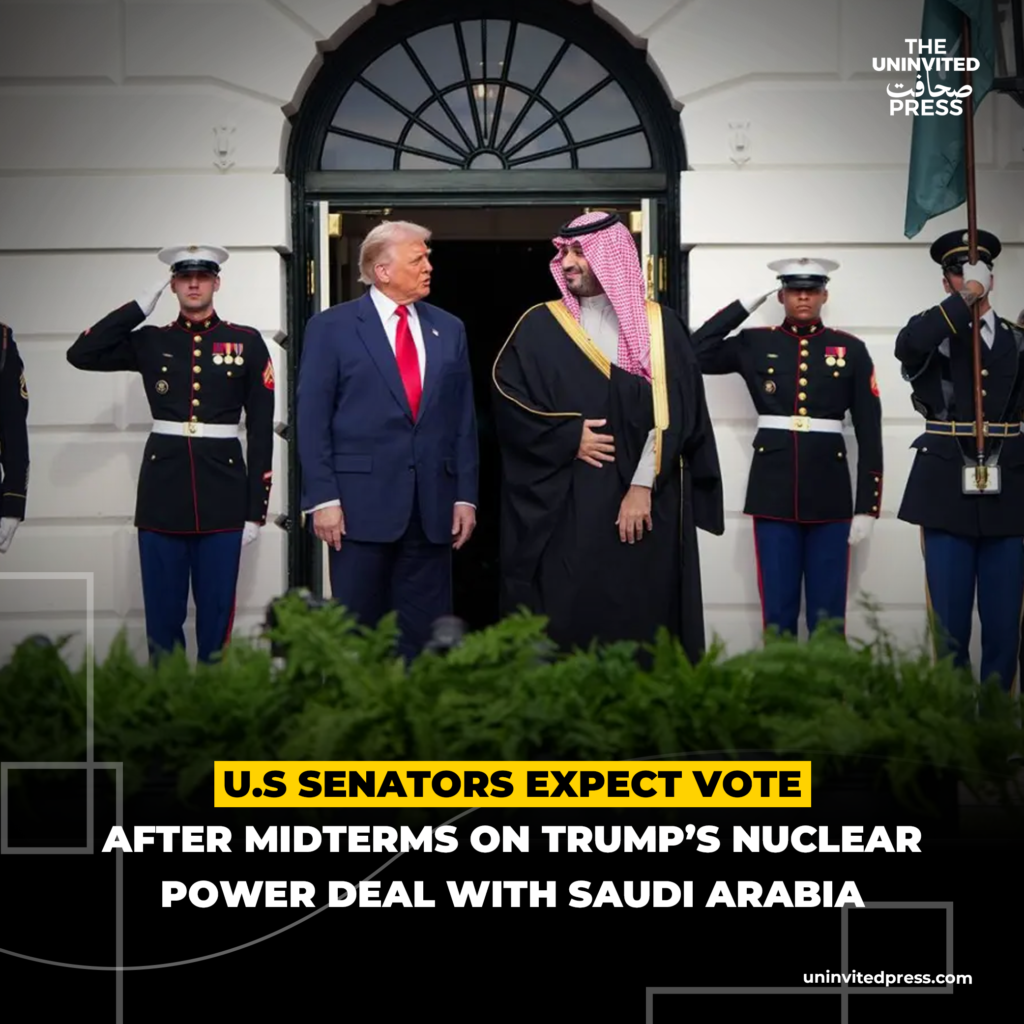
Lawmakers raise alarm over risks of regional arms race as Congress reviews controversial 123 Agreement lacking key nonproliferation safeguards.
US senators have secured a vote on President Donald Trump’s proposed nuclear power cooperation agreement with Saudi Arabia, with the ballot expected before December 13-after the midterm elections-amid growing concerns that the deal could fuel a nuclear arms race across the Middle East.
Democratic Senator Jeff Merkley of Oregon announced that he and colleagues had arranged the vote on a potential resolution of disapproval. “The Senate will now have a chance to fulfill its statutory responsibility to study and weigh in on the impact this agreement could have in driving a nuclear arms race in the Middle East and potentially undermining nuclear nonproliferation efforts around the world,” Merkley said.
Merkley worked with fellow Democrats Tim Kaine, Ed Markey, Chris Coons and Chris Van Hollen, as well as some Republicans, to ensure the chamber could act within the 90-day congressional review window. That clock began ticking when the pact, known as a 123 Agreement under the Atomic Energy Act, was printed in the Senate record on September 14 after Trump submitted it in late August.
US-Saudi Nuclear Deal Draws Proliferation Concerns:
The agreement would allow American companies to help develop Saudi Arabia’s civilian nuclear energy programme, including the construction of Westinghouse AP1000 reactors in a project valued at tens of billions of dollars. Supporters in the Trump administration describe it as a strategic deepening of US-Saudi ties that locks in American technology and excludes competitors from Russia or China, while including nonproliferation measures required by US law.
Critics, however, argue that the deal falls far short of the so-called “Gold Standard” applied to other partners. It does not explicitly bar Saudi Arabia from enriching uranium or reprocessing spent nuclear fuel-two pathways that could produce weapons-grade material. Nor does it require Riyadh to implement the International Atomic Energy Agency’s Additional Protocol, which grants inspectors broader access to nuclear sites and related activities. The United States has not concluded a new 123 Agreement with a country that has not accepted the Additional Protocol since it was approved in 1997.
Democratic lawmakers and nonproliferation advocates have warned that the arrangement effectively caves to Saudi demands and opens the door for the kingdom to develop the technical capacity for nuclear weapons. A classified US intelligence assessment shared with Congress has further intensified those fears, indicating that Saudi Arabia has not ruled out the option of pursuing a nuclear arsenal, even if it has made no formal decision to do so.
The timing adds another layer of complexity. Trump has publicly linked the nuclear cooperation to Saudi Arabia’s normalisation of relations with Israel, stating the deal would only take effect if Riyadh took that step. Congressional aides, however, note that the text of the agreement itself contains no such condition, leaving the linkage outside the formal pact.
Congress Faces Vote on US-Saudi Nuclear Deal:
The proposed vote comes as the region remains volatile. Ongoing tensions with Iran, combined with Saudi Arabia’s long-standing ambitions for energy diversification and strategic autonomy, have heightened anxieties that any weakening of nonproliferation standards could prompt other states to seek similar capabilities. Opponents of the deal argue that once the technological foundation is laid, political restraints may prove insufficient in a crisis.
For the resolution of disapproval to block the agreement, lawmakers would need majorities in both chambers. Even then, Trump could veto the measure, requiring a two-thirds majority in each house to override-a high bar in a politically divided Congress. If no resolution passes before the review period ends, the pact can enter into force automatically.
Senators have also pressed the administration to declassify two side letters accompanying the agreement, arguing that full transparency is essential for meaningful congressional oversight. Previous 123 Agreements with other countries have not withheld such documents, they note.
As the midterms approach and the December deadline looms, the debate over the US-Saudi nuclear pact has become a flashpoint for broader questions about American nonproliferation policy, the reliability of regional alliances, and the long-term risks of transferring sensitive nuclear technology in one of the world’s most unstable regions. Whether the Senate vote will produce a decisive check on the deal or merely register symbolic opposition remains to be seen, but the concerns raised by Merkley and his colleagues have already placed the agreement under intense scrutiny.