

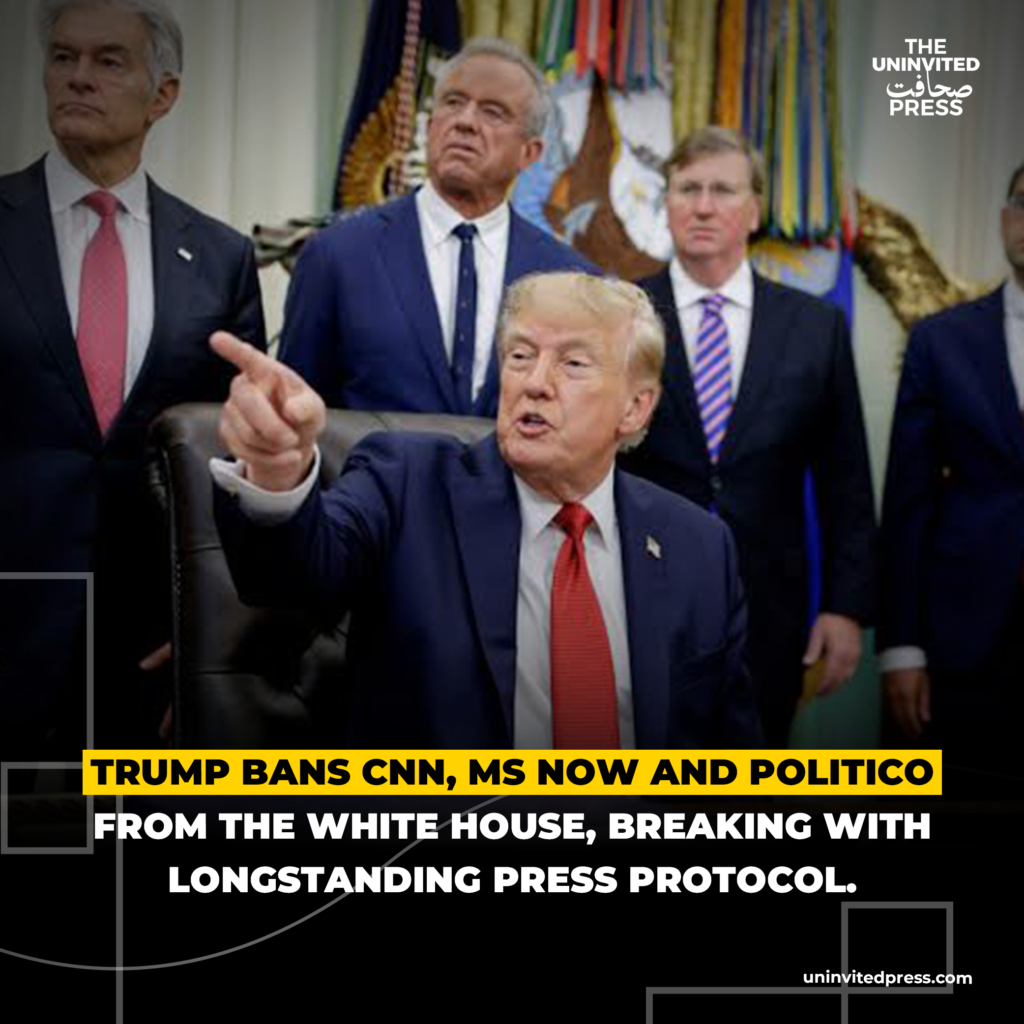
US president escalates long-running feud with media, threatening further restrictions and drawing accusations of an assault on press freedom.
United States President Donald Trump has announced that he is immediately banning journalists from CNN, MS NOW and Politico from the White House, accusing the outlets of constantly reporting “fiction and lies” about his administration.
In a Truth Social post on Friday, Trump declared the move “effective immediately” and framed it as a response to what he called “FAKE NEWS.” He wrote that media organisations “shouldn’t be able to constantly write or report FICTION and LIES when they’re covering the President of the United States, the Trump Administration, or the United States of America,” adding that “Other Fake News Media Outlets to follow.”
Speaking later to reporters in the Oval Office, Trump said the decision stemmed from “cumulative stories over the last few years” rather than any single report. “You get so tired of reading and seeing fake news,” he said. “They purposely write negative news… Now, if they want to write them, that’s fine, but I don’t have to let them into my-into the people’s house.” He described the ban as “very simple” and indicated it could be lifted if the outlets “could straighten themselves out.”
Media Outlets Challenge White House Press Restrictions:
The announcement marks a sharp break with longstanding White House press protocol, under which accredited journalists from a wide range of outlets have traditionally been granted access to the briefing room, presidential events and the White House grounds. As of Friday afternoon, reporters from the targeted organisations were still present at the White House, and it remained unclear how-or whether-the ban would be enforced in practice. Questions persist over whether it involves revocation of press credentials, exclusion from the press pool, or broader restrictions on entry to the complex.
CNN responded forcefully, stating that it “stands fully behind our White House team and their fair and accurate reporting.” A spokeswoman said the network has “a right under the U.S. Constitution to do that reporting without hindrance or interference from the government,” warning that any such ban “would be an illegal assault on that fundamental and constitutionally-protected right.”
Politico said it “will continue to fairly report on this White House and future ones” and would “vigorously defend our First Amendment rights against any attempt to restrict them.” MS NOW, the rebranded successor to MSNBC, had not issued an immediate public comment.
Trump’s Media Clash Raises Press Freedom Concerns:
Legal experts and press freedom advocates have indicated that any formal restriction is likely to face court challenges. US courts have previously held that once the White House opens its facilities to the press, access cannot be denied arbitrarily and that restrictions on credentials generally require due process. The First Amendment protects freedom of the press, and similar past attempts by Trump during his first term to limit specific outlets or individual reporters drew widespread criticism and legal pushback.
The move comes amid Trump’s second term and a pattern of confrontation with mainstream media organisations he has long labelled “fake news.” He has repeatedly criticised coverage of his policies, legal cases and personal conduct, while cultivating alternative platforms and friendly outlets. In Friday’s remarks he also named The New York Times and The Washington Post as potential future targets, calling them “crummy.”
Critics argue the action risks further eroding norms that have underpinned the relationship between the executive branch and the press for decades, potentially chilling independent reporting on the administration. Supporters of the president, however, view it as a legitimate response to what they describe as persistent bias and hostility from certain national media organisations.
Whether the ban is implemented in full, partially enforced, or blocked by legal action remains to be seen. What is clear is that the episode has intensified an already fraught relationship between the White House and significant portions of the US press corps, raising fresh questions about access, accountability and the boundaries of presidential authority over journalists covering the government.