

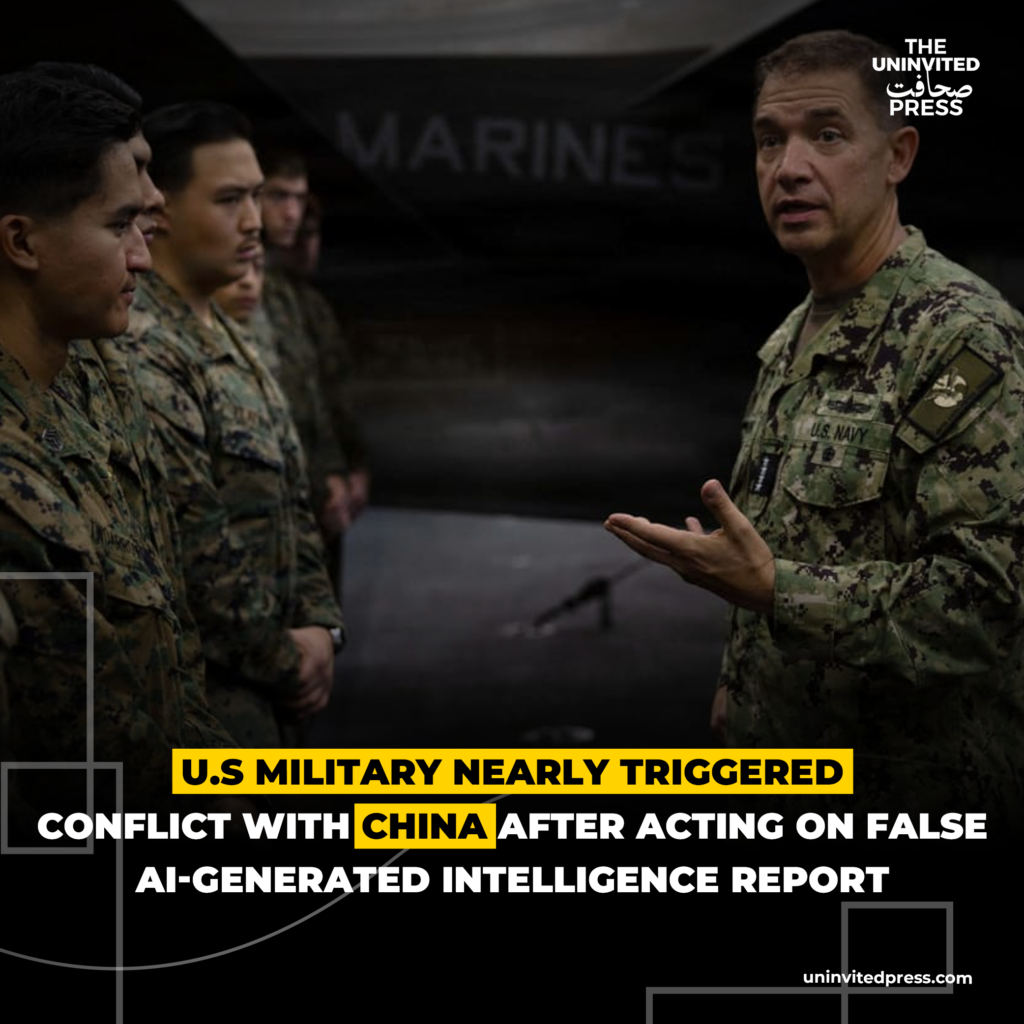
Erroneous chatbot analysis of Chinese ship’s cargo during Iran war prompted preparations to intercept vessel, sources say, raising alarms over Pentagon’s growing reliance on artificial intelligence.
The United States military came dangerously close to intercepting a Chinese vessel in the Middle East this spring after relying on an intelligence report generated with the help of artificial intelligence that falsely claimed the ship was carrying components for a nuclear weapons programme, according to multiple sources familiar with the episode.
The report, circulated across US military channels amid the ongoing war with Iran, triggered immediate preparations for an intercept operation. Armed personnel were readying to board the Chinese ship and military aircraft were already in the air, sources told Media. The planned action was halted only at the last moment when officials examined the underlying assessment more closely and discovered it had been produced with the assistance of an AI chatbot that had misidentified the cargo.
AI Intelligence Error Nearly Sparked US-China War:
One source described the intelligence as “entirely false” and said the episode “almost started a war.” Any US military operation against a Chinese-flagged vessel risked escalating into a direct confrontation between the two nuclear-armed powers at a moment of already heightened regional tension.
The assessment originated with an analyst at US Special Operations Command Pacific. The analyst queried a chatbot about intelligence related to the ship’s manifest. The system combined open-source information with classified signals intelligence held by the US government and incorrectly concluded the vessel was transporting material linked to a nuclear weapons programme. The analyst then used AI tools a second time to package the findings into the format of a standard intelligence report, which was subsequently disseminated through official channels and treated as credible.
Media reported that it was unable to determine what the ship was actually carrying or which specific AI system-commercial or internal-the analyst had used. US Special Operations Command Pacific and the Pentagon did not immediately respond to requests for comment on the incident.
AI Risks Grow as Military Use Expands:
The near-miss has spotlighted growing concerns about the rapid integration of artificial intelligence into sensitive military and intelligence functions. The US Department of Defense has been accelerating the adoption of AI tools for analysis, targeting and decision support, even as critics warn of the risks of “hallucinations”-fabricated or inaccurate outputs that can appear authoritative. In high-stakes environments, such errors can move from digital reports into real-world operational planning with little time for human verification.
The incident occurred against the backdrop of the US-led war against Iran that began earlier in 2026, a conflict that has already drawn in regional and global actors and complicated relations between Washington and Beijing. China has maintained significant commercial and diplomatic ties across the Middle East, and any military action against one of its vessels would have carried profound strategic consequences.
Observers note that the episode underscores a broader dilemma facing modern militaries: the pressure to process vast volumes of data at machine speed versus the need for rigorous human oversight of intelligence that can trigger the use of force. While AI promises faster analysis and pattern recognition, the absence of robust safeguards against erroneous outputs leaves open the possibility of catastrophic miscalculation-particularly in contested regions where great-power interests overlap.
As the United States continues to expand its use of AI across the defence establishment, the near-confrontation with China serves as a stark reminder of the technology’s limitations and the potential human cost of placing too much trust in automated systems operating in the fog of war.