

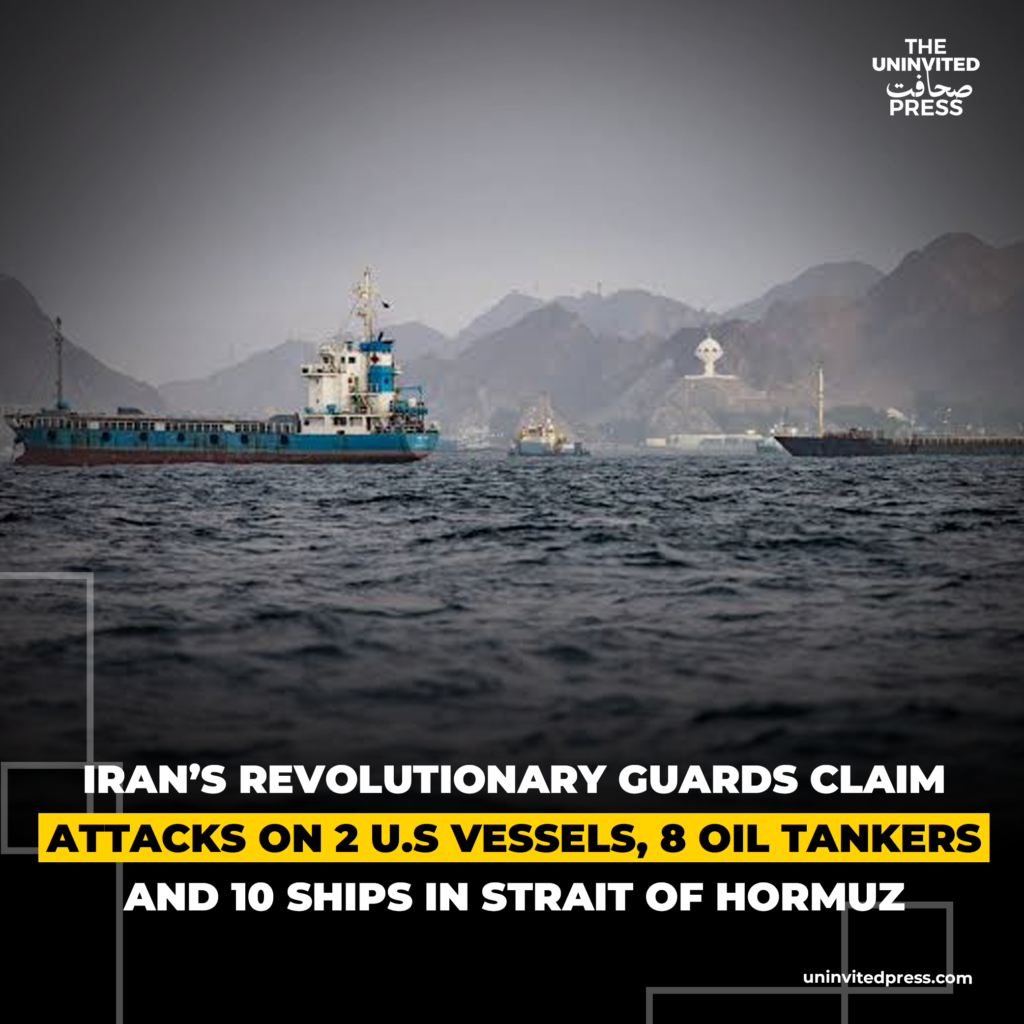
Tehran says naval forces targeted two American vessels, eight tankers and 10 other ships in retaliation for US attacks on Iranian oil carriers, as the conflict enters its seventh month.
Iran’s Islamic Revolutionary Guard Corps (IRGC) has claimed responsibility for attacks on two US vessels, eight oil tankers and 10 other ships in and around the Strait of Hormuz, describing the operations as a direct response to American strikes on Iranian tankers.
In a statement carried by Iranian state-linked media on Wednesday, the IRGC Navy said its forces targeted the vessels after the United States attacked five Iranian oil carriers in the Gulf of Oman and near Kharg Island. The Guards said the two US vessels and eight tankers sustained “great damage,” while 10 additional ships attempting to transit what Tehran calls a “prohibited and unsafe zone” in the strait were also struck.
The IRGC framed the action as retaliation for what it called the “aggression and mischief” of the “terrorist American army.” It reiterated that the Strait of Hormuz remains under its firm monitoring and management, warning that vessels cooperating with the United States or attempting to use unauthorised routes risk further action.
US-Iran Conflict Escalates Sharply:
The claims come hours after the US Central Command (CENTCOM) announced it had struck and rendered inoperable five Iranian crude oil carriers-identified as the M/T Kaviz, Charminar, Horizon 1, Riesco and Derya-following what Washington described as two failed Iranian ballistic missile attacks on a US Navy warship over the previous two days. CENTCOM said the American vessel successfully evaded the missiles and that no US personnel were harmed. Crews were directed to abandon the Iranian tankers before the strikes, according to the US military.
Iran also said it had fired missiles at US forces at the Al Azraq base in Jordan and claimed ballistic missile hits on US Navy destroyers, including vessels identified as DDG-119 and DDG-53, asserting “significant damage.” These claims have not been independently verified, and US officials have previously stated that earlier Iranian attempts on warships were unsuccessful.
The latest exchange marks a sharp escalation in a conflict that began in late February 2026 and has centred on control of the Strait of Hormuz, a vital chokepoint through which roughly a fifth of the world’s oil supply normally passes. Iran has sought to enforce strict controls over shipping in the waterway, while the United States has imposed a naval blockade on Iranian ports and targeted vessels it links to the IRGC’s “shadow fleet,” which Washington says funds the Guards and their regional allies.
Oil prices jumped in early trading on Wednesday, with Brent crude rising toward $99.50 a barrel amid fears of prolonged disruption to global energy supplies. Shipping through the strait has been severely restricted for months, contributing to what energy analysts have described as one of the largest supply shocks in modern history.
IRGC Warns Gulf Tankers as Tensions Escalate:
The IRGC also issued a warning to oil tankers docked or anchored off the coasts of Kuwait and Bahrain, urging crews to abandon their vessels immediately or face targeting. Tehran has repeatedly accused the United States of encouraging commercial shipping to defy Iranian regulations in the strait.
Neither the US military nor independent maritime authorities have immediately confirmed the Iranian claims of successful hits on American or commercial vessels. In previous rounds of the conflict, both sides have issued competing statements about damage that later proved difficult to verify independently.
The fighting forms part of the broader US-Israeli campaign against Iran that began earlier this year. Diplomatic efforts to secure a lasting ceasefire have repeatedly stalled, with each side accusing the other of violating earlier understandings. Regional states, including Gulf monarchies that host US forces, have repeatedly called for restraint while condemning attacks on commercial shipping.
As the IRGC asserted continued control over the strait and the United States vowed to impose further economic costs on Tehran’s oil network, the risk of further tit-for-tat strikes remained high, keeping global markets on edge and raising the prospect of deeper disruption to energy flows.