

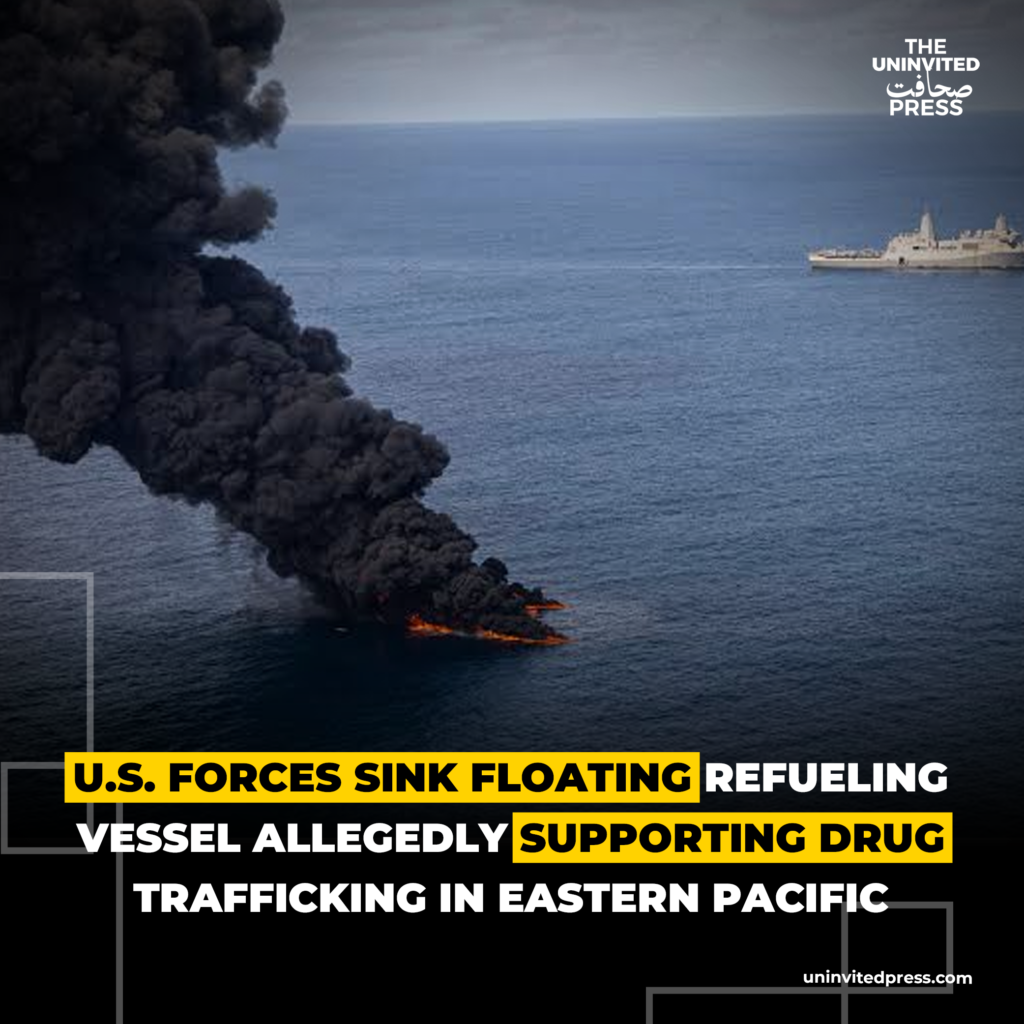
American military, working with Ecuador, boards then destroys another ship said to serve Los Choneros as crews are handed to Quito.
US forces have boarded and then sunk a vessel in the eastern Pacific that Washington says was operating as a floating refuelling station for drug-trafficking boats linked to Ecuador’s Los Choneros organisation. People on board were removed unharmed and transferred to Ecuadorian authorities before the ship was destroyed.
The operation, announced by US Southern Command (SOUTHCOM), was carried out by Joint Task Force Western Hemisphere units launched from the amphibious ship USS San Antonio. Marines and sailors interdicted the vessel in international waters, searched and cleared it without reported casualties, then sank it. SOUTHCOM said intelligence confirmed the ship supported “illicit at-sea drug trafficking operations” by Los Choneros, a group the United States has designated a foreign terrorist organisation.
US Intensifies Anti-Drug Trafficking Operations:
This was at least the fifth such interdiction since late August. Earlier operations on 28 August, 2 September and 5 September targeted vessels described as floating petrol stations that allow smaller smuggling boats to travel farther from the South American coast toward the United States. In one case US helicopters also struck accompanying craft. SOUTHCOM Commander Gen. Francis L. Donovan has called the actions a “decisive blow” to a “critical node” in the traffickers’ logistics chain.
The United States frames the campaign as part of an “Americas Counter Cartel Coalition” effort to stop narcotics from reaching American communities. Ecuador, whose Pacific ports have become a major departure point for cocaine bound for North America and Europe, has cooperated in the boardings and accepted custody of those detained.
Los Choneros is one of Ecuador’s most powerful criminal groups, accused of controlling trafficking routes, prisons and neighbourhoods through extreme violence. Its designation as a terrorist organisation has given Washington broader legal and military tools.
US Anti-Drug Campaign Sparks Maritime Concerns:
Relatives of fishermen in the Ecuadorian port of Manta have sought information about loved ones after losing contact following earlier strikes. Some crews of boats later identified by SOUTHCOM as “floating refuelling stations” have said they were ordinary fishing vessels. Independent verification of the military’s intelligence claims has been limited.
The eastern Pacific is a vast, lightly policed expanse. Trafficking groups have long used mother ships and at-sea refuelling to extend the range of go-fast boats. Destroying those platforms, US officials argue, forces smugglers into riskier, shorter runs. Critics in the region warn that the expanding use of military force at sea, even when no one is killed, blurs the line between law enforcement and armed conflict and risks sweeping up civilian mariners.
The operations form part of a broader US push against cartels that the current administration has treated as national-security threats. Joint Task Force Western Hemisphere was stood up in August specifically to counter those networks. The pattern is consistent: intelligence identifies a target, partner-nation forces or US boarding teams remove people, then the vessel is sunk so it cannot be reused.
For communities along Ecuador’s coast, the images of burning ships on the horizon are becoming familiar. Whether the campaign meaningfully reduces the flow of drugs-or simply pushes trafficking groups to adapt-will be measured in the months ahead. For now, US forces continue to treat the floating petrol stations as legitimate military targets in a war they say is already under way.