

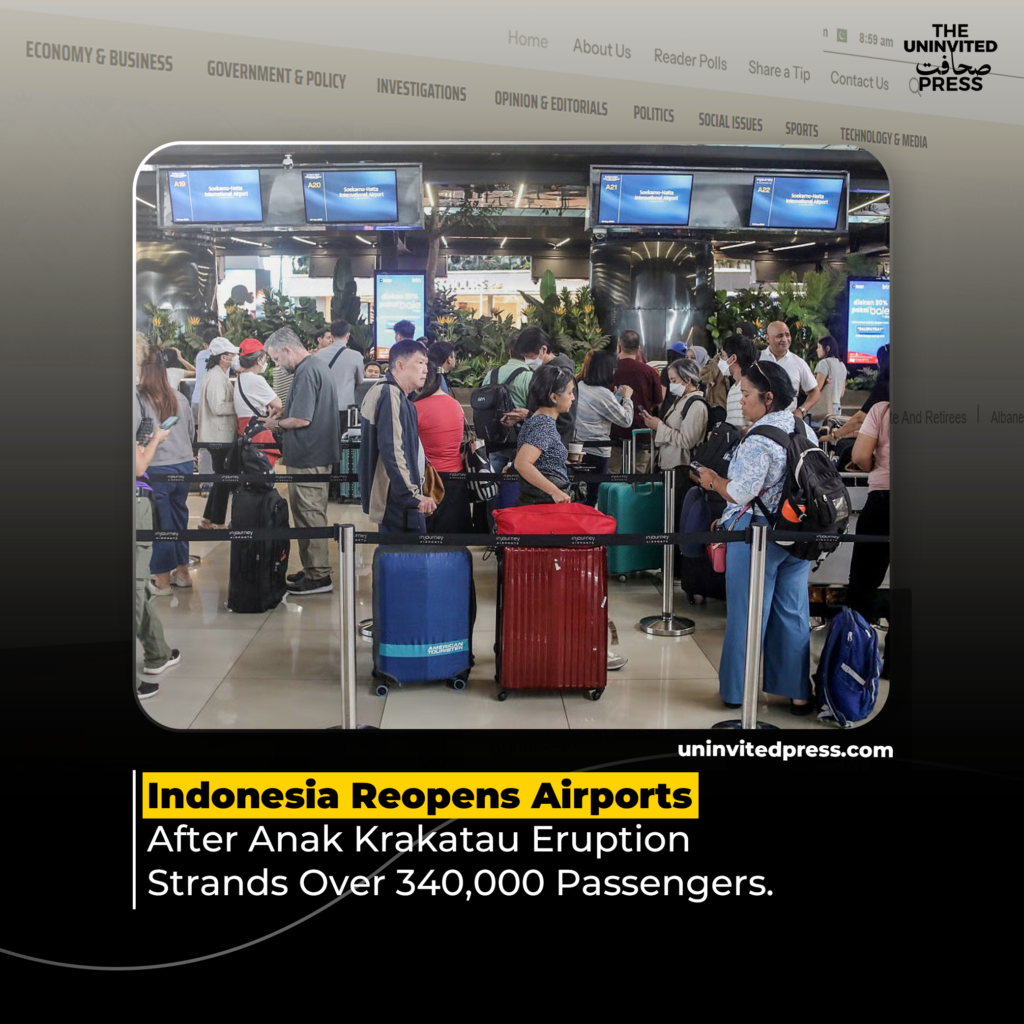
Jakarta’s main gateway and several other hubs resume flights as volcanic ash clears, but smaller eruptions keep authorities on alert.
Indonesia has reopened its busiest airport and several other aviation hubs after volcanic ash from Mount Anak Krakatau grounded nearly 3,000 flights and left more than 340,000 passengers stranded across western Java and southern Sumatra.
Soekarno-Hatta International Airport, the country’s primary gateway just outside Jakarta, resumed operations shortly after midnight on Tuesday after winds shifted and safety checks confirmed the ash had moved away from the airspace. Four other airports, including Halim Perdanakusuma in Jakarta and Husein Sastranegara in Bandung, also reopened. Two facilities in Lampung province remained closed pending further assessment.
Transport Minister Dudy Purwagandhi said authorities would inspect 178 aircraft that had been grounded at Soekarno-Hatta during the shutdown before allowing them back into service. “We’re taking a conservative approach because wind direction is highly dynamic,” he said. “We want to ensure that volcanic ash has moved away from airports around Anak Krakatau.”
Anak Krakatau Ash Cloud Disrupts Thousands of Flights:
The disruption began late Friday when Anak Krakatau, a volcanic island in the Sunda Strait between Java and Sumatra, erupted and sent ash plumes as high as 15,000 metres. The cloud drifted east toward Jakarta, more than 150 kilometres away, forcing eight airports to suspend operations. By Monday, officials said 2,961 flights had been delayed, diverted or cancelled, affecting about 341,000 travellers.
At Soekarno-Hatta, long queues formed as passengers sought refunds, rebookings and any scrap of information. Families slept on terminal floors. International routes to Singapore, Kuala Lumpur, Doha, Sydney and other cities were among those hit. Schools in Jakarta switched to online classes and fishing along parts of the Banten and Lampung coasts was halted.
The footage captured in photographs from the departure halls-travellers standing among rows of suitcases beneath departure boards still listing cancelled flights-reflected the scale of a disruption that rippled through one of Southeast Asia’s busiest aviation corridors.
Anak Krakatau Eruption Disrupts Flights in Indonesia:
Anak Krakatau, which means “Child of Krakatau,” rose from the caldera left by the catastrophic 1883 eruption that killed more than 36,000 people. In 2018 the same volcano triggered a tsunami that claimed hundreds of lives. This latest episode produced no tsunami, officials said, but the ash was enough to shut down the capital’s air links for days.
The volcano monitoring agency reported three smaller eruptions on Tuesday morning. While less powerful than the initial blasts, they still carried the potential to disrupt flights depending on ash height and wind direction. “So far, the impact is not as big as the previous eruptions, but we’ll continue to monitor,” said Lana Saria, head of the geological agency.
Airlines have been instructed to process refunds promptly and keep passengers informed. Foreign visitors whose visas expired during the shutdown were granted emergency stay extensions. For many of the 341,000 people whose journeys were interrupted, the reopening of Soekarno-Hatta marks the first chance to resume travel after days of uncertainty.
Sitting on the Pacific Ring of Fire, the archipelago of more than 17,000 islands is home to dozens of active volcanoes. Aviation, the backbone of connectivity in a country stretched across three time zones, remains vulnerable to even a modest shift in wind and ash.