

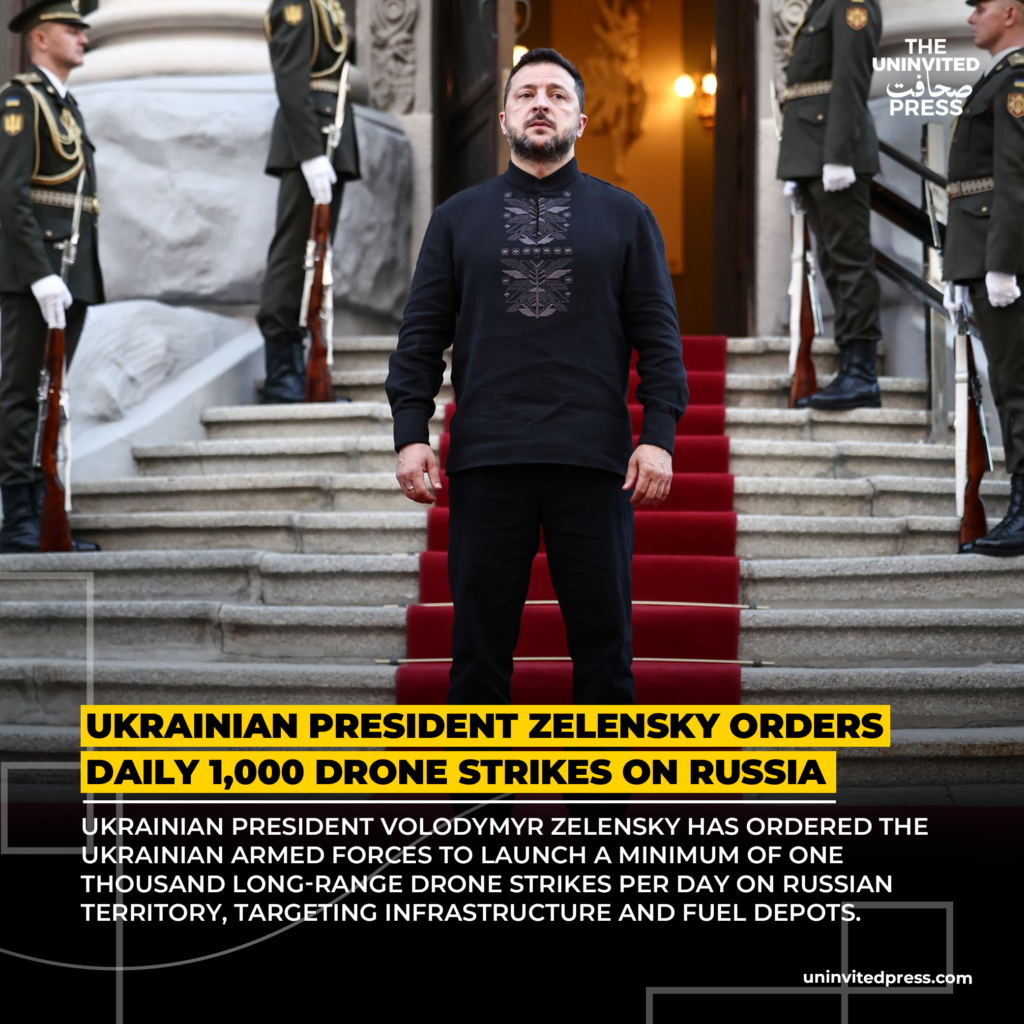
Ukrainian president says forces currently average more than 300 such attacks and must ramp up production to intensify pressure on Russian infrastructure and fuel supplies.
Ukrainian President Volodymyr Zelenskyy has ordered his armed forces and defence industry to scale up long-range drone strikes on Russian territory to a target of 1,000 per day, more than triple the current average.
In his evening address on Friday following a meeting of the Staff of the Supreme Commander-in-Chief, Zelenskyy said the priority was to maximise production of Ukrainian weapons both to defend against intensified Russian aerial attacks and to make deep strikes on Russia more frequent.
“The task is 1,000 drones a day for long-range sanctions against Russia. Right now, we’re averaging more than 300 a day-that number needs to grow,” he said. “We have a very specific goal, and we will fulfil this task.”
Zelenskyy Targets Russia’s Jet-Powered Shahed Drones:
Zelenskyy linked the new target to Russia’s stepped-up use of jet-powered Shahed drones, which he said were penetrating Ukrainian air defences and contributing to constant air-raid alerts in Kyiv and repeated strikes on cities including Kharkiv, Zaporizhzhia, and areas in the Sumy, Chernihiv, Dnipro and Kherson regions.
He called for accelerated production of interceptor drones capable of neutralising the faster jet-powered models, arguing that stronger Ukrainian deep strikes would increase the cost of the war for Moscow and create greater pressure for negotiations.
Ukrainian officials have said recent long-range operations have already reduced Russian fuel supplies, exports and logistical capacity. Zelenskyy noted that Russia is, for the first time, importing petrol and using budget funds to support its oil companies. He added that further losses would follow if Moscow refused “to talk rationally about ending this war.”
Zelenskyy Sets 1,000-Drone Daily Target Against Russia:
The announcement comes amid a sustained Ukrainian campaign of long-range drone and missile strikes targeting Russian oil refineries, military production sites, logistics hubs and energy infrastructure deep inside Russian territory. On the same day as Zelenskyy’s address, Ukrainian forces struck an oil refinery in the Yaroslavl region, roughly 1,000 kilometres from the front line, according to the president.
Earlier this summer, Zelenskyy told the Financial Times that the decisive phase of the war had shifted to the air. He argued that when the volume of drones flying toward Moscow rose from hundreds to a thousand, Russian President Vladimir Putin would feel the pressure personally and advisers might urge him to relocate farther from the capital.
Russia has significantly expanded its own drone attacks, moving from dozens of Shahed-type drones daily in earlier phases of the war to several hundred, with occasional larger salvos. Ukrainian production of long-range strike drones has also grown, though officials have previously cited funding constraints as a limit on further expansion.
In the same period, Zelenskyy acknowledged receiving information from the United States about meetings held in Moscow involving US officials, including reports of a visit by the US spy chief. He thanked Washington for the information and the “necessary tone of the conversation with Russia,” without providing further details.
The new drone target forms part of Kyiv’s broader strategy of imposing economic and military costs on Russia while seeking to strengthen its own air defences. Whether Ukrainian industry can rapidly scale production to meet the 1,000-drone daily goal, and how effectively Russian air defences will adapt, remains to be seen as the aerial dimension of the conflict intensifies.