

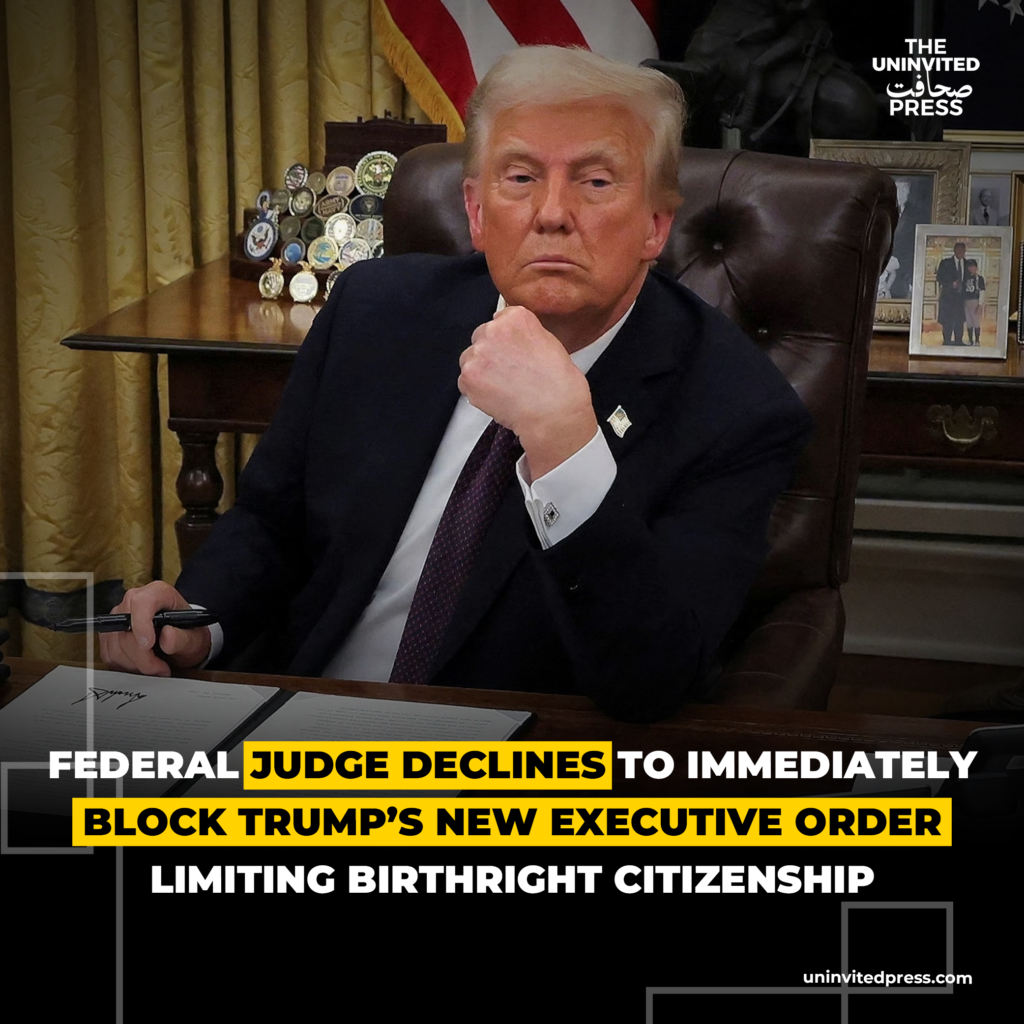
Maryland federal judge rejects temporary restraining order request, citing procedural issues, while expressing scepticism over the latest executive action after the Supreme Court struck down an earlier version.
A US federal judge on Friday declined to immediately halt President Donald Trump’s newest executive order seeking to restrict birthright citizenship, even as she voiced sharp doubts about its legal foundation following a Supreme Court ruling that rejected his previous attempt.
US District Judge Deborah Boardman in Greenbelt, Maryland, rejected a request for a temporary restraining order filed by immigrant rights advocates. The groups had previously secured a ruling from her blocking Trump’s initial 2025 executive order on the same issue. Boardman, appointed by former President Joe Biden, said she could not block the new order at this stage because the plaintiffs’ existing lawsuit did not reference the August 2026 directive.
She indicated she would allow the advocates to amend their complaint and set an expedited briefing schedule so they could challenge the measure again. Boardman described the order as one that “tries to strike out exceptions to birthright citizenship with the stroke of a pen” and called it “unprecedented” during the hearing.
Trump’s Birthright Citizenship Order Challenged:
Trump signed his first executive order on birthright citizenship on the opening day of his second term in January 2025. It sought to deny automatic citizenship to children born in the United States to parents who were undocumented or present on temporary visas, including tourists and students. Multiple federal judges quickly blocked the order, calling it unconstitutional under the 14th Amendment, which grants citizenship to those “born … in the United States, and subject to the jurisdiction thereof.”
After lower courts issued nationwide injunctions, the Supreme Court limited the use of such broad blocks in a separate ruling. On June 30, 2026, the high court struck down the original executive order in a 6-3 decision. Chief Justice John Roberts, writing for the majority, reaffirmed the long-standing interpretation of the 14th Amendment, holding that nearly all children born on US soil are citizens, with only narrow historical exceptions such as children of foreign diplomats.
Undeterred, Trump issued a revised executive order on August 6, 2026. The new measure specifically targets “birth tourism”-in which women travel to the United States to give birth so their children gain citizenship-as well as children of parents who work for foreign governments, engage in fraud to obtain citizenship, or are classified as “alien enemies.” Federal agencies are expected to issue implementing guidance by early September.
During Friday’s hearing, Justice Department lawyers argued against an immediate block, noting that agencies had not yet issued the public guidance needed to put the order into effect. Boardman expressed scepticism about delaying consideration. She questioned whether the Supreme Court’s June ruling left room for exceptions related to birth tourism, asking where in that decision any such carve-out appeared.
The decision represents a temporary procedural setback for the challengers, who include immigrant families and advocacy organisations such as CASA. Boardman instructed them to revise their lawsuit to address the new order directly. Once amended, she signalled she would move quickly to reconsider a restraining order.
US Birthright Citizenship Battle Continues in Court:
Birthright citizenship has been a core feature of US law since the ratification of the 14th Amendment after the Civil War and was cemented by the 1898 Supreme Court decision in United States v. Wong Kim Ark. Critics of Trump’s efforts argue that restricting it by executive order undermines constitutional text, historical practice and binding precedent, potentially leaving children in legal limbo or effectively stateless.
Supporters of the policy contend that the 14th Amendment’s “subject to the jurisdiction thereof” clause was never intended to cover children of those present unlawfully or temporarily, and that limiting citizenship helps deter migration and “birth tourism.”
The latest court action keeps the legal battle alive. Immigrant rights groups are expected to file an amended complaint promptly, setting the stage for further hearings in Maryland and possibly parallel challenges elsewhere. The outcome will likely hinge on how courts interpret the Supreme Court’s recent affirmation of broad birthright citizenship in light of the narrower language in Trump’s new order.