

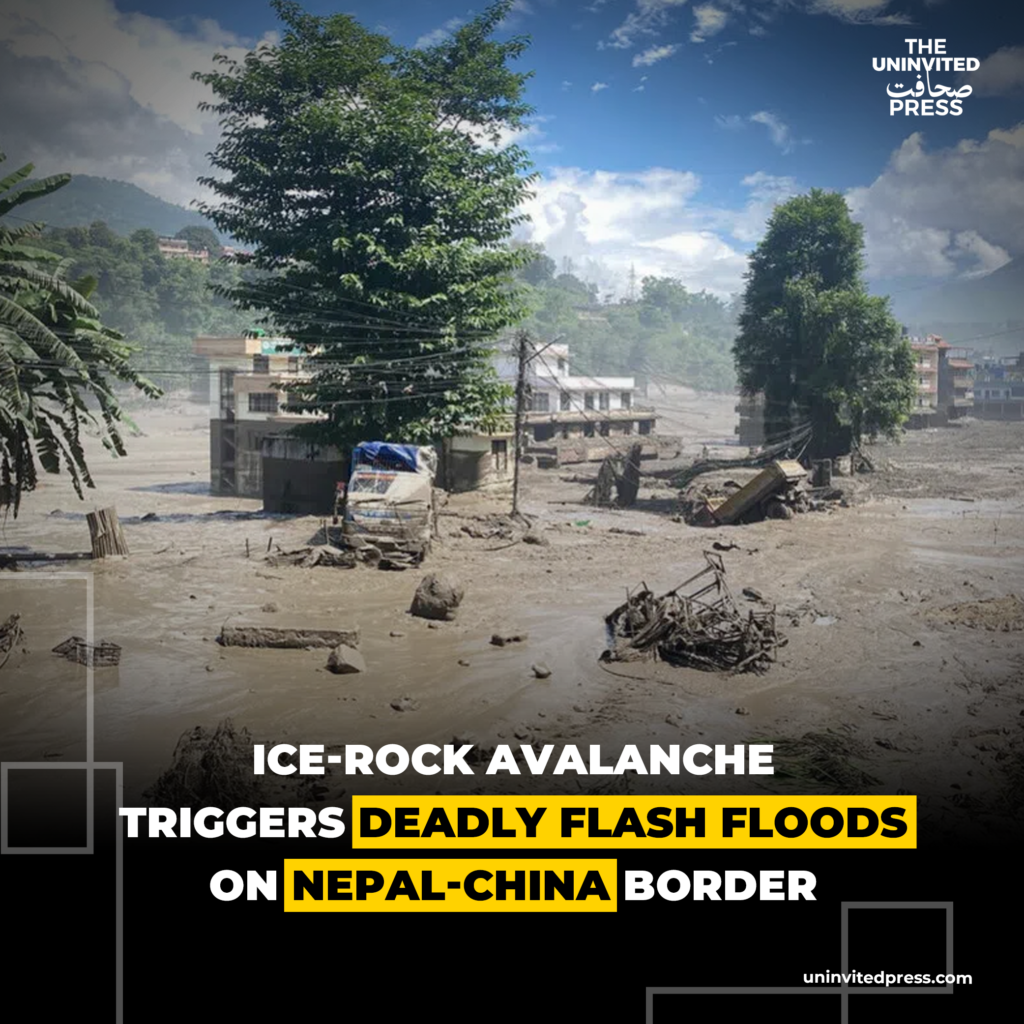
Glacier collapse sends surge of water, mud and debris through Himalayan valleys, killing at least 160 and leaving hundreds missing.
A massive ice-rock avalanche high in the Himalayas triggered catastrophic flash floods along the Nepal-China border on Wednesday, killing at least 160 people and leaving nearly 1,500 unaccounted for across the two countries.
Satellite imagery and preliminary assessments by geologists indicate that a substantial section of a glacier’s lower end broke away at an elevation of approximately 5,200 metres (about 17,000 feet). The mass of ice and rock plunged roughly 1,200 metres onto the valley floor, entraining sediment and debris as it fell. The resulting avalanche struck the Lhende River (also known as Lhende Khola), about 20 kilometres northeast of the Rasuwagadhi border crossing, temporarily damming the waterway before the blockage gave way and released a powerful surge downstream.
The floodwaters, laden with mud, boulders and ice, raced through the Bhote Koshi and Trishuli river systems, inundating villages, sweeping away bridges and roads, and devastating settlements in Nepal’s Rasuwa and Nuwakot districts as well as Gyirong County in China’s Tibet region. River levels in some stretches rose by as much as nine metres within half an hour.
Seismic signals and early uncertainty:
Initial reports suggested a magnitude 4.4 earthquake may have triggered the collapse. However, the United States Geological Survey later determined that the seismic signals were generated by the glacial collapse and subsequent debris flow itself, and that no tectonic earthquake had occurred. Nepal’s National Disaster Risk Reduction and Management Authority described the event as a “glacier-inclusive flood” caused by an ice-rock avalanche.
Experts from the International Centre for Integrated Mountain Development (ICIMOD) and independent glaciologists reviewing Planet Labs satellite imagery have broadly concurred that the collapse of the glacier snout initiated the chain of events. Whether climate-driven glacier instability, recent weather conditions or other factors contributed remains under investigation.
Nepal Flood Death Toll Rises as Rescue Efforts Continue:
At least 157 to 165 bodies have been recovered in Nepal, with three confirmed deaths reported on the Tibetan side. Hundreds of people remain missing, including large numbers of foreign tourists and pilgrims who were travelling through the popular border region. Many were en route to or from Mount Kailash and Lake Manasarovar, sacred sites for Hindus, Buddhists and others.
Rescue operations involving helicopters, drones, search dogs and ground teams have been severely hampered by destroyed infrastructure, high water levels and thick mud. Entire villages and market areas were reported wiped out. Authorities have also warned of the risk of a secondary flood if residual debris continues to block upstream sections of the river.
The disaster has underscored the growing vulnerability of Himalayan communities to cryosphere-related hazards amid a warming climate, where glaciers in the Hindu Kush Himalaya region have been melting at accelerated rates. Cross-border coordination between Nepal and China continues as search and recovery efforts proceed in difficult mountain terrain.