

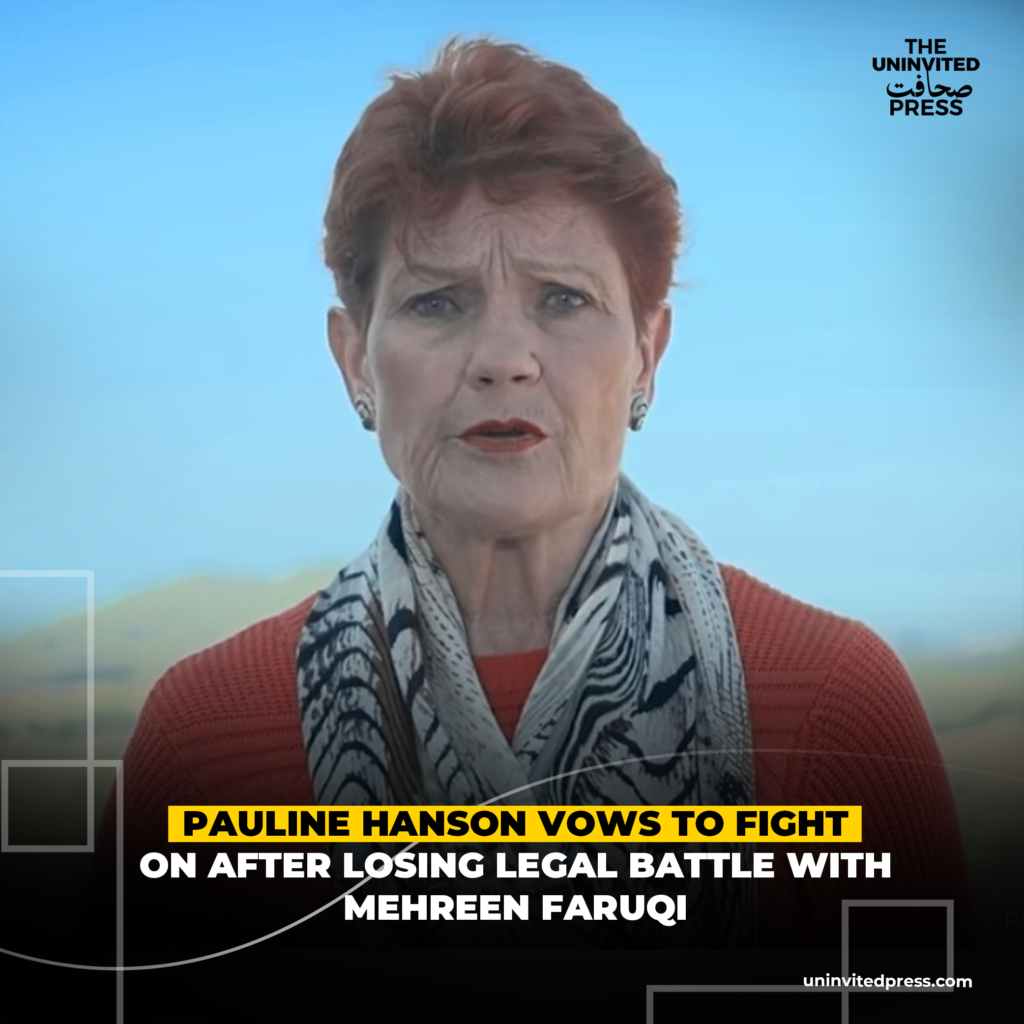
One Nation leader plans High Court challenge after Federal Court upholds ruling that she racially discriminated against Muslim senator in 2022 tweet.
Australian right-wing politician Pauline Hanson has vowed to continue her legal fight after the Full Federal Court rejected her appeal against a finding that she racially discriminated against Greens Senator Mehreen Faruqi.
In a unanimous decision delivered on 27 July 2026, Justices Melissa Perry, Geoffrey Kennett and Elizabeth Bennett dismissed all grounds of Hanson’s appeal. They upheld a 2024 Federal Court ruling by Justice Angus Stewart that a social media post by the One Nation leader breached section 18C of the Racial Discrimination Act 1975.
The dispute stems from a September 2022 exchange on the platform then known as Twitter (now X), hours after the death of Queen Elizabeth II. Faruqi, Australia’s first Muslim woman elected to any parliament and a migrant from Pakistan who arrived in 1992, posted: “Condolences to those who mourn the Queen. I cannot mourn the leader of a racist empire built on stolen lives, land and wealth of colonised peoples.”
Hanson replied: “When you immigrated to Australia you took every advantage of this country… It’s clear you’re not happy, so pack your bags and piss off back to Pakistan.”
Court Upholds Racial Discrimination Finding Against Pauline Hanson:
Justice Stewart found the post was an “angry personal attack” that constituted a “strong form of racism.” He characterised it as a variant of the long-standing racist trope “go back to where you came from,” carrying anti-Muslim and Islamophobic messages. The court determined it was reasonably likely to offend, insult, humiliate or intimidate Faruqi and members of relevant groups-people of colour who are migrants or of relatively recent migrant heritage, and Muslims who are people of colour in Australia-and that it was done because of Faruqi’s race, colour or national or ethnic origin. Hanson was ordered to delete the tweet and pay Faruqi’s legal costs.
Hanson, who was not in court for the appeal judgment, issued a statement expressing disappointment. “My legal team and I will now closely review the decision in the coming days, with a view to commencing an appeal in the High Court of Australia,” she said. She argued that public discussion in Australia had become “almost totally silenced by laws and rules which prevent ordinary people expressing their personal views in case some small part of our society takes some sort of offence or feels hurt or distressed.”
“This has never been, nor should be, the Australian way,” Hanson added. She maintained she had been “incensed by the incredible disrespect” shown to the late Queen and “simply wanted to call that out.” In subsequent comments, she described section 18C as a “ridiculous law” and framed the case as a broader battle for free speech.
Faruqi welcomed the outcome. Speaking outside court in Sydney, she said: “Today, justice has prevailed. Today’s win is for every single person out there who has been told to go back to where you came from… who has been made to feel that their belonging in this country is conditional.”
She described the lengthy judgment-spanning hundreds of paragraphs-as confirmation that Hanson had engaged in racism, Islamophobia and hate. “Hate speech is not free speech, and the Federal Court has reaffirmed that today,” Faruqi said. “This case was always about holding to account racism and holding to account those who perpetrate racism.” She indicated she would seek costs and later signalled readiness for any further challenge, stating that if Hanson wished to defend her position in the High Court, “bring it on.”
Court Backs Faruqi in Landmark Hanson Case:
The Full Court found no error in the primary judge’s characterisation of the tweet or his handling of evidence, including testimony from Faruqi and other witnesses about experiences of racism. It rejected arguments that the post was protected as fair comment on a matter of public interest under section 18D, or that the Racial Discrimination Act provisions were constitutionally invalid for burdening the implied freedom of political communication. The court held that any burden was limited and reasonably adapted to the legitimate purpose of protecting against racial vilification.
Australia’s Race Discrimination Commissioner, Giridharan Sivaraman, welcomed the decision as a landmark ruling that strengthens protections against racism and recognises intersectional discrimination involving race, colour, national origin and religion.
By late August 2026, Hanson had confirmed her intention to seek special leave to appeal to the High Court, Australia’s final court of appeal. Reports indicated her legal team aims to challenge not only the specific findings but the constitutional validity of key provisions of the Racial Discrimination Act, including section 18C. The case has therefore expanded beyond a personal dispute between two senators into a potential test of the boundaries of free speech and anti-discrimination law in Australia.
Hanson, a long-time critic of multiculturalism and immigration who has previously called for a “Muslim ban,” has built her political career on populist appeals. Faruqi has positioned the litigation as resistance to the normalisation of hate speech and far-right rhetoric. The prolonged legal battle, now approaching four years since the original post, continues to highlight deep divisions in Australian society over race, identity, belonging and the limits of political expression.
Whether the High Court grants leave to appeal remains to be determined. For now, the Federal Court’s affirmation stands as a significant affirmation of existing racial discrimination protections.