

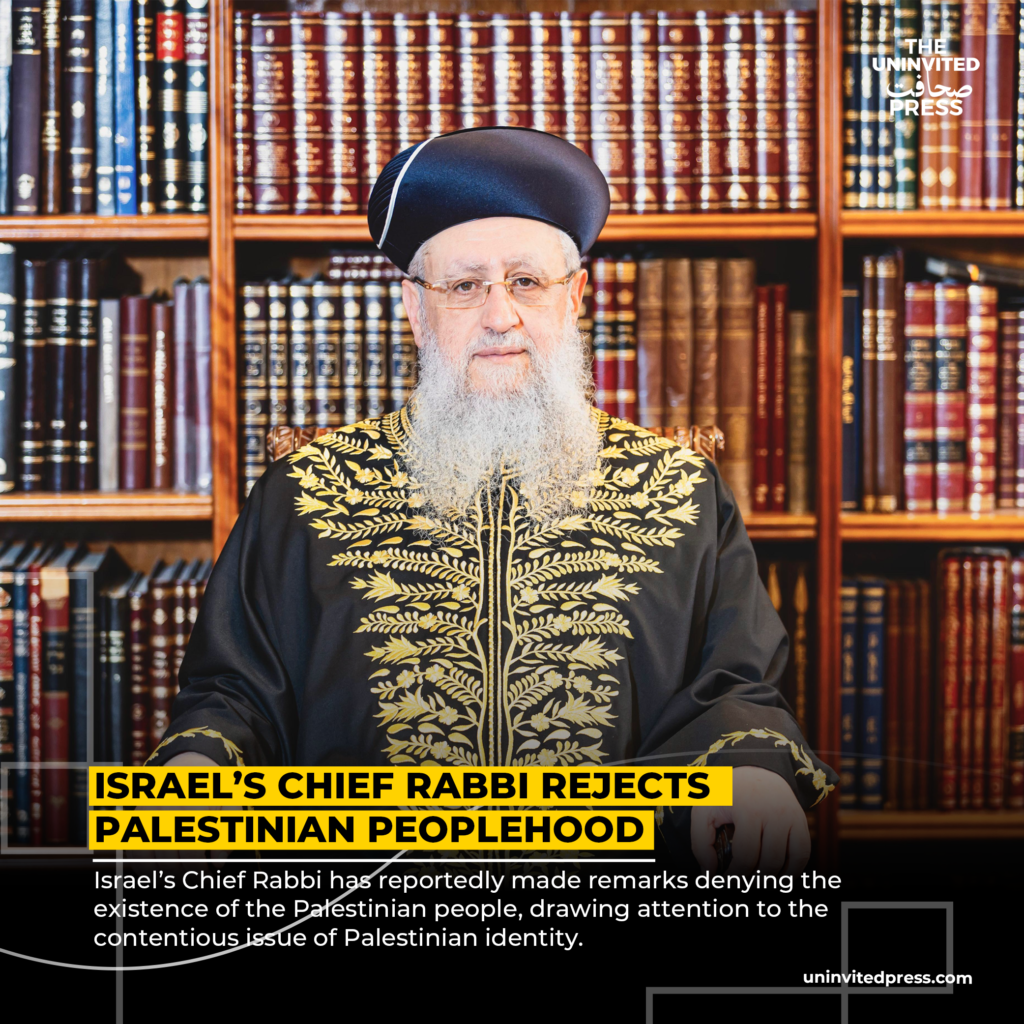
Sephardi Chief Rabbi David Yosef declares ‘there is no such thing as a Palestinian people’ and claims exclusive Jewish rights over Gaza and the occupied West Bank.
Israel’s Sephardi Chief Rabbi David Yosef has denied the existence of the Palestinian people and asserted that they “have no rights,” in remarks that have drawn widespread condemnation and highlighted deep divisions over identity, land and sovereignty in the occupied Palestinian territories.
Speaking at the Gush Katif Museum in West Jerusalem, Yosef said: “There is no such thing as a Palestinian people and they have no rights.” He went further, claiming exclusive Jewish ownership of the land. “Gaza is the Land of Israel, Gaza is ours, Nablus is ours, Jenin is ours, all of them are ours,” the rabbi declared, referring to cities in the occupied West Bank as well as the Gaza Strip.
Israel’s Chief Rabbi Calls for Gaza’s Destruction, Rejects Palestinian Peoplehood:
Yosef also called for the destruction of Gaza and the re-establishment of Jewish settlements in the enclave, from which Israel withdrew in 2005. He linked the idea to religious redemption, saying Jews should pray for the ability “to return truly to all our places.” The address marked the anniversary of the dismantling of the Gush Katif settlement bloc and the subsequent burning of synagogues by Palestinians after the Israeli pullout.
The comments come from one of Israel’s two official chief rabbis-Yosef holds the Sephardi position, while a separate Ashkenazi chief rabbi serves the other major Jewish community. As a senior religious authority, his words carry significant weight within Israeli society, particularly among religious and nationalist constituencies.
Palestinian officials and advocacy groups swiftly condemned the remarks as a denial of Palestinian identity and a form of dehumanisation. The Council on American-Islamic Relations (CAIR) described them as “hate-filled,” criticising the rejection of Palestinian peoplehood and rights at a time of ongoing conflict and suffering in Gaza. Critics argued that such statements erase Palestinian history, culture and national aspirations, framing the indigenous population as lacking any legitimate claim to the land.
The denial of Palestinian peoplehood is not new in Israeli political discourse. Former Israeli Prime Minister Golda Meir famously stated in 1969 that “there was no such thing as Palestinians.” More recently, far-right Finance Minister Bezalel Smotrich made similar claims in 2023, asserting there is “no such thing as a Palestinian people.” Yosef’s intervention as a leading religious figure has amplified these long-standing narratives, particularly amid the protracted war in Gaza and intensified settlement activity in the occupied West Bank.
Rabbi’s Gaza Remarks Deepen Israel-Palestine Tensions:
Supporters of the rabbi’s position often argue from a religious-historical perspective that the land constitutes the biblical Land of Israel, granted to the Jewish people, and that modern Palestinian national identity is a relatively recent political construct. Opponents counter that Palestinians possess a continuous presence on the land, a distinct national identity recognised by the United Nations and most of the international community, and inalienable rights under international law, including the right to self-determination.
Yosef’s remarks occur against a backdrop of severe humanitarian conditions in Gaza, where international organisations have repeatedly warned of catastrophic consequences from the ongoing Israeli military campaign. Calls from some Israeli officials and religious figures for permanent displacement of Palestinians and the reconstruction of settlements have grown louder in certain political circles.
The controversy underscores the entanglement of religion, nationalism and territorial claims in the Israeli-Palestinian conflict. For many Palestinians and their supporters, statements denying their peoplehood are seen as attempts to legitimise dispossession and permanent control over occupied territory. For segments of the Israeli right and religious establishment, they reflect a theological and historical conviction that Jewish sovereignty over the entire land is non-negotiable.
As the war continues and diplomatic efforts remain stalled, the chief rabbi’s words are likely to further polarise already entrenched positions, complicating any path toward a political resolution that acknowledges the rights and aspirations of both peoples.