

US president says Tehran seeks a deal but is unprepared for acceptable terms, as Washington maintains pressure over Strait of Hormuz.
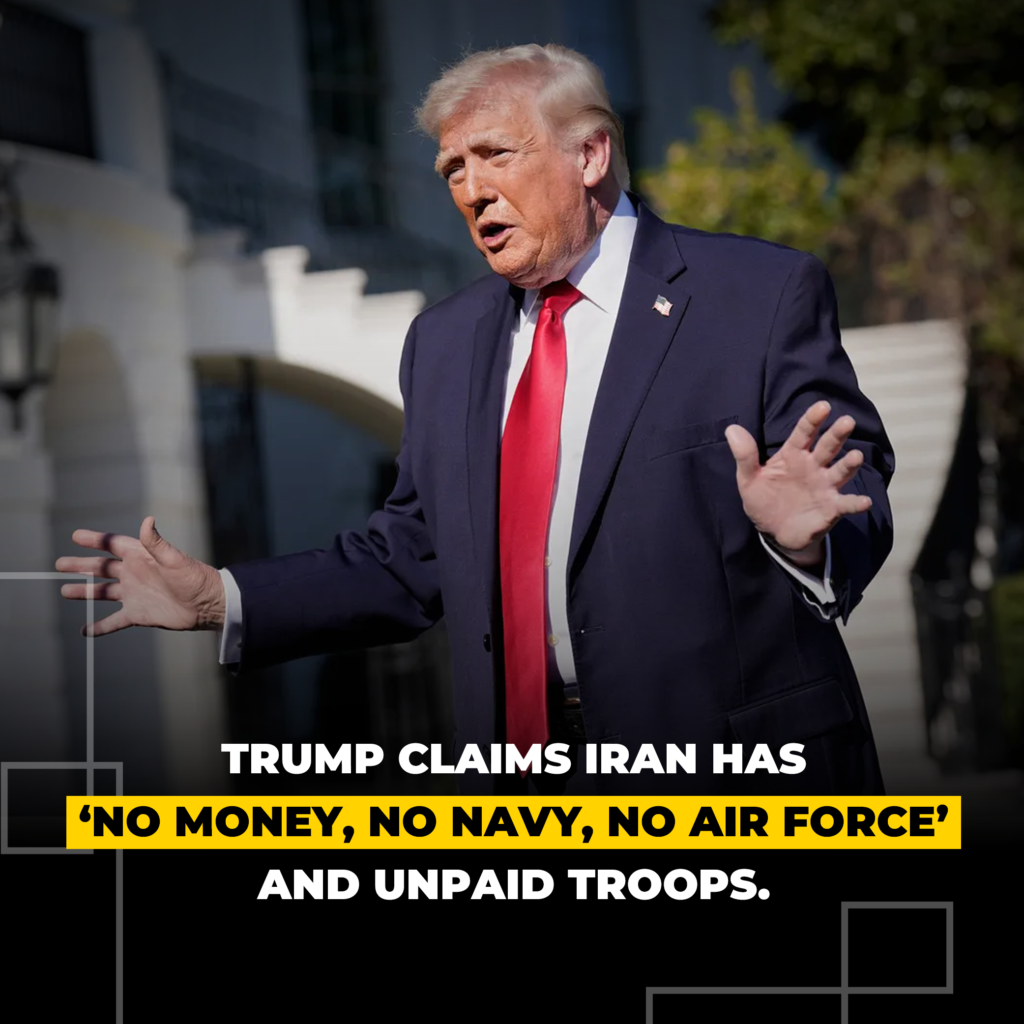
United States President Donald Trump has asserted that Iran is economically and militarily crippled, claiming the country has “no money, no navy, no air force” and is failing to pay its soldiers and police, while facing extreme inflation.
Speaking to reporters on Friday at Joint Base Andrews before travelling to South Carolina, Trump said Iran “would love to make a deal, but they’re not ready to make the right deal, in my opinion.” He added: “We’re seeing what happens. They have no money, they have no navy, they have no air force. They’re not paying their soldiers, they’re not paying their police. They have 350% inflation.”
The president also claimed the United States maintains “total control” of the area around the Strait of Hormuz, including the strategic waterway and adjacent land areas in southern Iran, through an ongoing naval blockade he has previously described as a “wall of steel.”
Trump Claims Iran’s Military Is “Decimated” Amid Rising Tensions:
Trump’s remarks come amid months of heightened confrontation between Washington and Tehran. Earlier this year, US and Israeli strikes targeted Iranian military infrastructure, which the Trump administration has repeatedly described as having devastated Iran’s navy, air force and other capabilities. Trump has made similar claims on multiple occasions, including in social media posts and public statements, asserting that Iranian forces have been “decimated” and that the country’s leadership is unstable.
Iran has rejected such characterisations. Iranian officials have maintained that their armed forces remain operational and capable of defending national interests, while accusing the United States of aggression and economic warfare. Tehran has also pushed back against claims of US control over the Strait of Hormuz, a critical chokepoint through which a significant portion of global oil trade passes.
Independent assessments of Iran’s military and economic condition remain contested. While US officials and Trump have highlighted damage to Iranian assets and severe economic strain under sanctions and conflict, Iranian state media and officials continue to report ongoing military readiness and accuse Washington of exaggerating its achievements for domestic and diplomatic leverage.
Trump Escalates Economic Pressure on Iran Over Hormuz:
Trump recently announced what he called the “most crushing economic operation ever taken” against Iran, warning countries that provide financial or commercial support to Tehran of severe consequences. The measures target oil smuggling networks, financial transfers and related activities. He has linked the economic campaign to broader efforts to prevent Iran from developing nuclear weapons and to reopen the Strait of Hormuz to normal commercial traffic.
Diplomatic efforts to stabilise the situation have faced repeated setbacks. Reports of potential ceasefire extensions or negotiations have circulated, but both sides have offered conflicting accounts of progress. Iranian officials have indicated that from Tehran’s perspective certain interim arrangements lack clear start dates, complicating any extension talks.
The Strait of Hormuz remains a focal point of concern for global energy markets. Disruptions or sustained blockades risk elevating oil prices and affecting supply chains far beyond the Middle East. Regional states have watched the confrontation closely, balancing security concerns with economic interests tied to stable maritime routes.
Trump’s latest comments underscore Washington’s dual-track approach of sustained economic pressure combined with assertions of military dominance, while leaving open the possibility of negotiations on terms favourable to the United States. Iran, for its part, continues to frame the conflict as resistance to external coercion and has signalled it will not accept conditions it views as capitulation.