

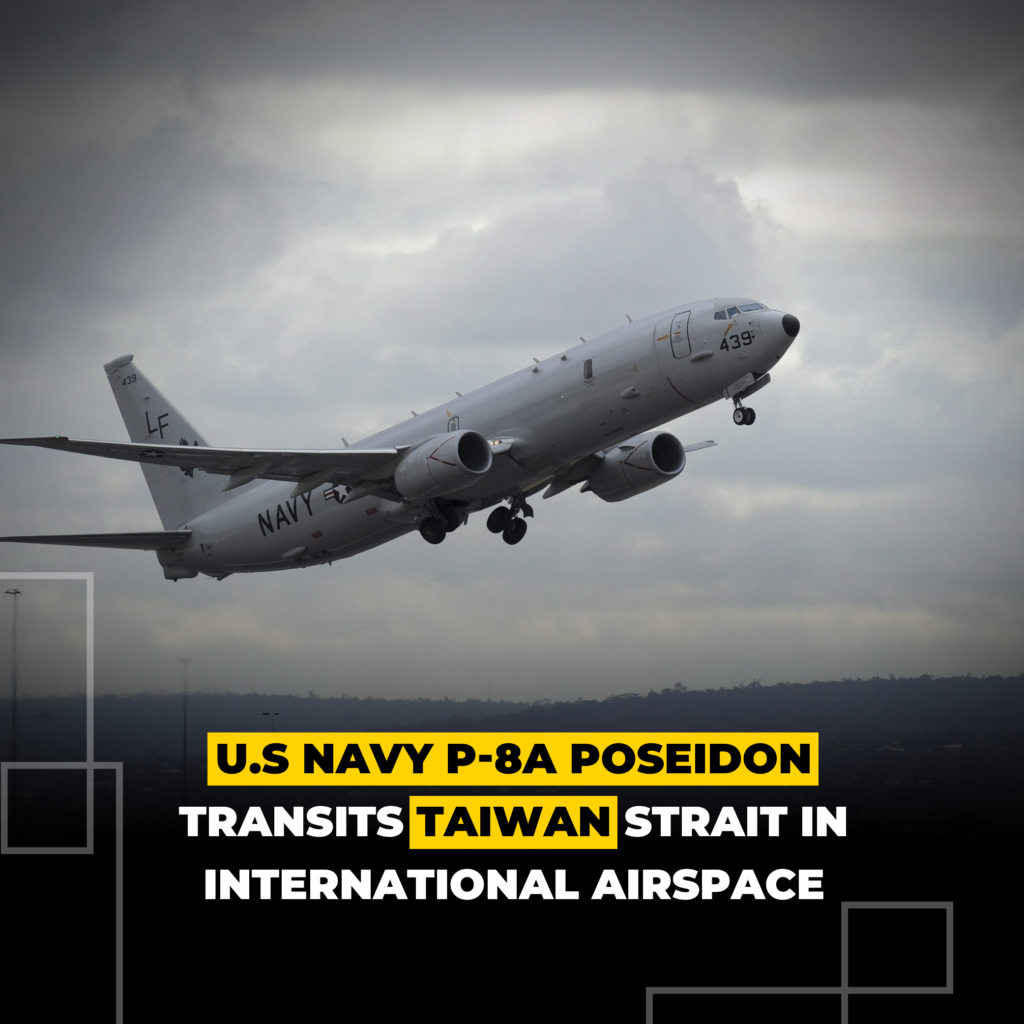
American surveillance aircraft transits international airspace as China monitors the flight ahead of planned Xi-Trump meeting.
A United States Navy P-8A Poseidon maritime patrol aircraft transited the Taiwan Strait in international airspace on Friday, the US 7th Fleet confirmed, describing the operation as a demonstration of Washington’s commitment to a free and open Indo-Pacific.
The long-range reconnaissance plane conducted the passage in accordance with international law, the fleet said in a statement. “By operating within the Taiwan Strait in accordance with international law, the United States upholds the navigational rights and freedoms of all nations,” it added. “The United States military flies, sails and operates anywhere international law allows.”
China Tracks US Navy Aircraft Through Taiwan Strait:
China’s military tracked and monitored the aircraft throughout the transit, according to a report in the state-backed Global Times citing a military source. The source said the situation remained “under control.” Chinese forces routinely shadow such flights, which Beijing views as provocative challenges to its sovereignty claims.
The Taiwan Strait, roughly 180 kilometres wide at its broadest point, separates the self-ruled island of Taiwan from mainland China. Beijing claims Taiwan as part of its territory and asserts jurisdiction over the waterway, while the United States and Taiwan maintain that the strait constitutes an international waterway open to free navigation and overflight.
US P-8A Transit Highlights Rising Taiwan Strait Tensions:
US military ships and aircraft periodically transit the strait-typically every few months-as part of operations intended to reinforce freedom of navigation principles. The P-8A Poseidon, a highly capable anti-submarine and intelligence, surveillance and reconnaissance platform, has conducted similar flights in previous years, often prompting Chinese air and naval responses.
The latest transit occurs as Chinese President Xi Jinping is expected to visit the United States next month for talks with President Donald Trump. The two leaders are seeking to stabilise bilateral relations strained by disputes over Taiwan, trade tariffs, technology restrictions and regional security issues.
Taiwan’s government rejects Beijing’s sovereignty claims, insisting that only the island’s people can determine their future. Taipei routinely monitors foreign military activity in nearby airspace and waters, describing such transits as normal when conducted in international areas.
These operations form part of a wider pattern of military activity in the Indo-Pacific, where the United States and its allies seek to counter what they describe as China’s expanding assertiveness, while Beijing frames foreign military presence near its claimed territories as interference in internal affairs.
Analysts note that while such flights are presented by Washington as routine and lawful, they contribute to an atmosphere of heightened tension in one of the world’s most strategically sensitive waterways. No incidents of unsafe interaction were reported during the latest transit.
The US 7th Fleet, based in Japan, remains the primary forward-deployed naval force responsible for operations across the western Pacific. Further details on the specific flight path or any interactions with Chinese forces have not been released by the American side.