

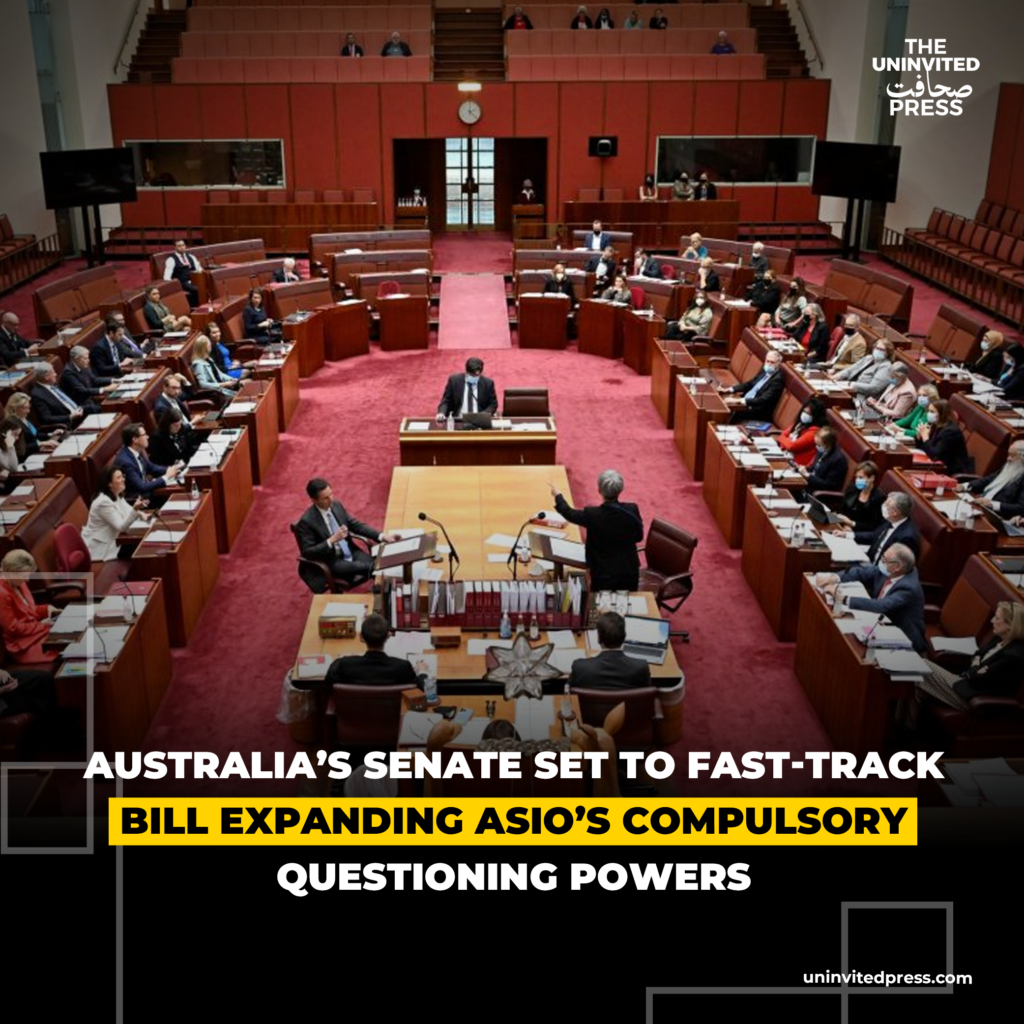
Government and Coalition move to pass legislation broadening grounds for secret questioning warrants, drawing sharp criticism from rights advocates and the Greens.
Australia’s Senate is preparing to fast-track legislation that would significantly expand the Australian Security Intelligence Organisation’s (ASIO) powers to compel people to answer questions in secret, with a vote expected as early as Thursday under an agreement between the Labor government and the opposition Coalition.
The Australian Security Intelligence Organisation Amendment Bill (No. 2) 2025 would broaden the grounds on which ASIO can seek compulsory questioning warrants for adults. Currently limited to matters involving espionage, politically motivated violence (including terrorism) and foreign interference, the powers would be extended to cover sabotage, the promotion of communal violence, attacks on Australia’s defence system, and serious threats to the country’s territorial and border integrity.
Australia Moves to Expand ASIO Questioning Powers:
The bill retains existing features of the regime introduced after the September 11, 2001 attacks: people as young as 14 can be subject to questioning warrants; there is no right to silence; legal representation is restricted; and the process occurs largely in secret under the supervision of a prescribed authority. Failure to answer questions or produce requested items can result in criminal penalties.
Greens Senator David Shoebridge said the government and opposition planned to vote the bill through on Thursday afternoon as part of a deal to clear a package of legislation. “This is the dirtiest of deals between them,” he posted on social media, describing the arrangement as “grubby and unprincipled.” Shoebridge and other critics have long argued that the powers are extraordinary and that expanding them risks sweeping up legitimate political activity, community organising and activism under vague new categories such as “promotion of communal violence.”
The government originally sought to make the compulsory questioning framework permanent by removing its sunset clause. After facing resistance, Labor dropped that element earlier this year. Instead, the bill will retain periodic parliamentary review-expected every three years-while still expanding the scope of the powers. Home Affairs Minister Tony Burke and the government have justified the changes by pointing to what they describe as a “dynamic, diverse and degraded” security environment, including rising concerns over foreign interference, sabotage risks and communal tensions.
ASIO has used the compulsory questioning powers sparingly since their introduction in 2003, according to official statements, but has consistently argued they remain a necessary tool when other intelligence methods are insufficient. The Parliamentary Joint Committee on Intelligence and Security previously recommended that the powers be retained and, subject to strengthened safeguards, made permanent, citing the evolving threat landscape.
Rights Groups Warn Over Expanded ASIO Powers:
Human rights groups, the Law Council of Australia and civil liberties organisations have repeatedly raised concerns. They argue that the regime already represents a significant departure from ordinary criminal justice principles-allowing secret questioning without the usual protections of a fair trial-and that further expansion without clearer thresholds or stronger independent oversight risks abuse. Critics note that the powers can apply even where there is no reasonable suspicion of a criminal offence, only a belief that the person may have information relevant to a security matter.
The legislation also includes some procedural changes: post-charge questioning would be limited to retired judges acting as prescribed authorities, eligibility rules for those authorities would be tightened, and additional reporting requirements would be imposed on ASIO to the Attorney-General. Oversight by the Inspector-General of Intelligence and Security would continue.
The bill’s progress reflects a longstanding bipartisan consensus on national security legislation in Australia. Successive governments have extended the original post-9/11 powers multiple times rather than allowing them to lapse. Supporters say the expansions are a measured response to contemporary threats; opponents warn that each incremental broadening normalises exceptional powers and erodes democratic safeguards.
If passed this week, the changes would take effect after receiving royal assent, further embedding ASIO’s compulsory questioning regime into Australia’s permanent national security architecture while leaving the core secrecy and compulsion features largely intact.