

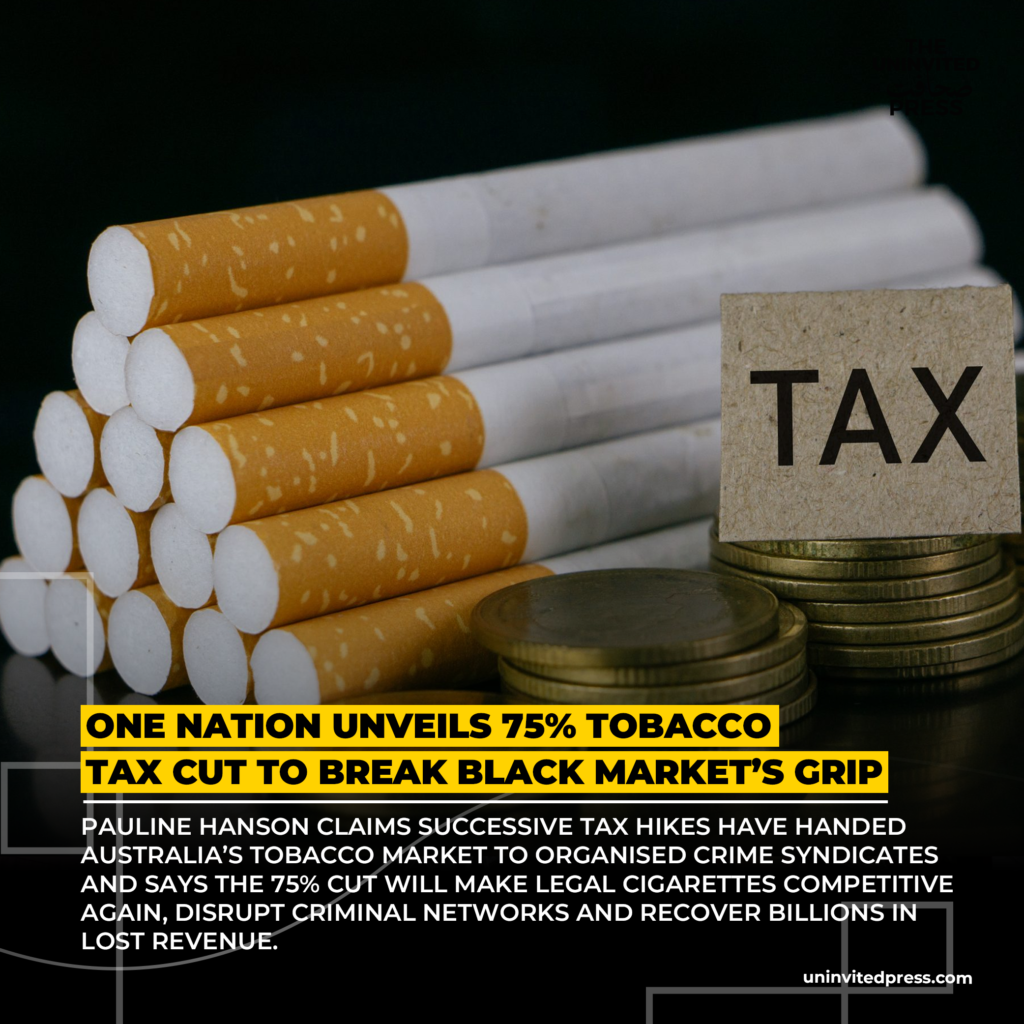
Pauline Hanson claims successive tax hikes have handed Australia’s tobacco market to organised crime syndicates and says the cut will make legal cigarettes competitive again, disrupt criminal networks and recover lost revenue.
Australia’s Pauline Hanson’s One Nation party has proposed a dramatic 75 percent cut to the federal tobacco excise, arguing that successive tax increases have driven smokers into the illicit market and handed control of the trade to organised crime.
Party leader Senator Pauline Hanson announced the policy this week, saying a full implementation would reduce the price of a legal pack of 20 cigarettes from around A$46.50 to approximately A$21-22. The plan also includes a three-year freeze on further indexation of the remaining excise. Hanson described the current regime as a failure that has underwritten criminal networks rather than reduced smoking.
“People are sick of the firebombing, shootings, extortion and killings. They are sick of watching tobacco shops burn, while organised crime takes control of the market,” Hanson said. She cited Australian Bureau of Statistics estimates that illicit sources supplied about 80 percent of the nicotine consumed in Australia in 2025, while overall consumption rose nearly 40 percent between 2017 and 2025. Legal tobacco, she argued, is being steadily displaced by cheaper black-market products.
One Nation Proposes 75% Tobacco Tax Cut:
According to One Nation, the federal excise now accounts for roughly A$30.60 of the cost of a standard pack and is scheduled to rise again in September. Government revenue from the tobacco excise has collapsed from A$12.6 billion in 2022-23 to an estimated A$4.1 billion in 2025-26 and a projected A$3.6 billion in the current financial year. Hanson claimed every official budget forecast on the tax has been “wrong, wrong, wrong.”
Illicit packs currently sell for between A$12 and A$25, according to evidence given to a Senate inquiry. Hanson said her party’s cut would close much of that price gap, “make legal tobacco competitive and attack the gangs’ extraordinary profit margin.” The policy would be paired with stronger border enforcement, more shop closures for illegal sales and tougher penalties for those involved in the trade. She insisted the measure was “not about encouraging smoking” but about “restoring the rule of law and breaking the black market.”
Australia has long pursued one of the world’s strictest tobacco control regimes, combining high excise, plain packaging and advertising bans. Successive governments of both major parties have raised the tax multiple times, arguing that higher prices reduce smoking rates and generate revenue for health services. Smoking prevalence has declined over the longer term, yet the rapid expansion of the illicit market has created a parallel crisis of violence, lost revenue and enforcement challenges.
Victoria Police have linked more than 190 arson attacks and several homicides to the so-called “tobacco wars” in recent years, as rival groups fight for control of the lucrative illegal trade. Legal retailers and convenience stores have reported intimidation and firebombings. The Australian Taxation Office has estimated the value of illicit tobacco attempting to enter the market rose from A$1.74 billion in 2018-19 to more than A$6.4 billion in 2023-24.
Health Experts Warn Against Tobacco Tax Cut:
Public health advocates and some experts warn that sharply lowering the price of legal cigarettes could reverse decades of progress in reducing smoking, particularly among younger and lower-income groups. They argue that the black market is driven primarily by sophisticated international organised crime networks rather than price alone, and that the solution lies in better enforcement and supply disruption rather than tax cuts. The Albanese Labor government has so far defended the high-excise approach while acknowledging the scale of the illicit trade and increasing resources for border and law-enforcement agencies.
One Nation’s proposal places the issue firmly in the political arena ahead of the next federal election. By framing the tax cut as a law-and-order measure rather than a pro-smoking policy, Hanson is seeking to capitalise on public frustration with rising crime linked to the black market and the visible decline in legal tobacco revenue. Whether the plan would genuinely shrink criminal profits or simply increase overall consumption remains contested.
For now, the policy highlights a deepening tension in Australian tobacco control: the conflict between the public-health goal of making smoking prohibitively expensive and the unintended consequence of creating a multibillion-dollar underground industry that has proved difficult to contain.