

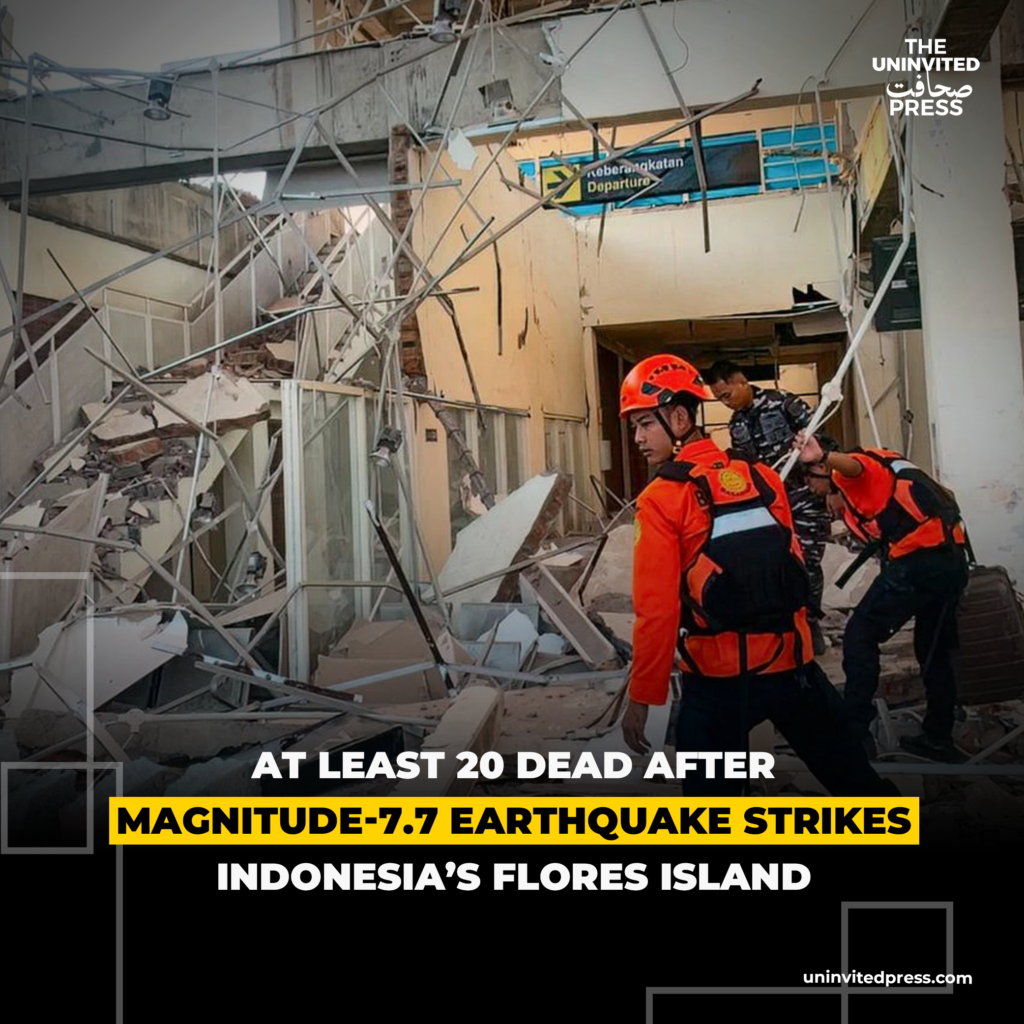
Tsunami warning lifted after powerful early-morning quake collapses buildings, triggers evacuations and aftershocks across East Nusa Tenggara.
A powerful magnitude-7.7 earthquake struck off the northern coast of Flores Island in eastern Indonesia early on Saturday, killing at least 20 people, injuring several others and leaving two people trapped under rubble, according to local search and rescue officials.
The shallow quake hit at approximately 4:58am local time (2158 GMT Friday), with its epicentre located about 68 kilometres (42 miles) north-northwest of the town of Ende in East Nusa Tenggara province, according to the United States Geological Survey (USGS) and Indonesia’s Meteorology, Climatology and Geophysics Agency (BMKG). Depth estimates ranged from 10 to 15 kilometres.
Rescuers in the port town of Maumere, the main centre in Sikka Regency, reported 20 deaths across four villages, six injuries and two people still buried, said Fathur Rahman, head of the city’s search and rescue agency, speaking to media while travelling by boat towards the hardest-hit areas. Officials noted that communications and access to Nagekeo Regency, closest to the epicentre, remained disrupted, with landslides and damaged roads complicating efforts.
East Nusa Tenggara Governor Emanuel Melkiades Laka Lena earlier confirmed at least five deaths from collapsing buildings as residents slept, with fatalities reported in Sikka and Manggarai districts. Indonesia’s national disaster management agency (BNPB) initially reported lower figures that were later revised as more information emerged from the ground. Power outages and congested roads slowed the flow of updates.
Residents Flee as Buildings Collapse Following Massive Quake:
The intense shaking, felt across much of Flores and parts of neighbouring provinces including West Nusa Tenggara and South Sulawesi, lasted up to a minute in some areas. Video footage verified from Maumere showed concrete chunks falling from a ferry terminal building onto waiting passengers, while other clips captured people screaming and running as structures collapsed into dust and rubble.
Hospitals evacuated patients outdoors as a precaution. Homes, government offices, warehouses and places of worship sustained damage. In Nagekeo Regency, about 2,000 residents fled to higher ground after the sea briefly retreated-a classic warning sign of a potential tsunami. Residents described the jolt as “massive,” with one woman in Talibura village saying she and her family were resting at home when the shaking began.
Dozens of aftershocks followed, including magnitudes of 5.9, 5.6 and 6.1. Authorities warned people not to re-enter damaged buildings due to the risk of further collapses.
Tsunami Alert Triggered, Then Lifted:
Indonesia’s BMKG issued a tsunami warning minutes after the main quake, urging coastal communities along northern and southern Flores, as well as parts of South Sulawesi and West Nusa Tenggara, to move inland or to higher ground more than 10 metres above sea level and at least two kilometres from the shore. Modelling initially suggested potential waves of 0.5 to 3 metres.
Tide gauges later recorded waves under one metre in several locations, including a peak of about 0.94 metres at Maurole in Ende. The warning was lifted roughly three hours after the earthquake once monitoring confirmed no significant ongoing threat. Australia’s tsunami warning centre also stated there was no threat to its mainland or territories.
Search and rescue ongoing in a high-risk region:
Emergency teams, including military, police and national search and rescue personnel, are prioritising locating those trapped, verifying casualty figures, assessing infrastructure damage and restoring access cut by landslides. Officials emphasised that the full extent of the impact was still being assessed, particularly in more remote villages.
Flores Island and the surrounding region sit along the Pacific Ring of Fire, a zone of intense seismic and volcanic activity. The same area suffered a devastating magnitude-7.5 earthquake and tsunami in 1992 that killed around 2,500 people. Indonesia, an archipelago of more than 17,000 islands, experiences frequent tremors due to its position at the junction of several tectonic plates.
As of Saturday afternoon, rescue operations continued amid aftershocks, with authorities focusing on preventing further casualties and providing aid to those displaced. Updated figures on deaths, injuries and damage are expected as teams reach previously inaccessible areas.