

Right-wing party’s latest protest against Indigenous recognition renews debate over respect, division and national identity.
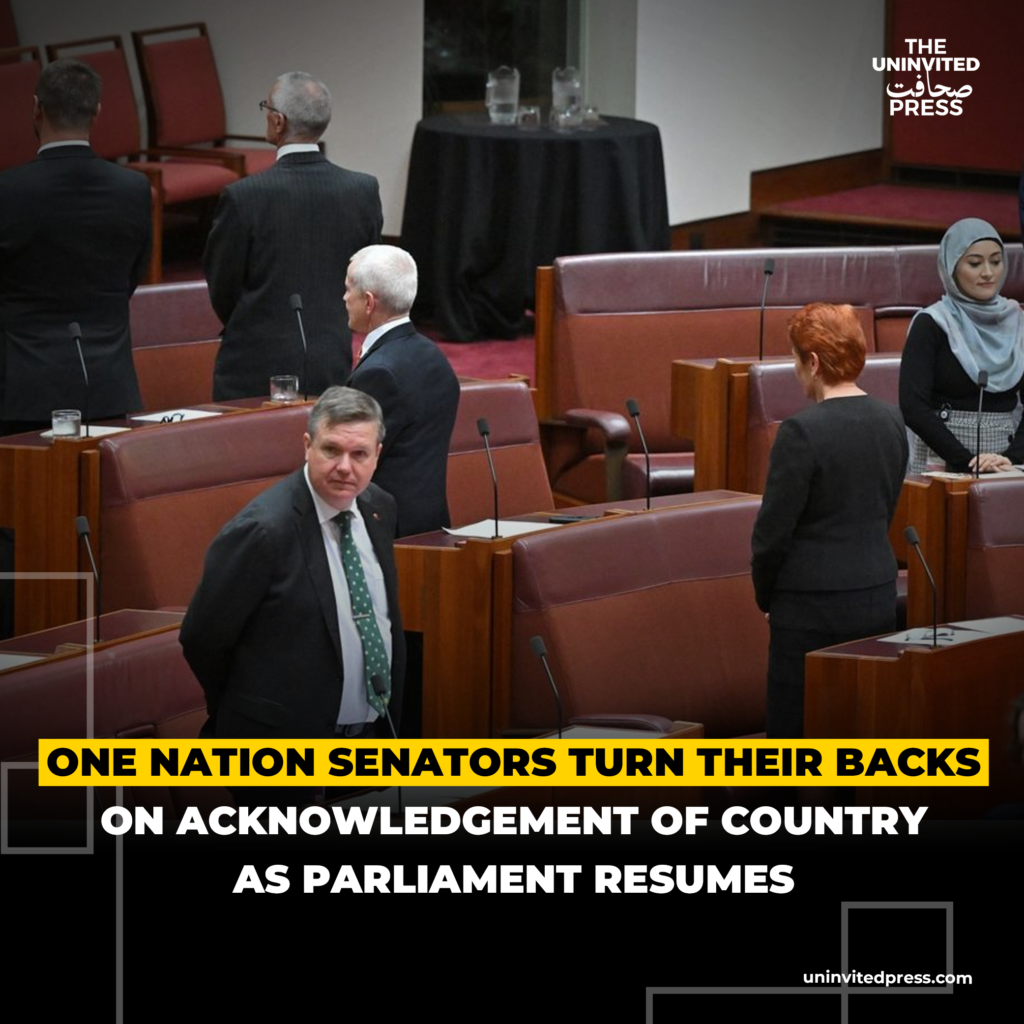
Three senators from Pauline Hanson’s One Nation party turned their backs during the customary Acknowledgement of Country as Australia’s federal parliament resumed for its spring sitting this week, in a deliberate act of protest against a longstanding parliamentary practice recognising the country’s First Nations peoples.
Queensland Senator Malcolm Roberts, New South Wales Senator Sean Bell and Western Australia Senator Tyron Whitten were observed facing away while Deputy Senate President Slade Brockman delivered the brief statement acknowledging the traditional custodians of the land on which Parliament House stands. The trio reportedly turned back around for the subsequent Lord’s Prayer that forms part of the Senate’s daily opening proceedings. Party leader Pauline Hanson was not present in the chamber at the time.
Hanson’s Acknowledgement of Country Campaign Continues:
The gesture, captured in the opening minutes of the sitting fortnight, immediately drew attention as another chapter in One Nation’s sustained campaign against Welcome to Country and Acknowledgement of Country ceremonies. These practices, which recognise Aboriginal and Torres Strait Islander peoples as the traditional owners of the land and pay respects to elders past and present, have become a routine feature of official events, schools, workplaces and parliamentary sessions across Australia.
Hanson, a longstanding critic of the ceremonies, has repeatedly described them as “divisive” and “tokenistic.” She has called for their removal from schools, government departments and official occasions, arguing that they make non-Indigenous Australians feel like outsiders in their own country and distract from issues such as the cost of living. In recent comments, she has said that if she were prime minister she would scrap the practice and that “there won’t be three flags.”
The party’s latest action echoes a similar protest in July 2025, when Hanson and her then-Senate colleagues, including Roberts and Whitten, collectively turned their backs during the Acknowledgement of Country at the opening of the new parliament. At that time, Hanson insisted the move reflected the views of constituents who were “fed up” with being “welcomed to our own country.” Indigenous Affairs Minister Malarndirri McCarthy condemned the earlier protest as an “incredibly childish stunt” and a “deliberate decision to disrespect First Nations Australians,” while other Labor and Greens figures described it as hurtful and designed to stoke division.
Acknowledgement of Country differs from a formal Welcome to Country, which is typically delivered by an Aboriginal or Torres Strait Islander elder. The parliamentary version is a short, standardised statement that has been part of the Senate’s order of business for years. Supporters view it as a modest but meaningful act of recognition of Australia’s deep Indigenous history-spanning more than 65,000 years-and a gesture of respect in a nation still grappling with the legacies of colonisation, dispossession and the ongoing disparities faced by First Nations communities.
One Nation Sparks Controversy in Parliament:
Critics within One Nation and sections of the conservative spectrum argue the ceremonies have become performative, politically driven and a source of unnecessary division, particularly after the decisive rejection of the Indigenous Voice to Parliament referendum in 2023. Hanson and her colleagues have framed their opposition as a defence of a singular Australian identity against what they call activist ideology.
The practice has become a flashpoint in Australia’s culture wars. It has been disrupted at Anzac Day services and other public commemorations, drawing condemnation from government figures who call such actions disgraceful. For many Indigenous Australians and their allies, the repeated snubs by elected representatives send a clear message of rejection at a time when practical progress on Closing the Gap remains uneven and when symbolic recognition continues to matter deeply to communities that have long fought for visibility and respect.
One Nation’s senators are not required to be present for the Acknowledgement. Their choice to attend specifically to turn away underscores the political theatre involved. Hanson later entered the chamber to attempt a procedural move related to other issues, while in the House of Representatives a newly elected One Nation MP was scheduled to deliver a maiden speech.
As parliament settles into its sitting period, the episode is likely to fuel further exchanges about national identity, historical truth-telling and the place of Indigenous recognition in Australian public life. For advocates of reconciliation, the senators’ backs turned towards a statement of respect represent more than a procedural protest-they highlight persistent fault lines in a country still negotiating what it means to acknowledge its past while building a shared future. For One Nation and its supporters, the act is presented as standing up for those who feel the rituals have gone too far.