

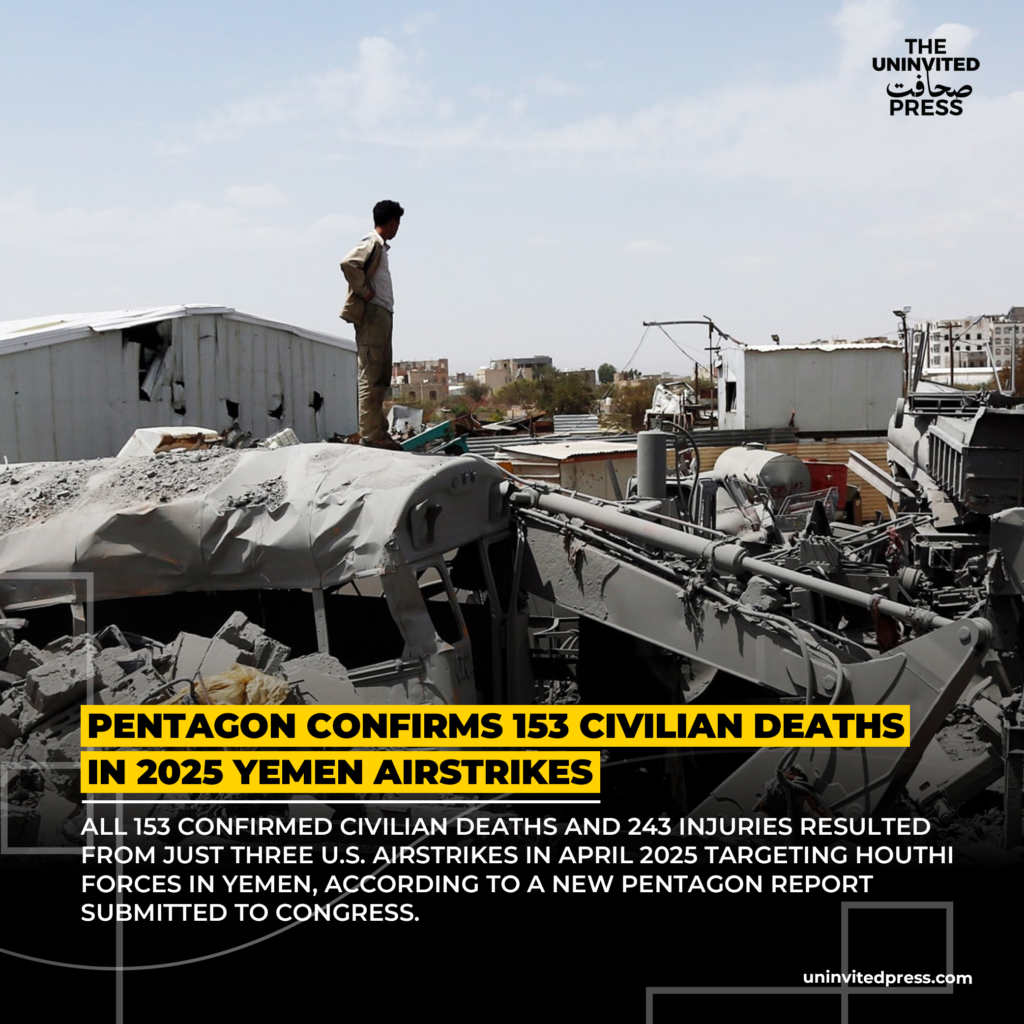
All recorded US military civilian casualties in 2025 linked to April operations against Houthis, report to Congress shows, as independent monitors cite higher toll.
A new Pentagon report submitted to the US Congress has confirmed that American military operations in 2025 killed 153 civilians and wounded 243 others-all resulting from just three airstrikes in Yemen in April targeting Houthi forces.
The assessment, released publicly this week, marks the US military’s formal acknowledgment of significant civilian harm during the campaign known as Operation Rough Rider. According to the report, US Central Command determined that the three strikes “more likely than not” caused civilian casualties. The findings stand in sharp contrast to the Pentagon’s assessment for 2024, which recorded only two civilian deaths and two injuries from US operations.
Three US Strikes in Yemen Killed 153 Civilians:
The first incident occurred on April 6, 2025, when a strike on a residence in the Houthi-controlled capital Sanaa killed five civilians and injured 25. The second, on April 17 at Ras Isa port in Hodeidah governorate, resulted in 80 civilian deaths and 171 injuries-an attack that human rights groups, including Human Rights Watch, have said warrants investigation as a potential war crime. The third strike, on April 28 near Saada, killed 68 civilians and wounded 47, according to the Pentagon figures. That attack hit a facility holding African migrants, an incident Amnesty International described as requiring investigation for possible violations of international humanitarian law.
The Pentagon said its assessments relied on US military intelligence, imagery and open-source reporting rather than on-site investigations or interviews with witnesses. As of February 2026, Central Command was still reviewing 15 additional incidents in Yemen flagged by non-governmental organisations.
The strikes formed part of a broader US campaign launched in March 2025 under the Trump administration in response to Houthi attacks on commercial and military vessels in the Red Sea and Gulf of Aden. US forces struck more than 1,000 targets across Yemen before the operation wound down in early May after the Houthis indicated they would halt attacks on shipping. The campaign targeted Houthi leadership, weapons systems and economic infrastructure, including fuel facilities.
Yemen Airstrikes Leave Disputed Civilian Death Toll:
Independent monitors have reported higher civilian tolls. The Yemen Data Project estimated at least 238 civilians killed, including 24 children, and 467 injured across hundreds of US strikes during the operation. Airwars, another casualty-tracking organisation, documented figures exceeding the Pentagon’s confirmed numbers. These discrepancies highlight long-standing challenges in verifying harm in Yemen’s complex conflict environment, where access is limited and multiple parties operate.
Yemen has endured more than a decade of war, with the Iran-backed Houthis controlling large parts of the north and west, including the capital, while a Saudi-led coalition and other forces backed the internationally recognised government. US strikes against the Houthis date back years, but the 2025 campaign produced a concentrated spike in reported civilian harm. Critics have pointed to the dismantling of certain civilian harm mitigation offices within the Pentagon as potentially contributing to higher risks for non-combatants.
The report does not include any civilian casualties from separate US operations in the Caribbean and eastern Pacific targeting alleged drug-trafficking vessels, which the Southern Command assessed as having caused no civilian harm under the same “more likely than not” standard.
For Yemenis living under the dual pressures of conflict, blockade-related shortages and repeated aerial campaigns, the Pentagon’s figures represent only a partial accounting of the human cost. As the report circulates in Washington, questions persist about accountability, the adequacy of targeting procedures, and whether the scale of civilian harm in just three strikes reflects a broader pattern that independent monitors argue is even more severe.