

Death toll rises as rescuers battle toxic gas and collapsed tunnels in Balochistan’s notoriously dangerous mining sector.
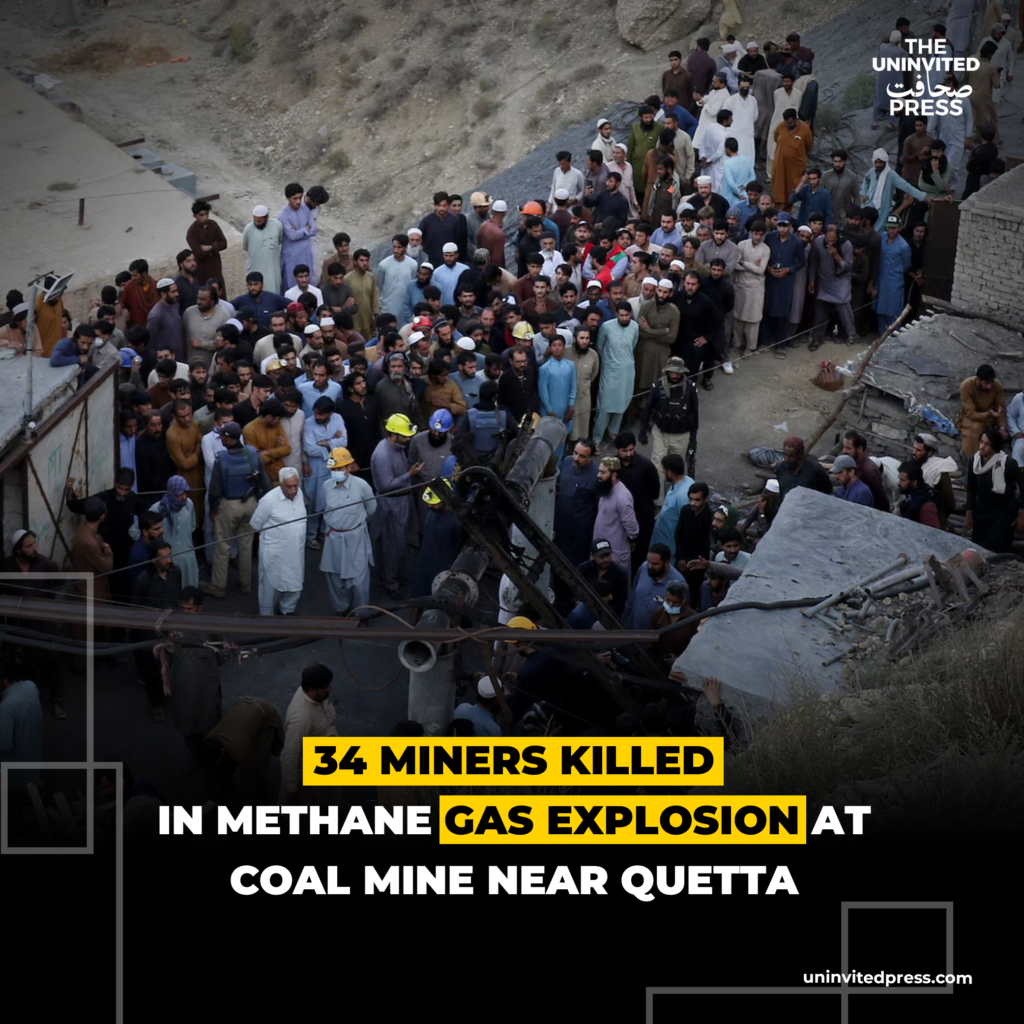
At least 34 coal miners have been killed after a powerful methane gas explosion tore through a private mining complex in the Sorange (also known as Sor Range or Sorang) area near Quetta, the capital of Pakistan’s restive Balochistan province, officials said on Friday.
The blast, which occurred on Thursday afternoon, damaged two adjoining mines and triggered a fire and major collapses deep underground. Rescue teams from the Provincial Disaster Management Authority (PDMA) and the Mines Department recovered 34 bodies overnight and into Friday morning, while continuing to search for any remaining trapped workers amid hazardous conditions of toxic gases, debris and low oxygen levels.
Balochistan’s Provincial Disaster Management Authority confirmed the recovery of the bodies in a statement, noting that joint rescue operations were still under way. Earlier reports had put the death toll lower, with figures rising steadily as teams worked through the night at depths estimated between 2,500 and 4,000 feet (roughly 760 to 1,220 metres).
Methane Blast Traps 42 Miners Near Quetta:
Officials and the mine owner attributed the disaster to a buildup of methane gas, a common and deadly hazard in poorly ventilated underground coal mines. Methane can accumulate in confined workings and ignite from a spark or other source, producing a violent explosion that collapses tunnels and depletes oxygen.
“Two mines close to each other were damaged in a powerful methane gas explosion,” said Abdul Ghani Baloch, a senior government mining official in the region. Chief Inspector of Mines Muhammad Atif described rescue efforts as extremely difficult after the blast also damaged an alternate air-supply passage.
Mine owner Qurban Jogezai said around 42 labourers had been working inside at the time. Many of the miners were reported to be from Shangla district in Khyber Pakhtunkhwa province, a common pattern in Balochistan’s coalfields where migrant labourers from poorer regions take on high-risk work for low wages.
Witnesses described chaotic scenes at the surface as relatives, fellow miners and emergency workers gathered around the mine entrance. Some workers who rushed in to help after the initial blast were themselves killed, according to accounts from the site.
Balochistan Coal Mine Disaster Highlights Safety Failures:
The disaster is the latest in a long series of deadly accidents in Balochistan’s coal mining sector, where weak enforcement of safety regulations, inadequate ventilation, outdated methods and the absence of modern gas detection systems have repeatedly proven fatal. Similar methane-related incidents and collapses have claimed dozens of lives in recent years in areas around Quetta, Duki, Chamalang and Sanjdi.
Labour representatives and mining unions have long accused private operators and authorities of negligence, pointing to the lack of protective equipment, irregular inspections and pressure on workers to continue in dangerous conditions. A national miners’ union has previously blamed systemic failures and demanded stricter enforcement of safety laws in a sector marked by poor wages and high mortality.
Provincial Mines and Minerals Minister Mir Shoaib Nosherwani said the government had mobilised all available resources and was closely monitoring the operation. He announced compensation of 500,000 Pakistani rupees (approximately $1,800) for the families of each deceased miner. Chief Minister Mir Sarfraz Bugti directed an immediate response, and federal officials also expressed condolences.
Rescue teams faced severe obstacles: collapsed shafts, lingering fire, toxic gases and the extreme depth of the workings. Officials expressed limited hope of finding further survivors, noting that oxygen levels typically drop to near zero after such explosions.
Conflicting accounts of how many workers were underground at the time have left the exact number of remaining missing unclear. Early reports spoke of dozens trapped; later statements focused on body recovery while confirming that search efforts continued.
The incident has once again highlighted the human cost of Pakistan’s reliance on coal extraction in a province rich in minerals but plagued by underdevelopment, insecurity and weak governance. Families of the dead now face the dual burden of loss and economic hardship in a region where mining remains one of the few available sources of income for many.
As recovery operations continued on Friday, authorities said an investigation into the cause would be conducted. For the communities that supply Balochistan’s mines with labour, however, the pattern of repeated tragedies has become grimly familiar.