

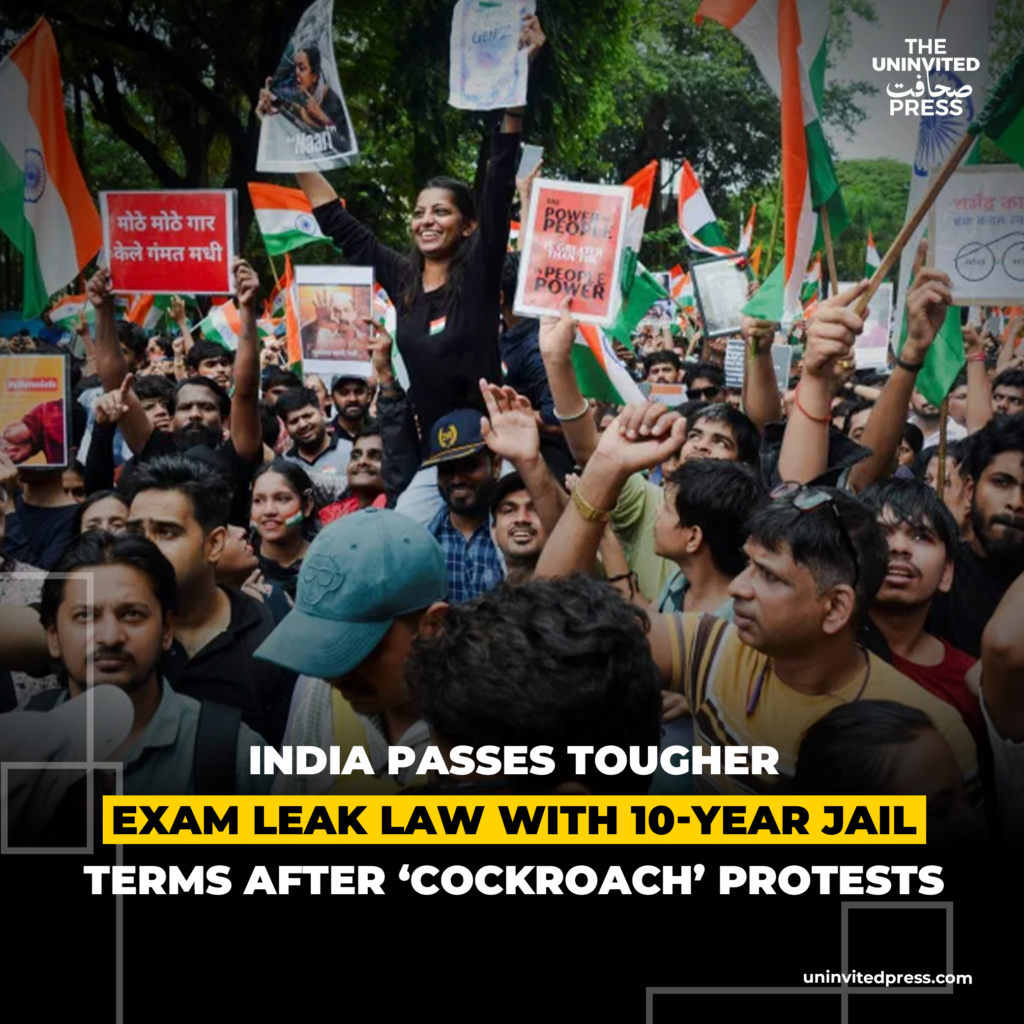
Parliament approves harsher penalties and fast-track courts as youth-led movement forces education minister’s resignation.
India’s parliament has passed legislation significantly strengthening punishments for examination paper leaks, introducing jail terms of up to 10 years and fines reaching tens of millions of rupees, following weeks of nationwide protests led by a youth movement that called itself the Cockroach Janta Party.
The Public Examinations (Prevention of Unfair Means) Amendment Bill, 2026, cleared both houses of parliament in late July. It amends a 2024 law that had already criminalised paper leaks and other forms of exam malpractice. The new provisions raise the maximum prison sentence for individuals involved in unfair means from five to 10 years and increase fines substantially. For organised crime or “paper leak mafias,” the minimum sentence rises and fines can reach 10 crore rupees (more than $1 million). Service providers found complicit face higher penalties and longer bans from conducting public exams.
The legislation also establishes dedicated fast-track courts and sets strict timelines: investigations must be completed within two months, and trials within three months of a chargesheet being filed. The government presented the changes as a response to public anger over repeated failures in the integrity of high-stakes national examinations.
A Cancelled Exam Ignites a Youth Movement:
The crisis began in early May 2026 when the National Eligibility cum Entrance Test (Undergraduate), or NEET-UG-the sole gateway for medical, dental and veterinary courses-was cancelled after evidence emerged of a question paper leak. More than two million students had sat the exam. A re-test was later held, but the episode triggered widespread frustration among young people already facing intense competition, high unemployment and a series of past paper leaks across recruitment and entrance tests.
The protests gained a distinctive identity after India’s chief justice referred to some unemployed young Indians as “cockroaches” who complain on social media. The remark, which the judge later said was misquoted, prompted Abhijeet Dipke, a 30-year-old graduate, to launch the satirical Cockroach Janta Party online. Within days the movement attracted large followings and organised demonstrations that spread to dozens of cities.
Protesters, many of them students and recent graduates, demanded the resignation of Education Minister Dharmendra Pradhan, accountability for those behind the leaks, systemic reforms to prevent future scandals, and compensation for families of students who died by suicide amid the stress and uncertainty. Demonstrations in Delhi turned confrontational in mid-July when police used tear gas and batons to stop crowds attempting to march towards parliament from the Jantar Mantar protest site. Dozens were detained.
India Toughens Exam Leak Law After Youth Protests:
Facing sustained pressure and opposition criticism, Prime Minister Narendra Modi publicly promised that those who “try to harm the future of our youth will not be spared” and announced plans for fast-track courts. The Union Cabinet approved the tougher draft legislation in late July. Pradhan resigned on July 25, a key demand of the protesters. The Cockroach Janta Party subsequently called on demonstrators to disperse, saying the government had conceded major points, including compensation for affected families.
Opposition leaders, including Congress figure Rahul Gandhi, argued that the scandals reflected deeper failures in the education system and accused the government of inadequate action over years of leaks. Government ministers maintained that the 2024 law and the new amendments demonstrated a firm commitment to protecting the credibility of public examinations and the aspirations of honest candidates.
The amended law covers major national exams conducted by bodies such as the National Testing Agency, the Union Public Service Commission, the Staff Selection Commission and others. Candidates themselves remain outside its direct punitive scope; the focus is on those who leak papers, organise malpractice or facilitate unfair means.
Paper leaks have long plagued India’s competitive examination system. Critics point to weak enforcement, organised networks that profit from selling access to questions, and the enormous pressure on young people for whom a single exam can determine careers and social mobility. The 2024 Act had already made offences cognisable, non-bailable and non-compoundable, yet high-profile scandals continued, eroding confidence.
Whether the new penalties and faster judicial processes will deter future leaks remains to be tested. For the generation that turned a judicial insult into a political slogan, the passage of the law and the minister’s resignation mark a rare moment of visible accountability. The deeper questions of exam integrity, youth employment and trust in institutions, however, are likely to persist long after the protests subside.