

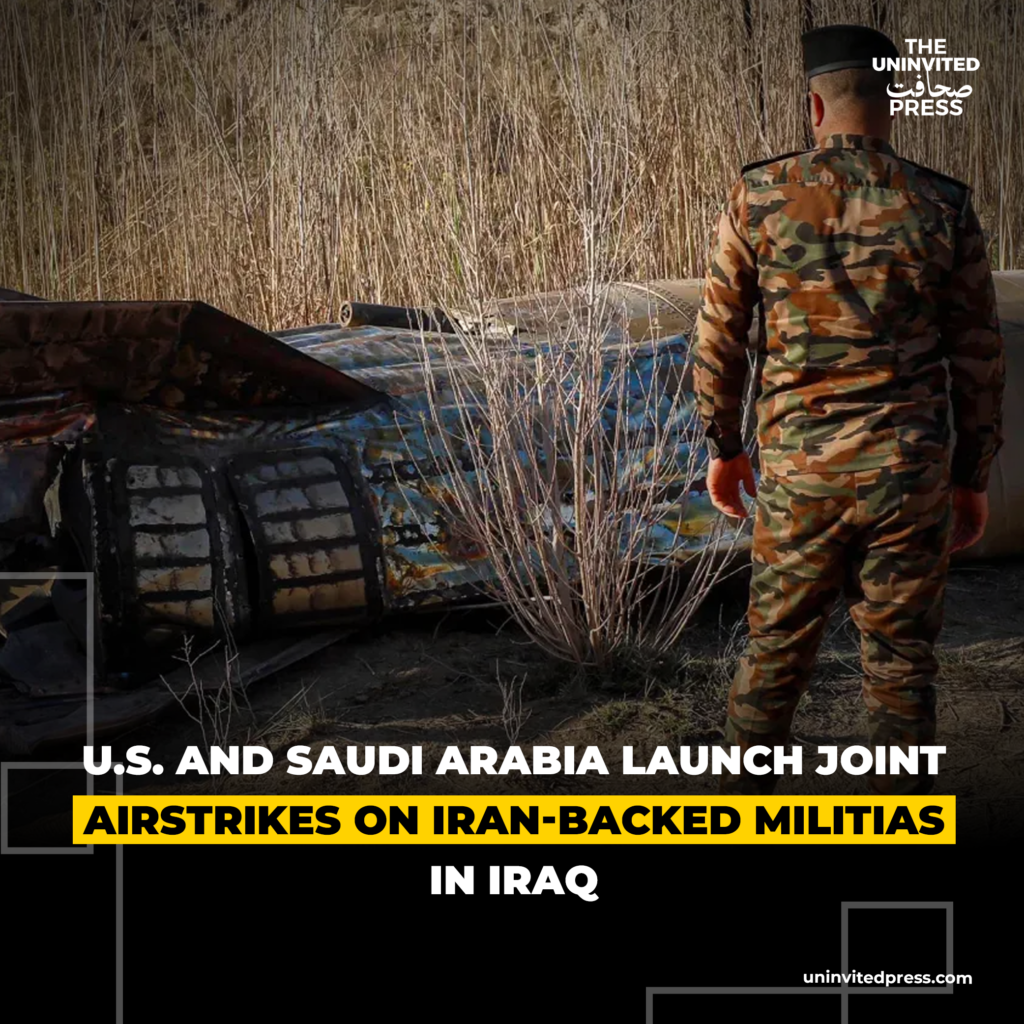
Riyadh and Washington say the precision strikes targeted logistics and weapons sites after drone attacks on Saudi energy facilities and US forces.
The United States and Saudi Arabia have carried out joint airstrikes against Iran-aligned armed groups in eastern Iraq, marking a rare combined military operation between the two allies on Iraqi soil.
US Central Command (CENTCOM) and the Saudi Arabian Armed Forces said the precision strikes on Tuesday targeted multiple “terrorist logistics and weapons sites” used by groups that Iran’s Islamic Revolutionary Guard Corps (IRGC) had directed to attack US forces and Saudi energy infrastructure. The operation came in response to more than 30 drone attacks launched over a 72-hour period, according to the US military statement.
Saudi Targets Iran-Linked Militias in Iraq:
Saudi Arabia’s Ministry of Defence confirmed it had conducted “precise and targeted strikes” in coordination with CENTCOM. Riyadh said the action followed recent drone attacks on petroleum facilities in its Eastern Province and the Riyadh region that were launched from Iraqi territory by what it described as Iran-aligned militias. Saudi air defences had intercepted and destroyed several of those drones, the ministry added.
“The Kingdom emphasises that it does not seek escalation but will respond to any aggression it faces,” the Saudi statement said.
Iraq’s Popular Mobilisation Forces (PMF), an umbrella organisation of mostly Shia paramilitary groups that includes several factions aligned with Iran, reported that its headquarters and facilities in different parts of the country had been hit. Preliminary accounts from the PMF indicated that several members were killed and others wounded, with damage caused to buildings and installations. One report cited eight fighters killed and four wounded. The PMF described the attacks as a “highly dangerous escalation” and a violation of Iraq’s sovereignty.
The Islamic Resistance in Iraq, another umbrella grouping of Iran-backed factions, denied responsibility for the drone attacks on Saudi Arabia, calling the accusations “fabrications” and warning that any “foolish” Saudi action would be met with a harsh response.
Iraqi Prime Minister Ali al-Zaidi ordered security agencies to investigate the earlier drone launches from Iraqi territory and is expected to travel to Saudi Arabia in the coming days. Iraq’s military has reiterated its commitment to preventing the country’s territory from being used as a launch pad for attacks on neighbouring or friendly states.
Joint US-Saudi Operation Targets Iraq:
The joint US-Saudi operation is notable for involving Saudi warplanes directly in strikes inside Iraq alongside American forces. It comes amid a broader regional confrontation that has seen periods of intense exchanges between the United States and Iran, interspersed with short diplomatic pauses. CENTCOM said the recent drone attacks directed against US forces had been unsuccessful and warned that the IRGC and its proxies must cease such actions or face further military responses.
Eastern Iraq has long served as a logistical corridor for Iran-aligned groups, with areas near the Iranian border frequently used for weapons storage, staging and launch positions. The latest strikes follow a series of reported drone and missile incidents targeting energy infrastructure and military sites across the Gulf and neighbouring countries.
Oil markets reacted with a rise in crude prices as concerns over regional stability and potential disruption to shipping routes, including the Strait of Hormuz, resurfaced. Diplomats and regional observers are watching closely to see whether the joint operation will remain limited or contribute to a wider escalation.
Iraq finds itself once again caught between competing regional powers. Successive governments in Baghdad have sought to balance relations with both Iran and the United States while trying to assert control over the numerous armed groups that operate within the country’s borders. The PMF, formally integrated into Iraq’s security architecture after the fight against ISIL (ISIS), continues to occupy a complex position that blurs the lines between state forces and independent militia networks.
As assessments of the damage and casualty figures continue, both Washington and Riyadh have framed the strikes as defensive responses rather than a deliberate broadening of the conflict. Whether that framing holds will depend on the reactions from Tehran, Baghdad and the armed groups themselves in the days ahead.