

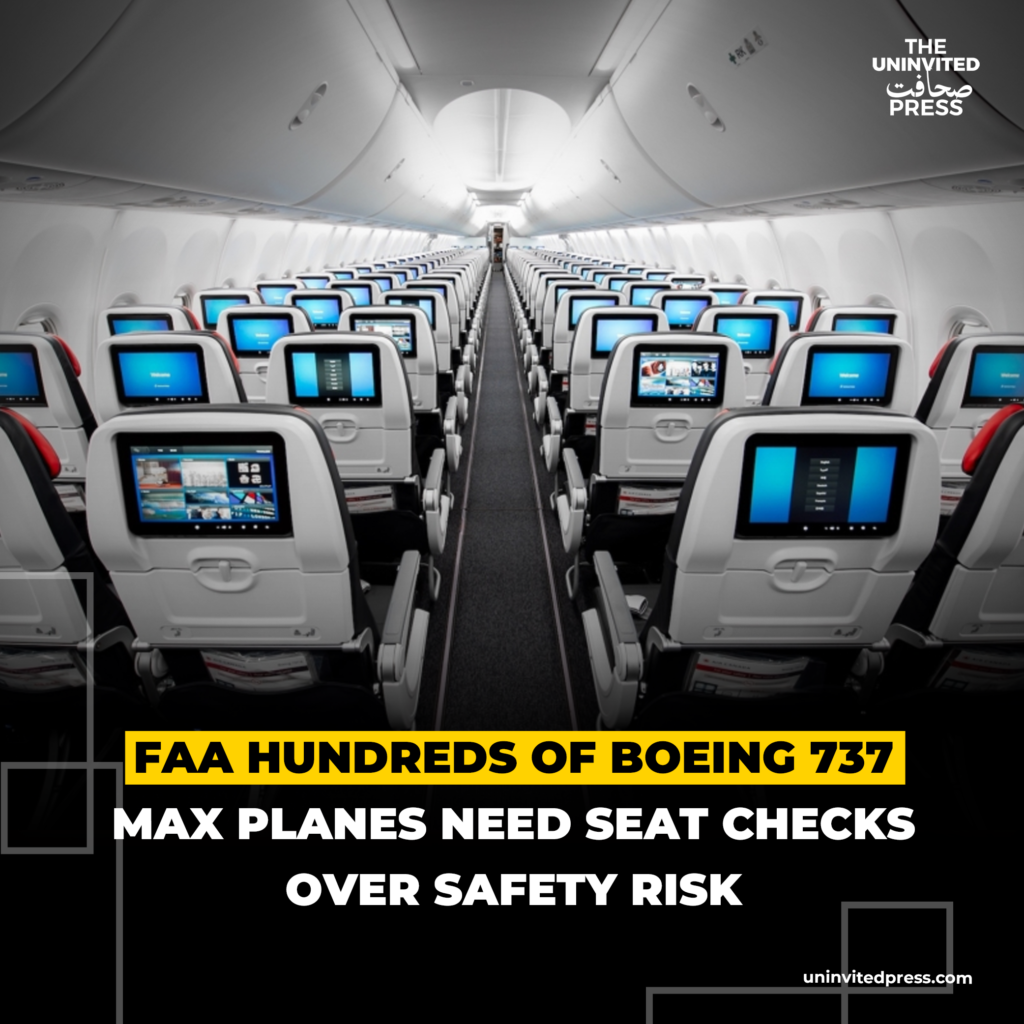
U.S regulator warns improperly secured seats could detach in turbulence or emergency landings, risking injuries and delayed evacuations.
The US Federal Aviation Administration(FAA) has proposed mandatory inspections of passenger seats on hundreds of Boeing 737 MAX aircraft after discovering that some were incorrectly installed, creating a potential safety hazard during turbulence or emergency landings.
In a notice of proposed rulemaking published on 27 July 2026, the FAA said certain track-mounted passenger seat assemblies on specific 737-8, 737-9 and high-density 737-8200 models were not properly locked into their floor tracks. The agency estimates the directive would apply to approximately 453 aircraft on the US registry. While the proposal covers only US-registered jets, foreign regulators often adopt similar measures for aircraft of the same type operated internationally.
Seat Safety Checks Ordered for 737 MAX:
According to the FAA, the problem centres on the aft fitting shear plungers-the pins designed to secure each seat leg into the cabin floor tracks-which in some cases were not fully lowered and engaged during installation. An incorrectly installed seat “can disengage from the seat tracks if there is an increased load, turbulence, or emergency landing,” the agency stated. Such a failure could injure passengers or crew and potentially block an aisle, slowing evacuation in an emergency.
Each affected aircraft may have as many as 69 track-mounted passenger seat assemblies requiring inspection. The proposed directive would require operators to conduct a detailed check of the left- and right-side seat-track fittings on every such assembly and carry out corrective actions where necessary. The FAA estimates the inspection would take about one labour hour per seat assembly at a cost of roughly $85, with similar additional time and cost for any reinstallation work. No replacement parts are required. Boeing has indicated that some or all of these costs may be covered under warranty.
The issue first came to light through a Boeing Special Attention Requirements Bulletin issued in December 2025. The manufacturer identified the installation shortcoming and provided operators with inspection and corrective procedures. The FAA is now seeking to make those steps mandatory. The proposal is not an emergency airworthiness directive and does not ground any aircraft. A public comment period remains open until approximately 10 September 2026, after which the agency will decide whether to issue a final rule and set a compliance timeline.
The latest development adds to the prolonged scrutiny of Boeing’s production quality. The company has faced intense regulatory and public attention since a door plug blew out mid-flight on an Alaska Airlines 737-9 MAX in January 2024, an incident that grounded dozens of similar aircraft and intensified FAA oversight of the manufacturer’s assembly processes. Boeing has been working under new leadership to strengthen quality controls and restore confidence while increasing production rates of the 737 MAX family, one of the world’s most widely used narrow-body airliners.
Boeing Faces Fresh FAA Safety Review:
Aviation safety experts note that seat attachment integrity is a critical survivability issue. Seats that remain fixed during a hard landing or severe turbulence help protect occupants and keep escape routes clear. Although the seats function normally under routine flight conditions, the risk emerges only under elevated loads-precisely the conditions present in emergencies.
Airlines operating the affected models are expected to incorporate the inspections into scheduled maintenance once a final directive is issued. Because multiple technicians can work simultaneously, the impact on individual aircraft turnaround times may be manageable. International operators of the 737 MAX, including major carriers in Europe, Asia and the Middle East that fly the 737-8200 high-density variant, will be watching the FAA process closely, as equivalent requirements often follow from other national aviation authorities.
The FAA has emphasised that the proposed rule addresses an “unsafe condition” identified through existing reporting channels. No incidents involving seat detachment linked to this specific installation error have been publicly reported. The agency’s action underscores its continued focus on production and installation quality across Boeing’s commercial aircraft programmes.
For passengers, the immediate practical effect is limited: flights continue as scheduled, and any required work would occur during routine maintenance windows. The episode nevertheless serves as another reminder of the complex interplay between manufacturer processes, regulatory oversight and the everyday systems that keep commercial aviation safe.