

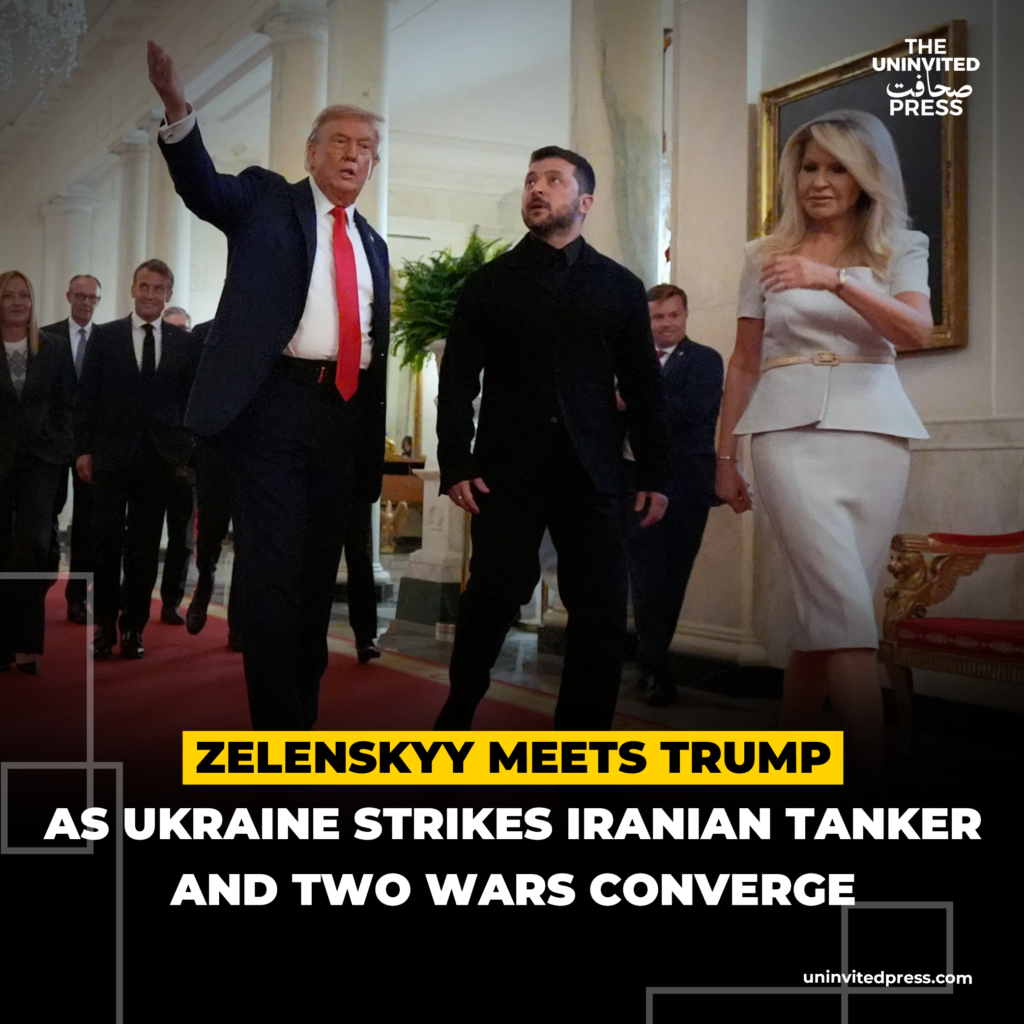
Ukrainian president’s visit comes days after Kyiv claimed attacks on vessels carrying Iranian-linked military cargo, underscoring deepening Russia-Iran ties amid stalled diplomacy.
Ukrainian President Volodymyr Zelenskyy is set to hold talks with US President Donald Trump at the White House on Tuesday, as Kyiv’s recent long-range strikes in the Caspian Sea have drawn a direct connection between Russia’s war on Ukraine and the escalating conflict involving Iran.
The meeting, scheduled for 9:30am Washington time, marks another high-level engagement between the two leaders following a noticeable thaw in their relationship after earlier tensions. It takes place against the backdrop of Ukraine’s claim that its forces struck vessels used in military cargo shipments involving Iran, as well as a Russian warship, in the Caspian Sea over the weekend.
Ukraine Targets Iran-Russia Logistics Corridor:
Zelenskyy announced on Saturday that Ukrainian forces had achieved “very strong results” with the long-range operation. Ukraine’s Security Service said drones hit an oil platform, a Russian missile boat and cargo ships under international sanctions that had been used to transport military cargo between Iran and Russia. Iran confirmed that one of its commercial vessels was struck, resulting in the death of one sailor and injuries to others. Tehran summoned Ukraine’s diplomat in protest and warned that the “hostile and criminal act” would not go unanswered.
Iranian Foreign Minister Abbas Araghchi accused Kyiv of violating the UN Charter and suggested the attack was carried out at Israel’s behest. Ukraine’s Foreign Minister Andrii Sybiha rejected the threats as “unjustified and groundless,” stating that Tehran has been a “direct accomplice to Russian aggression” by supplying weapons used against Ukrainian civilians since 2022.
The Caspian Sea has long served as a key logistics corridor linking Russia and Iran, carrying both commercial goods and, according to Kyiv, military components. Ukraine has for years faced waves of Iranian-designed Shahed drones deployed by Russian forces. Zelenskyy further claimed that Russian satellite surveillance of Gulf states and US military facilities has been shared with Iran to help coordinate strikes, and said intelligence on this cooperation would be shared with partners.
The timing of the Caspian operation-just days before the White House meeting-has been widely interpreted as an attempt by Kyiv to highlight the military partnership between Moscow and Tehran at a moment when the United States is intensifying pressure on Iran. Analysts note that the strike disrupts one of the remaining relatively secure routes for Iran amid pressure on its southern coastline and oil exports.
Trump and Zelenskyy’s relationship has evolved significantly since a contentious Oval Office encounter early in Trump’s second term. A brief private conversation at the Vatican and subsequent meetings, including on the sidelines of the NATO summit in Turkey earlier this month, appear to have improved the tone. Trump has publicly described the relationship as “good” and has moved to allow Ukraine to produce Patriot air-defence interceptors under licence-a capability Kyiv has long sought.
Caspian Becomes New War Front:
The White House talks come as US-Russia diplomacy remains stalled. Earlier efforts by Trump to engage Russian President Vladimir Putin, including a summit in Alaska, have not produced a ceasefire. Moscow has warned that intensified Ukrainian strikes inside Russia would prolong the conflict, while Kyiv continues to press for stronger air defences, deeper defence industrial cooperation and greater Western leverage over Moscow.
European leaders and Ukrainian officials have stressed the need for sustained support as the war enters its fifth year. Zelenskyy has repeatedly stated his readiness to pursue a peace agreement and has discussed diplomatic options with US envoys. Tuesday’s meeting is also expected to touch on sanctions, air defence and the broader implications of Russia’s partnerships.
The Caspian incident illustrates how the two conflicts are increasingly interconnected. Iran’s provision of drones and other systems to Russia has been well documented. In return, Moscow is alleged to be offering technological and intelligence support that benefits Tehran’s regional activities. By targeting the supply route, Ukraine has sought both to degrade Russia’s war logistics and to demonstrate to Washington that Moscow is assisting a US adversary.
Iran maintains that it has not intervened in the Russia-Ukraine war and describes the Caspian vessel as commercial. Russian officials have similarly characterised the cargo as civilian. Independent verification of the precise contents of the struck ships remains limited, though Western sanctions had already targeted some of the vessels involved for their role in Iran-Russia military logistics.
As Trump and Zelenskyy meet in Washington, the convergence of these theatres raises difficult questions for US policy. Supporting Ukraine’s defence against Russia while managing confrontation with Iran creates overlapping pressures on military resources, diplomatic bandwidth and global energy markets. The Caspian Sea, long a relatively quiet body of water, has now become another arena where the consequences of both wars are felt.