

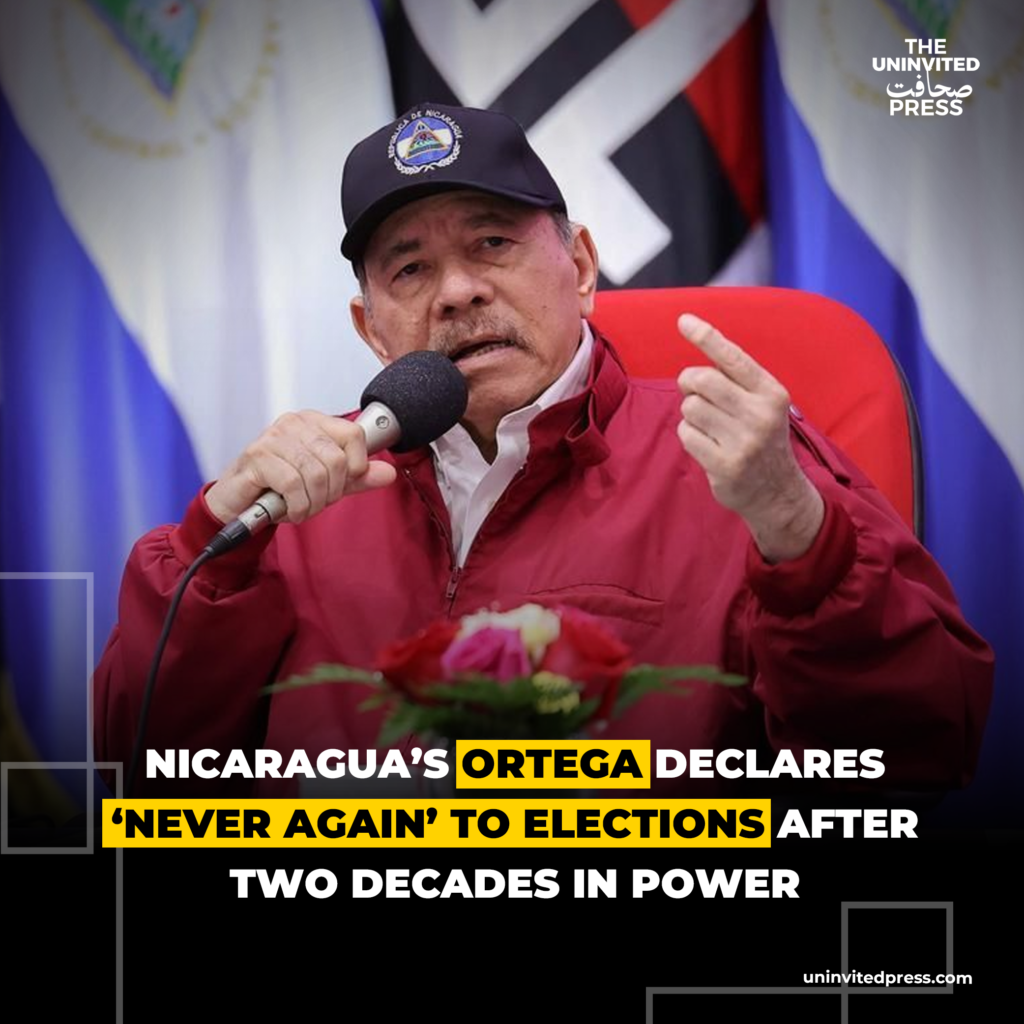
‘Never again’: Long-ruling Sandinista leader says opposition will never return to power through the ballot box.
In a stark declaration that strips away the last vestiges of democratic pretense in Nicaragua, President Daniel Ortega has announced that the country will hold no more elections, vowing to erect legal barriers to prevent any opposition challenge to his nearly two-decade grip on power.
Speaking at a rally on July 19, 2026, marking the 47th anniversary of the Sandinista revolution that brought him to prominence, the 80-year-old leader told supporters: “There will never again be elections here for them to try to seize the government, to seize power.”
Ortega, who has ruled Nicaragua since 2007 alongside his wife, Vice President and now co-president Rosario Murillo, framed the move as a defence against “coup plotters,” “traitors,” and foreign interference, primarily from the United States. He announced plans to work with the Sandinista-controlled National Assembly to pass laws creating a “wall” or “blockade” against opposition parties.
Nicaragua Ends Elections Under Ortega:
Ortega’s journey traces back to the 1979 Sandinista revolution that overthrew the US-backed Somoza dictatorship. He served as president in the 1980s during a turbulent period marked by civil war with US-supported Contras, before losing power in 1990 elections. He returned in 2007 and has since systematically consolidated control.
Constitutional changes in recent years, including the 2025 reforms that extended presidential terms to six years and formalised the co-presidency with Murillo, have already raised alarms. Critics say these moves transformed Nicaragua into a de facto family diarchy.
Elections in 2011, 2016, and 2021 were widely criticised as neither free nor fair. Opposition candidates were jailed, independent media outlets shuttered, and civil society organisations closed by the thousands. The 2021 vote, in particular, saw virtually all serious challengers imprisoned or disqualified before the polls.
The announcement comes amid a broader crackdown that intensified after 2018 protests against proposed social security reforms, which spiralled into nationwide demonstrations against government repression. Authorities responded with lethal force, killing hundreds according to human rights groups and the UN. Thousands more were detained, and many fled into exile.
Rights organisations estimate hundreds of thousands of Nicaraguans have left since 2018, with figures approaching 800,000 or more-roughly 13 percent of the population-fleeing political persecution, economic hardship, and fear of arbitrary arrest.
Opposition figures in exile, such as former presidential contender Félix Maradiaga, have described the latest declaration as merely formalising a dictatorship that has long buried democratic processes. Groups like Nicaragua Nunca Más condemned the move as completing the transformation into a one-party state with no real internal opposition.
US, UN Criticise Ortega Regime:
The United States and other Western governments have strongly criticised Ortega’s rule, imposing sanctions on officials and describing the regime as a dictatorship. In response to the latest statement, US officials signalled that Washington would not stand by as democratic principles are further eroded in the hemisphere.
The Organisation of American States, European Union, and United Nations have repeatedly voiced concerns over democratic backsliding, human rights violations, and the erosion of institutional checks and balances in Nicaragua.
Ortega’s speech also referenced regional dynamics, criticising US actions elsewhere in Latin America and positioning his government within a shrinking circle of like-minded leftist authoritarian regimes.
Analysts warn that the explicit rejection of future elections risks deepening isolation for Nicaragua while exacerbating humanitarian challenges, including continued migration flows and economic stagnation under heavy state control and sanctions.
With the next elections previously anticipated around 2027 now effectively cancelled, the Ortega-Murillo regime appears intent on ruling indefinitely through institutional dominance, security forces loyalty, and suppression of dissent.
For many Nicaraguans, both inside the country and in the diaspora, the declaration represents the culmination of a long shift from revolutionary ideals to entrenched authoritarianism. Whether internal pressures or sustained international isolation can alter this trajectory remains uncertain in a nation where power has become synonymous with one family and one party.