

Historic achievements highlight Pakistan’s growing strength in high-altitude mountaineering as climbers scale two iconic peaks in Gilgit-Baltistan.
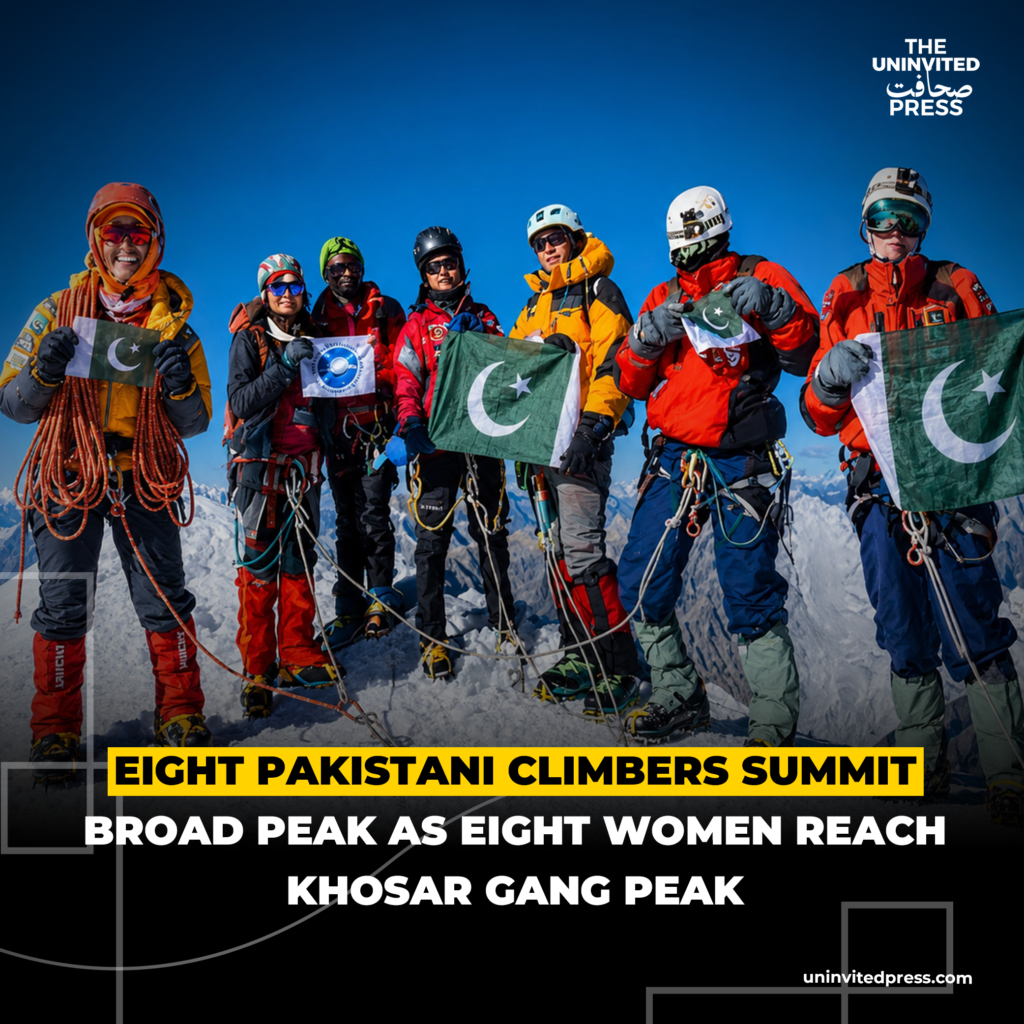
Pakistan’s mountaineering community celebrated a landmark day as eight Pakistani climbers successfully reached the summit of Broad Peak (8,051 metres) while another team of eight women mountaineers completed a successful ascent of Khosar Gang Peak (6,040 metres), marking two significant milestones for adventure sports and women’s participation in high-altitude climbing.
The twin achievements underscore the rapid growth of Pakistan’s mountaineering culture, with local climbers increasingly taking centre stage on some of the world’s most challenging peaks. Once dominated largely by foreign expeditions, Pakistan’s highest mountains are now witnessing a new generation of homegrown climbers pushing the boundaries of endurance and inspiring future adventurers.
Women Climbers Shine on Khosar Gang:
Broad Peak, located in the Karakoram Range near K2, is the world’s 12th-highest mountain and is regarded as one of the most demanding 8,000-metre summits. Climbers face extreme weather, thin oxygen levels, technical ridges, and unpredictable avalanche risks before reaching its summit.
The successful Pakistani expedition reflects years of preparation, physical endurance, and technical expertise. Despite challenging conditions, the climbers completed their ascent safely, carrying the national flag to one of the highest points on Earth and showcasing Pakistan’s growing capability in elite mountaineering.
At the same time, another milestone unfolded on Khosar Gang Peak in the Shigar region of Gilgit-Baltistan, where eight women mountaineers successfully reached the summit. Their achievement represents one of the largest successful female climbing teams from Pakistan to conquer the peak, highlighting the increasing role of women in a sport traditionally dominated by men.
The expedition brought together climbers from diverse backgrounds, reflecting a broader movement to encourage women’s participation in outdoor adventure, leadership, and environmental awareness. Organisers described the climb as both a sporting achievement and a symbol of empowerment, resilience, and equal opportunity in Pakistan’s mountaineering community.
Pakistan’s Peaks Continue to Inspire Climbers:
Pakistan is home to five of the world’s fourteen mountains above 8,000 metres, including K2, Nanga Parbat, Broad Peak, Gasherbrum I, and Gasherbrum II. Every climbing season attracts international expeditions seeking to test themselves against the formidable peaks of the Karakoram and Himalayan ranges. In recent years, however, Pakistani climbers have increasingly earned recognition for their own achievements, setting national records and representing the country on the global mountaineering stage.
Experts believe these latest successes could further boost adventure tourism in Gilgit-Baltistan, an area renowned for its spectacular landscapes, glaciers, alpine lakes, and some of the world’s most technically demanding climbing routes. The growing visibility of Pakistani climbers is also expected to inspire more young people to pursue mountaineering, trekking, and other outdoor sports.
Officials and mountaineering organisations congratulated both teams, describing the double success as a proud moment for the nation. Beyond sporting excellence, the climbs highlight Pakistan’s immense natural heritage and reinforce its reputation as one of the world’s premier destinations for high-altitude adventure.
As the climbing season continues across the Karakoram, these achievements are expected to encourage greater investment in mountaineering infrastructure, safety training, and youth development programmes, ensuring that future generations of Pakistani climbers continue to make their mark on the world’s highest peaks.