

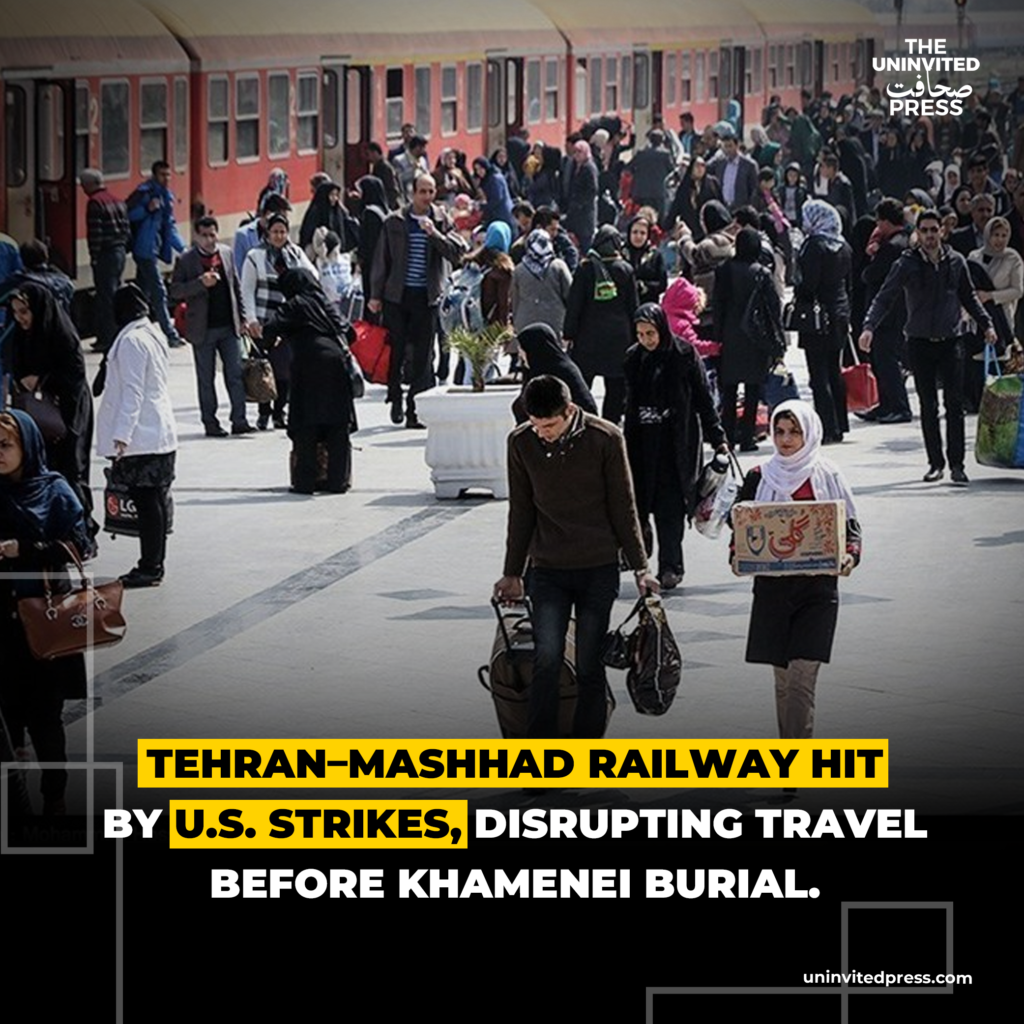
Damage to the Tehran-Mashhad railway line has disrupted a key transport route to Mashhad, where funeral ceremonies are being held. The incident underscores the widening impact of the conflict on civilian infrastructure and public movement amid heightened regional tensions.
American airstrikes have reportedly damaged key sections of Iran’s vital Tehran-Mashhad railway line, causing widespread disruption to passenger and freight services at a time when millions are preparing to travel for the burial of the late Supreme Leader Ayatollah Ali Khamenei.
The strikes, part of the ongoing US military campaign against Iranian targets, have compounded the humanitarian and logistical challenges facing the country following the death of its top leader. Iranian state media and local reports indicate significant damage to rail infrastructure on one of the country’s busiest routes, which connects the capital to the holy city of Mashhad.
Hundreds of thousands of Iranians are expected to converge on Mashhad for the burial ceremonies, making the disruption particularly acute. Crowded stations and stranded travellers have been reported, with many forced to seek alternative-and often more expensive-modes of transportation.
Heavy civilian toll:
Over two days of intensified US strikes, at least 14 people have been killed and 78 wounded, according to Iranian officials. Blasts were reported in several cities along the Strait of Hormuz, including Bushehr, Chabahar, Bandar Abbas, and Sirik. The attacks have raised serious concerns about the targeting of infrastructure with civilian significance.
The Tehran-Mashhad railway is a critical artery for domestic travel in Iran, serving both pilgrims heading to the Imam Reza shrine in Mashhad and ordinary citizens. Damage to the line has forced the suspension or severe delays of services, exacerbating difficulties for a population already reeling from weeks of conflict, power outages, and economic strain.
Iranian officials condemned the strikes as a deliberate attempt to undermine national unity during a period of mourning. “This is not just an attack on infrastructure-it is an attack on the Iranian people at their most vulnerable moment,” one official was quoted as saying.
The US has not officially confirmed targeting civilian rail facilities, stating that its operations focus on military and strategic sites linked to the Islamic Revolutionary Guard Corps. However, the broadening scope of strikes has raised concerns about collateral damage to essential services.
War Expands, Civilian Impact Grows:
The incident comes as Iran continues to retaliate against US bases in the Gulf, with recent missile and drone attacks reported in Kuwait and Bahrain. The cycle of escalation shows no immediate signs of abating, despite international calls for restraint.
The death of Supreme Leader Khamenei earlier in the conflict had already triggered massive funeral processions and a period of national mourning. Analysts note that disruptions to travel could fuel public anger and complicate the political transition in Tehran.
As the war enters a new phase, the targeting of infrastructure such as railways highlights the growing human cost extending far beyond the battlefield. Humanitarian organisations have warned of potential crises in mobility, supply chains, and access to essential services if the conflict persists.