

Indian and Australian leaders launch bilateral sports collaboration roadmap as part of efforts to deepen people-to-people links through youth programmes and shared sporting passion.
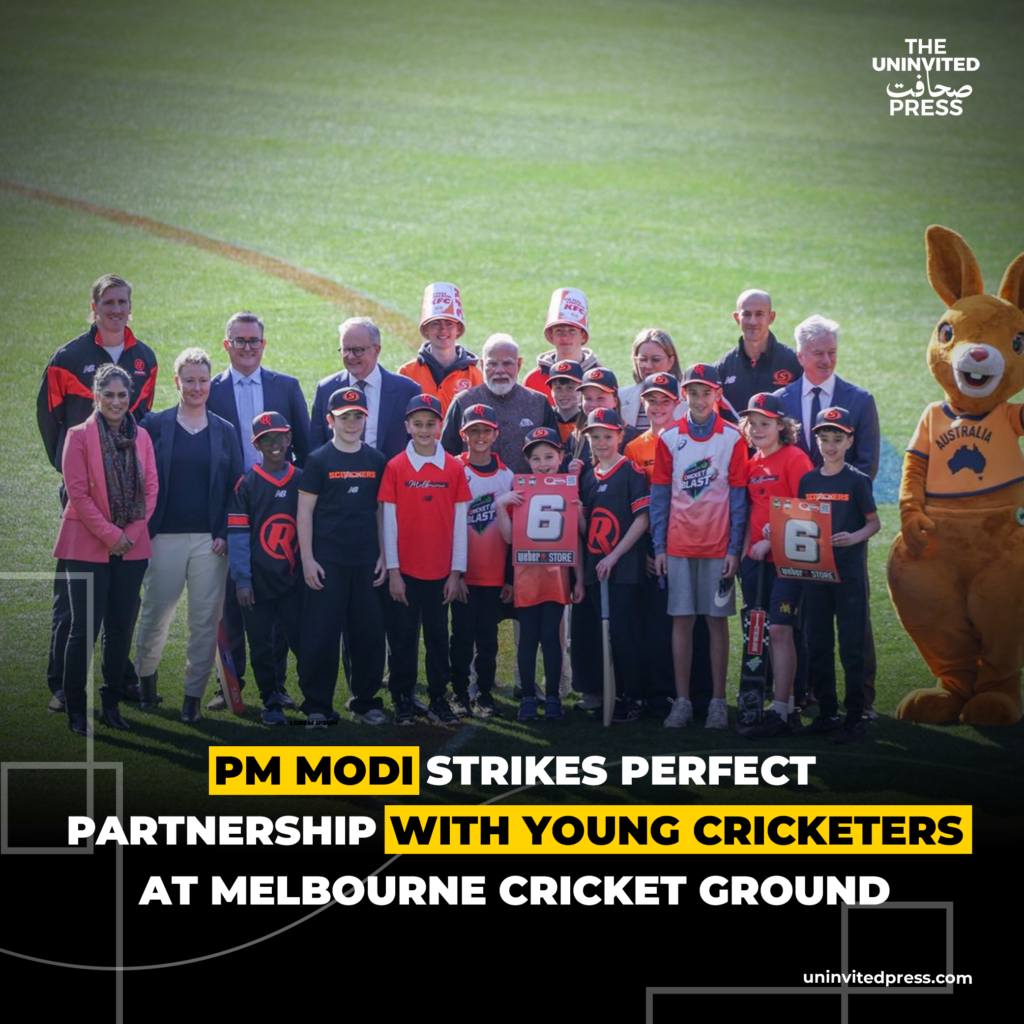
Indian Prime Minister Narendra Modi and his Australian counterpart Anthony Albanese interacted with groups of young athletes, including cricketers, at the historic Melbourne Cricket Ground (MCG) on 10 July 2026, in a high-profile display of sports diplomacy between the two nations.
The visit formed part of Modi’s ongoing trip to Australia and featured the launch of an India-Australia Sports Collaboration Roadmap aimed at expanding cooperation in training, sports science, technology, industry investment and youth exchanges. Victorian Premier Jacinta Allan also joined the leaders at the iconic venue, alongside Australian cricket legends Steve Waugh and Lisa Sthalekar.
Some youngsters held bats and promotional signs while posing for group pictures on the lush green outfield. A large kangaroo mascot in an “Australia” jersey added a distinctly local flavour to the gathering. Modi was seen signing jerseys for the young players, who appeared delighted by the attention from the visiting leader.
The interaction extended beyond cricket. Young athletes also demonstrated skills in kabaddi and Australian rules football during exhibition games, underscoring the breadth of sporting connections the two countries are seeking to nurture.
Sports as a bridge between nations:
Cricket has long served as one of the most visible links between India and Australia. The two countries share a fierce yet respectful rivalry on the field, most notably in the Border-Gavaskar Trophy. Beyond competition, however, the sport has repeatedly acted as a diplomatic lubricant, facilitating people-to-people contact and cultural understanding.
Modi highlighted this dimension in remarks at the MCG. “Wonderful to visit the Melbourne Cricket Ground with PM Albanese,” he said. “The passion for sport continues to bring the people of India and Australia closer.”
The newly launched Sports Collaboration Roadmap seeks to move beyond symbolic gestures. It outlines practical steps including joint training initiatives, exchanges in sports science and technology, support for the sports industry, and the organisation of an India-Australia Youth Sports Festival. Officials from both sides described the framework as a way to diversify and institutionalise sporting cooperation under the broader India-Australia Comprehensive Strategic Partnership.
key purposes of the visit:
- Annual Leaders’ Summit: To strengthen the India-Australia Comprehensive Strategic Partnership and discuss regional security, trade, technology, and Indo-Pacific cooperation.
- Defence and security: The two countries agreed to expand defence cooperation, maritime security collaboration, and joint military exercises.
- Trade and energy: Both governments advanced negotiations on trade and investment, while Australia agreed to deepen cooperation on uranium exports and energy security.
- Business engagement: Modi met Australian business leaders to encourage investment and economic partnerships.
- Indian diaspora event: Modi attended the “Melbourne Meets Modi” community reception at Marvel Stadium, where tens of thousands of Indian-Australians gathered to welcome him. The event celebrated the Indian diaspora’s contribution to Australia, although it was also accompanied by protests from some groups outside the venue.
- Sports diplomacy: During the visit, Modi also toured the Melbourne Cricket Ground, highlighting cricket as a shared passion between India and Australia.
Modi, Albanese Inspire Young Cricketers:
The MCG event comes amid steadily strengthening ties between New Delhi and Canberra. The two nations cooperate closely within the Quad grouping alongside the United States and Japan, share concerns over Indo-Pacific security, and have expanded defence and trade links in recent years. People-to-people connections are also significant, with a large Indian diaspora in Australia and growing numbers of Australian students and professionals engaging with India.
Sports engagement is viewed by both governments as a low-friction yet high-impact channel for building goodwill, especially among younger generations. By bringing children from local cricket programmes into direct contact with the Indian prime minister, the visit reinforced cricket’s role as a soft-power asset for both countries. Modi also welcomed reports that India would host the opening match of the upcoming Big Bash League season in Chennai, describing the move as an opportunity to expose Australian cricket to vast Indian audiences.
Young athletes were at the heart of the event, highlighting both countries’ commitment to expanding grassroots sports and youth exchanges. A planned Youth Sports Festival will give children from India and Australia more opportunities to train, compete and connect. At the MCG, Prime Ministers Narendra Modi and Anthony Albanese met young cricketers, signed autographs and celebrated the unifying power of sport, reinforcing the growing India-Australia partnership through sports diplomacy.