

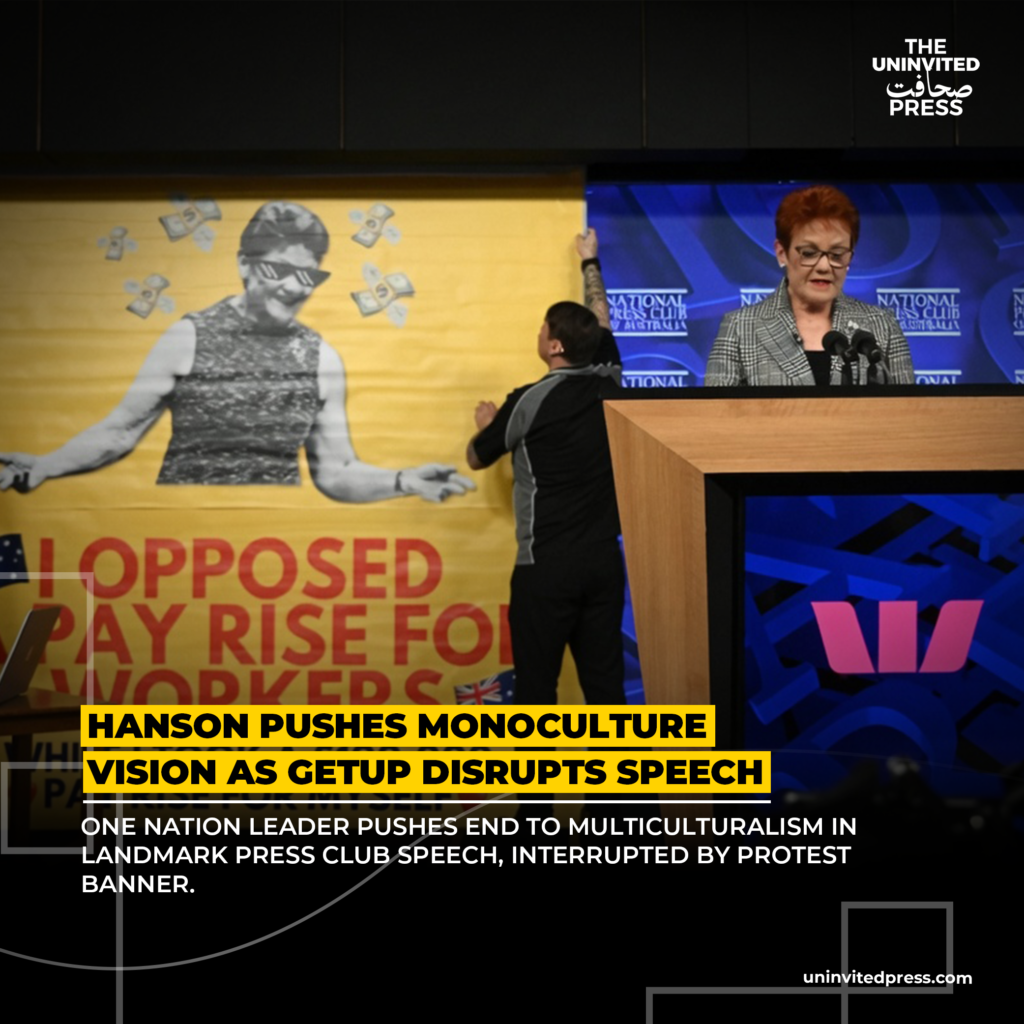
One Nation leader’s landmark speech disrupted by protest banner as she pushes ‘monocultural’ vision for Australia.
Pauline Hanson, the veteran leader of Australia’s One Nation party, used her first-ever address to the National Press Club on Wednesday to declare that multiculturalism has failed and that Australia must instead embrace a “monocultural” society unified under a single cultural umbrella.
The speech, delivered amid surging support for One Nation amid widespread concerns over immigration, housing shortages, and cost-of-living pressures, was briefly interrupted by a protest banner unfurled behind her on stage. The bright yellow banner, claimed by the left-leaning activist group GetUp, featured an image of Hanson surrounded by money and accused her of opposing pay rises for workers while accepting a significant salary increase herself.
Hanson did not acknowledge the disruption and continued speaking as staff quickly removed the banner. GetUp later took responsibility, stating the stunt highlighted perceived inconsistencies in Hanson’s record as a champion of “battlers.”
‘We cannot be a multicultural society’:
In a pointed critique of long-standing Australian policy, Hanson told the audience: “We are a multiracial society, but we must be monocultural. Australians must live under the one cultural umbrella.” She described multiculturalism as a “failed policy” that allows cultures equivalence with Australia’s own, arguing it undermines social cohesion, language proficiency, and integration.
Citing census data, she pointed to hundreds of thousands of residents who speak English poorly or not at all, linking this to broader failures in migration management. Hanson called for stricter English language requirements for citizenship, reduced immigration intake, and measures to address what she described as incompatible values, including from certain religious communities.
Her remarks come as One Nation has gained significant traction in recent polls, positioning itself as a voice for Australians frustrated with major parties on issues ranging from net-zero policies to rapid population growth and cultural change.
Hanson Defends Nationalist Vision:
Hanson used the platform to outline a wide-ranging vision, criticising mainstream media, public broadcasters like the ABC and SBS, renewable energy targets, and the current industrial relations system. She advocated for major reforms, including potential abolition of certain public institutions if One Nation gains power, and stronger protections for what she called Western and Judeo-Christian values.
The address also drew external protests, with demonstrators outside the venue accusing One Nation of promoting racist policies.
In the subsequent question-and-answer session, Hanson faced tough scrutiny from journalists, including on topics such as her party’s staffing arrangements and how her views might be received in Australia’s Asian neighbours.
For Hanson, who first rose to prominence in the 1990s with outspoken views on immigration, Wednesday’s speech represents a significant milestone nearly three decades into her political career. Once a fringe figure, she now leads a party that many analysts see as capable of influencing the balance of power in future elections.
Critics argue her “monocultural” vision revives outdated and divisive ideas that ignore Australia’s successful history as a diverse immigrant nation. Supporters, however, see it as a pragmatic response to real pressures on housing, services, and national identity.
As Australia grapples with high migration levels and economic challenges, Hanson’s message is likely to reverberate well beyond the National Press Club walls, forcing mainstream parties to contend with the growing appeal of her unapologetic brand of nationalism.