

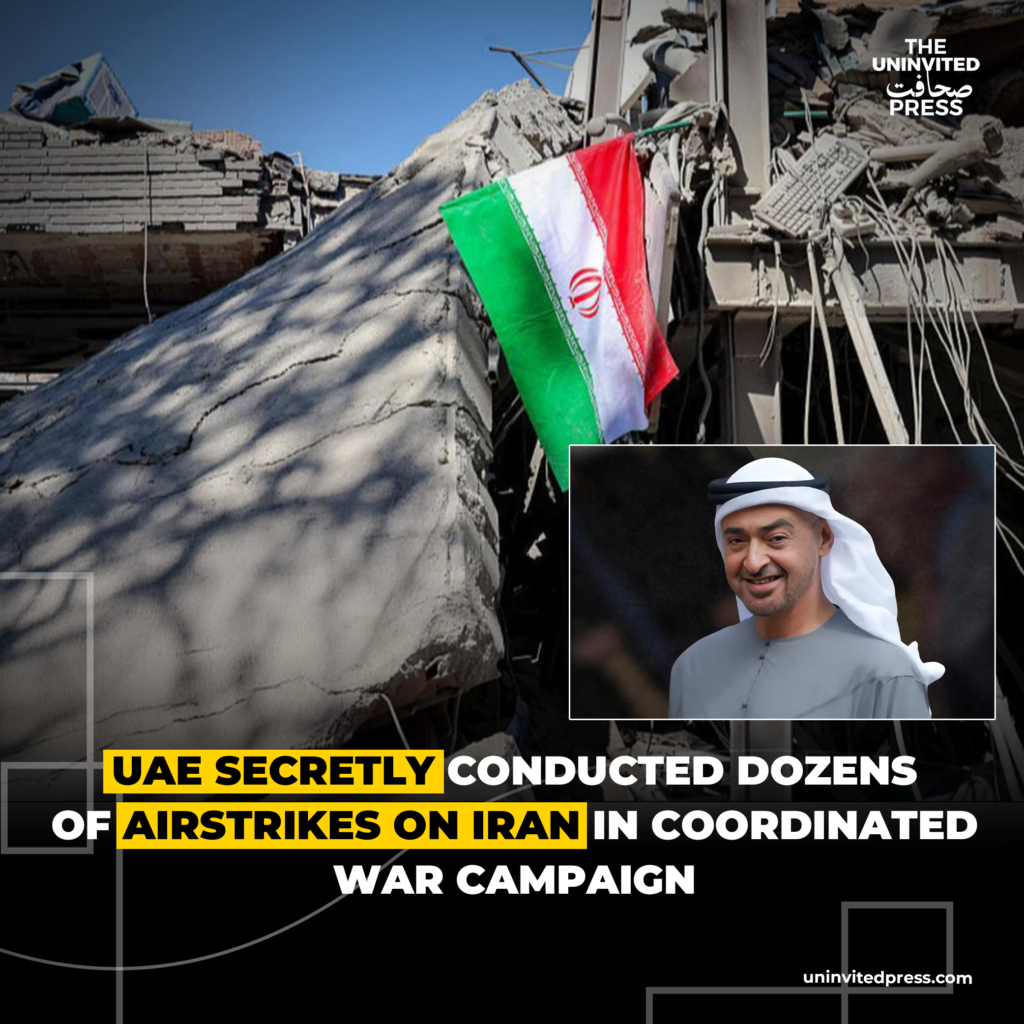
Gulf state played deeper military role than previously known, striking Iranian targets in coordination with Washington and Tel Aviv, WSJ reports.
The United Arab Emirates secretly conducted dozens of airstrikes on Iranian territory during the recent conflict between Iran, the United States and Israel, according to a report that reveals a more extensive Emirati involvement than previously acknowledged.
Citing people familiar with the matter, The Wall Street Journal reported that the UAE launched the strikes from the early days of the war and continued operations even after a ceasefire was announced in April. The attacks were coordinated with the US and Israel, which provided intelligence support.
Targets reportedly included military and energy infrastructure such as sites on Qeshm and Abu Musa islands in the Strait of Hormuz, the port of Bandar Abbas, an oil refinery on Lavan Island in the Persian Gulf, and the Asaluyeh petrochemical complex.
Iranian retaliation triggers UAE counter-strikes:
The strikes came as Iran launched hundreds of missiles and drones at the UAE in retaliation for the broader US-Israeli campaign. While Emirati air defences intercepted most of the incoming projectiles, some strikes caused casualties and damage to infrastructure, prompting a stronger response from Abu Dhabi.
The UAE has not publicly confirmed its direct role in offensive operations against Iranian soil. Officials have traditionally maintained a policy of strategic ambiguity regarding sensitive military engagements, while emphasising the need to protect national security and economic interests.
The revelations underscore the evolving security posture of Gulf states, which have grown increasingly assertive in confronting what they view as Iranian threats to regional stability and their own territories. The UAE’s actions mark a significant departure from its more cautious approach in previous regional conflicts.
Analysts note that the involvement risks further straining already tense relations between Gulf Cooperation Council members and Iran, while highlighting divisions within the Gulf over the extent of confrontation with Tehran. Saudi Arabia has also been reported to have carried out its own limited strikes.
Iran has accused the UAE and other actors of aggression, warning of consequences, though the fragile ceasefire has so far held amid ongoing diplomatic efforts.
UAE’s Role in Iran Conflict Raises Regional Tensions:
The UAE’s deeper engagement in the conflict reflects Abu Dhabi’s long-standing concerns over Iran’s ballistic missile programme, support for proxy militias, and perceived threats to maritime security in the Gulf.
While some view the strikes as legitimate self-defence, others warn that such direct confrontations could destabilise the region further and complicate post-war reconstruction and de-escalation efforts.
As more details emerge about the full scope of Gulf states’ involvement in the 2026 Iran war, questions remain about the long-term impact on fragile regional balances and the prospects for lasting peace in the Middle East.