

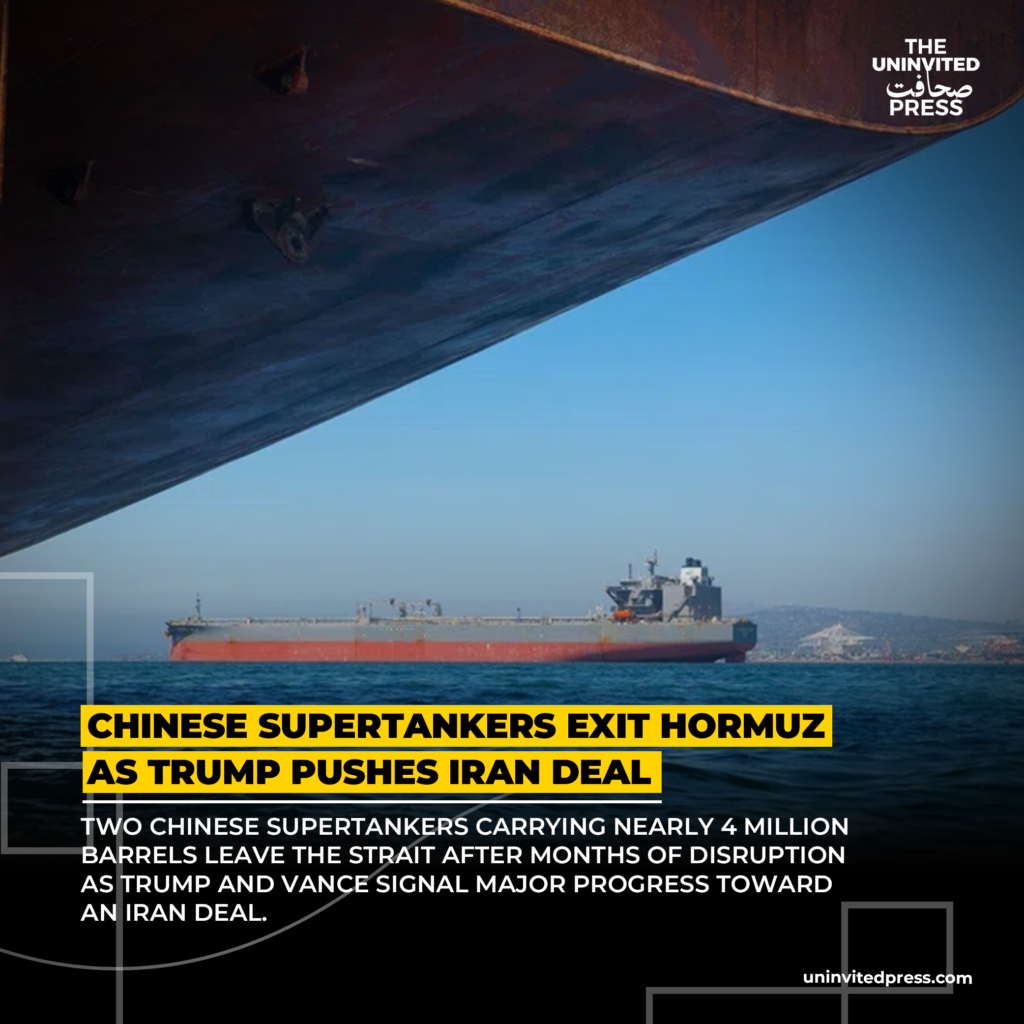
Oil prices ease amid signs of de-escalation, but analysts warn full normalisation of Gulf shipping remains uncertain.
Two Chinese supertankers carrying nearly four million barrels of crude oil have safely exited the Strait of Hormuz after months of disruption, as US President Donald Trump and Vice President JD Vance signal major progress toward a potential deal to end the ongoing conflict with Iran. The departure of the vessels-the Chinese-flagged Yuan Gui Yang and Hong Kong-flagged Ocean Lily-marks one of the most significant movements of large-scale commercial shipping through the vital chokepoint since Iran largely closed the strait to foreign vessels following US-Israeli strikes that began in late February.
Shipping data from LSEG and Kpler confirmed the tankers, laden with Iraqi crude, navigated out of the waterway on Wednesday, offering a tentative sign that maritime traffic could gradually resume if diplomatic efforts bear fruit.
China-Iran Oil Tanker Passage Signals Easing Gulf Tensions:
The tanker movement coincides with optimistic statements from the White House. Trump told US lawmakers the war on Iran would end “very quickly” and “hopefully in a very nice manner,” while Vance described “lots of progress” in behind-the-scenes negotiations.
Iran has reportedly eased restrictions for Chinese vessels as part of broader efforts to maintain economic ties with Beijing, its key trading partner. The development comes after weeks of intense shuttle diplomacy, including Trump’s recent visit to Beijing.
Analysts say the safe passage of the supertankers reflects a fragile mutual interest in preventing a complete collapse of global energy markets. The prolonged closure of the Strait of Hormuz-through which about one-fifth of the world’s seaborne oil normally passes-triggered the biggest disruption to global energy supplies in decades and sent oil prices soaring.
Fragile Gulf Ceasefire Keeps Oil Markets on Edge:
The US responded to Iran’s restrictions with its own naval blockade of Iranian ports, further complicating maritime traffic in the Gulf. While a ceasefire has held since early April, sporadic tensions and mutual threats have kept shipping insurance premiums elevated and many operators wary.
Iranian officials have warned that any renewed attacks could lead to spillover effects beyond the region, while continuing to demand the lifting of sanctions and the release of frozen funds as part of any comprehensive agreement.
Oil prices eased slightly on news of the tankers’ exit and positive comments from Washington, but experts caution that volatility will persist until a formal deal is reached and the strait returns to full operation.
For Gulf states and global energy consumers, the developments offer cautious hope that the worst of the energy shock may be over. However, regional analysts stress that any lasting resolution must address deeper issues, including Iran’s nuclear programme, its regional alliances, and long-standing security concerns for Israel and Arab states.