

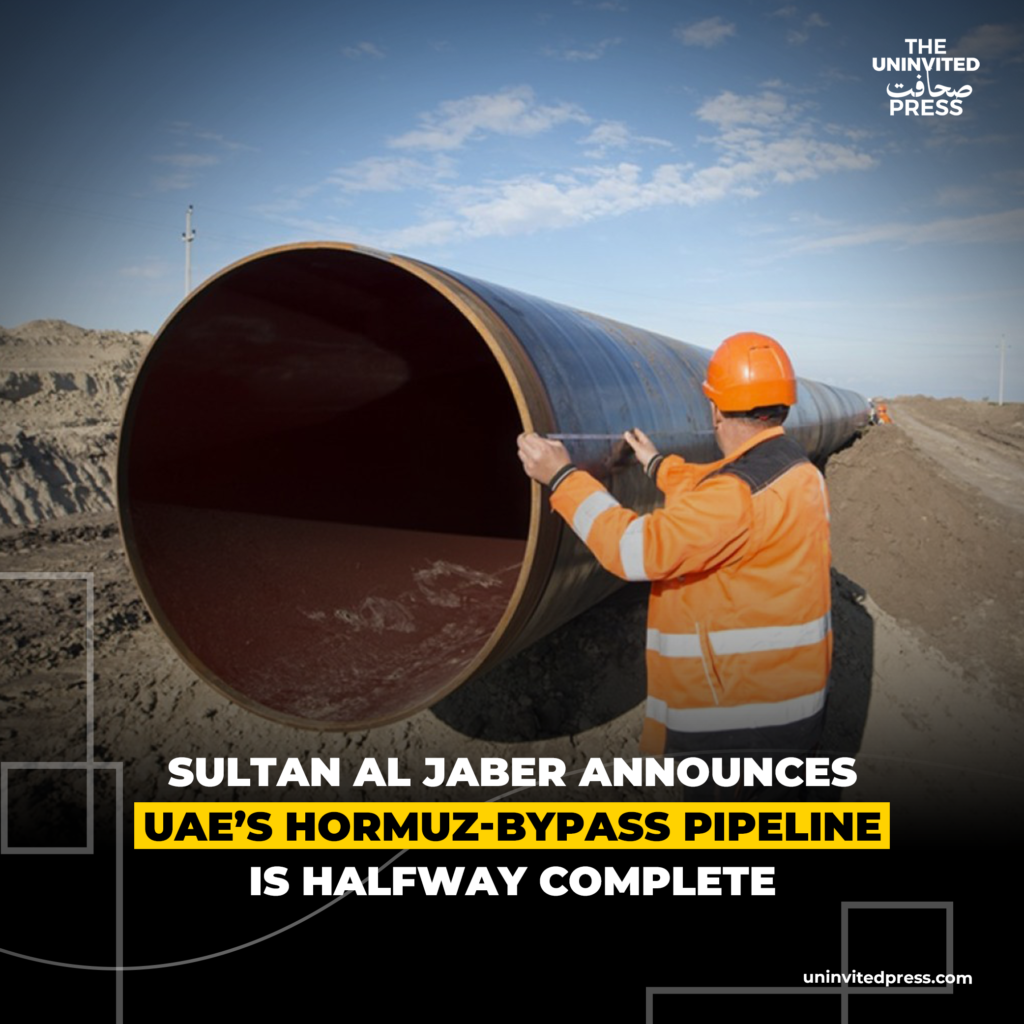
Sultan Al Jaber says new 1.2 million barrel-per-day line will reduce reliance on Strait of Hormuz amid regional tensions.
The United Arab Emirates has reached a major milestone in its ambitious project to build a new strategic oil pipeline that bypasses the Strait of Hormuz, with officials announcing on Thursday that construction is now halfway complete.
Energy Minister and ADNOC Group CEO Sultan Ahmed Al Jaber said the project, designed to carry up to 1.2 million barrels per day of crude oil directly to the Gulf of Oman, is progressing on schedule despite regional instability.
The announcement comes as the Gulf continues to grapple with the fallout from the US-Israel-Iran conflict, which severely disrupted shipping through the Strait of Hormuz earlier this year.
UAE Expands Oil Pipeline to Bypass Strait of Hormuz Risks:
The new pipeline, stretching from Abu Dhabi’s onshore fields to the Fujairah terminal on the eastern coast, will significantly enhance the UAE’s ability to export oil without passing through the narrow chokepoint between Iran and Oman.
The UAE already operates the Habshan-Fujairah pipeline with a capacity of around 1.5 million barrels per day. The new parallel line will nearly double bypass capacity, providing critical redundancy at a time when maritime insurance premiums for tankers transiting Hormuz remain elevated.
“This infrastructure is not only vital for the UAE’s energy security but also contributes to the stability of global oil markets,” Al Jaber said in a statement.
UAE Expands Oil Export Security via New Pipeline:
Officials expect the pipeline to become operational by late 2027. Once complete, it will allow the UAE to maintain export levels even if access to the Strait of Hormuz is restricted due to conflict or political tensions.
The project forms part of the UAE’s broader strategy to diversify export routes and strengthen its position as a reliable global energy supplier. It also reflects growing concerns among Gulf states about the vulnerability of the world’s most important oil transit route, through which roughly 21 million barrels of oil pass daily under normal conditions.
The development arrives as diplomatic efforts between the United States, Iran and regional actors continue in the wake of the recent ceasefire. Several Gulf countries have quietly accelerated alternative export infrastructure projects since the February escalation.
Industry analysts note that while the pipeline will not eliminate all risks, it provides the UAE with greater strategic autonomy and could serve as a model for other producers seeking to mitigate Hormuz-related vulnerabilities.
The UAE is one of the world’s top oil exporters and a key OPEC+ member. ADNOC has been investing heavily in expanding production capacity towards a target of 5 million barrels per day by 2027.