

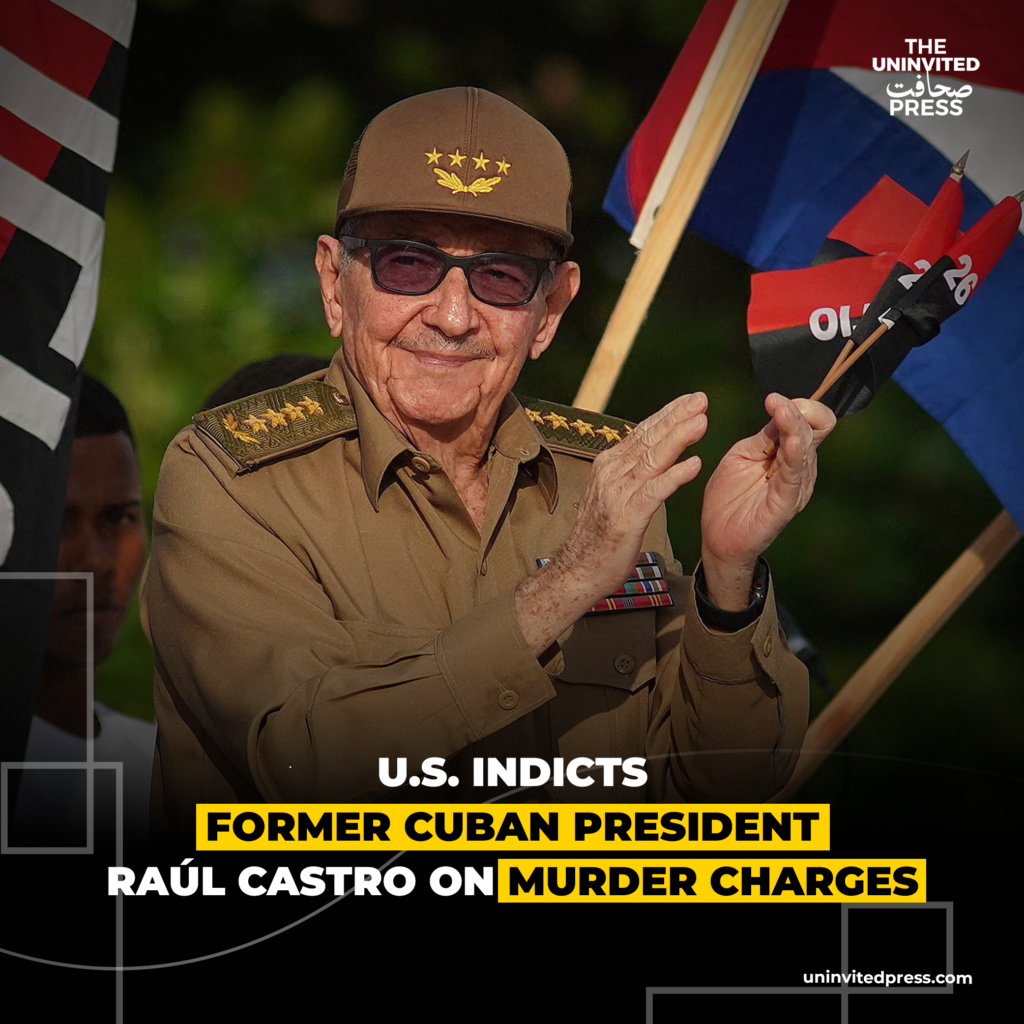
94-year-old revolutionary leader faces accusations over 1996 downing of civilian planes, in latest escalation of Trump administration pressure on Havana.
The United States has unsealed an indictment charging former Cuban President Raúl Castro with murder, conspiracy to kill US nationals, and destruction of aircraft in connection with the 1996 shootdown of two civilian planes operated by the Cuban exile group Brothers to the Rescue.
The federal grand jury indictment, announced by the US Department of Justice on Wednesday, names the 94-year-old Castro and five other former Cuban officials as defendants. It alleges that Cuban military forces, under Castro’s command as then-defence minister, shot down the unarmed aircraft over international waters on February 24, 1996, killing four people, including three US citizens.
Acting Attorney General Todd Blanche described the move as delivering long-sought justice for the victims’ families during a news conference at Miami’s Freedom Tower.
Decades-old case revived:
The incident, one of the most contentious episodes in US-Cuba relations, involved two small planes from the Miami-based humanitarian group Brothers to the Rescue (Hermanos al Rescate), which flew missions to assist Cuban migrants and protest the Cuban government. Cuba claimed the planes had entered its airspace, while the US maintained they were shot down in international waters.
The charges include one count of conspiracy to kill US nationals, four counts of murder, and two counts of destruction of aircraft. US officials say the indictment is largely symbolic, as Castro is unlikely to face trial in the US while remaining in Cuba.
Castro, who succeeded his brother Fidel as president in 2008 and stepped down in 2018, has long been a symbol of the Cuban Revolution. Cuban state media has dismissed the indictment as a “political provocation” by the Trump administration aimed at tightening the economic embargo on the island.
US Indictment of Raúl Castro Deepens Cuba Tensions:
The indictment comes as the Trump administration intensifies pressure on Cuba, including renewed sanctions and efforts to isolate the government amid the island’s severe economic crisis, energy shortages, and mass emigration.
Cuban officials have condemned the move as interference in the country’s internal affairs, while Cuban-American communities in South Florida have welcomed it as a historic step toward accountability.
Analysts say the case revives painful memories for both sides but is unlikely to alter the fundamental dynamics of the decades-long standoff between Washington and Havana. Cuba has repeatedly rejected US demands for political change, insisting on its sovereignty.
The development underscores the enduring legacy of Cold War-era conflicts in the region and the challenges of seeking justice for events that occurred 30 years ago.