

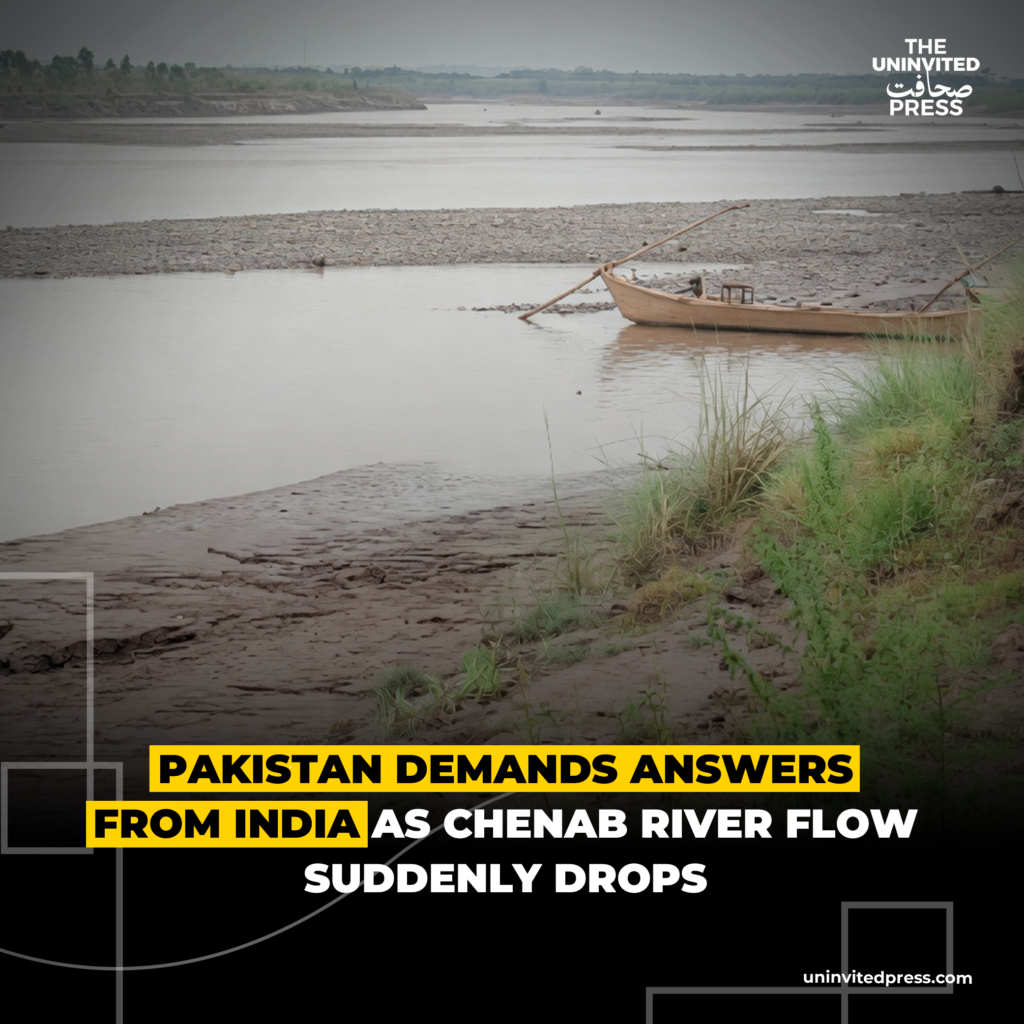
Islamabad accuses New Delhi of possible violation of Indus Waters Treaty as reduced water levels threaten agriculture, power generation and livelihoods in Punjab province.
Pakistan has summoned Indian officials and demanded urgent clarification after a sudden and sharp drop in water flow in the Chenab River, raising fears of deliberate diversion upstream and potential breach of the 1960 Indus Waters Treaty.
Sudden Chenab Flow Decline Triggers Pakistan’s Protest:
The Chenab River, one of the six rivers covered by the Indus Waters Treaty brokered by the World Bank, is allocated primarily to Pakistan. Under the agreement, India is permitted limited uses upstream but must allow uninterrupted flow to Pakistan except in clearly defined circumstances.
Pakistani officials say the flow at the Marala Headworks near Sialkot fell dramatically in recent days without prior notification, a requirement under the treaty’s dispute resolution mechanisms.
“Pakistan expects India to immediately explain the reasons behind this abrupt reduction and restore the flow in accordance with its treaty obligations,” said Pakistan’s Ministry of Water Resources in a strongly worded statement.
Impact on Agriculture and Power:
The Chenab is a lifeline for millions in Pakistan’s breadbasket province of Punjab. Farmers rely on its waters for irrigation of wheat, rice, and cotton crops, while several hydropower projects generate electricity for the national grid.
Local farmers have already reported damage to standing crops and fear a prolonged reduction could lead to severe water shortages during the critical summer planting season.
“This is not just about water-it is about survival,” said Chaudhry Muhammad Ashraf, a farmer from Gujrat district. “If the flow is not restored, thousands of acres will be ruined and power cuts will worsen.”
History of Water Tensions:
Water sharing has long been a flashpoint between the nuclear-armed neighbours. India has previously been accused by Pakistan of manipulating flows in the Indus system, particularly during times of heightened political tension. India consistently denies any violation, attributing fluctuations to natural causes, weather patterns or legitimate hydro projects.
The current incident comes amid already strained bilateral relations, with both sides accusing each other of supporting militancy and violating ceasefire agreements along the Line of Control in Kashmir.
Experts warn that climate change, glacial melting, and increasing upstream dam construction are adding new layers of complexity to the decades-old treaty, which many consider one of the most successful water-sharing agreements in the world.
Water Diplomacy Urged Amid Chenab Dispute:
The World Bank, guarantor of the Indus Waters Treaty, has been informed of the latest developments. Pakistani authorities have also raised the issue through the Permanent Indus Commission, the bilateral body established to resolve technical disputes.
Analysts urge both countries to engage transparently to prevent the water issue from escalating into a broader crisis.
“Timely communication and data sharing are essential to building trust,” said Dr. Shaheen Akhtar, a water security expert at the Institute of Regional Studies in Islamabad. “Any perception of weaponising water could have dangerous consequences for regional stability.”