

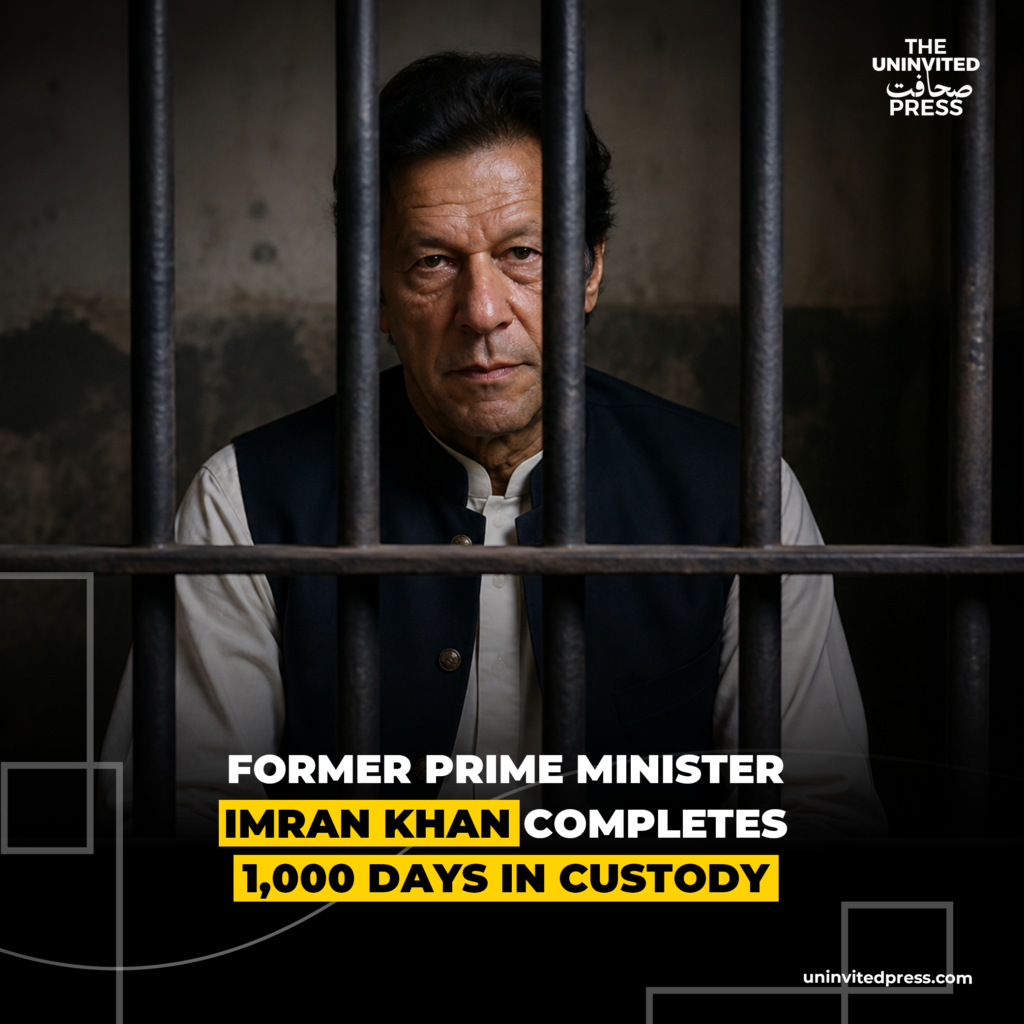
Pakistan’s former prime minister remains behind bars amid multiple convictions his party calls fabricated, as his family and loyalists highlight health concerns and restricted access.
Former Pakistani Prime Minister Imran Khan has completed 1,000 days in custody, a milestone that has galvanised his supporters and drawn renewed international attention to what his Pakistan Tehreek-e-Insaf (PTI) party describes as a systematic campaign to sideline him from politics.
Arrested in August 2023, the 73-year-old cricket legend-turned-politician has faced a series of legal cases ranging from corruption to leaking state secrets. Khan and his party maintain all charges are politically motivated to prevent him from returning to power.
Concerns Grow Over Imran Khan’s Health in Custody:
Khan’s family has repeatedly voiced distress over his conditions in Adiala Jail. His wife, Bushra Bibi-herself imprisoned in related cases-and close relatives have spoken of limited visits, denied medical access at times, and reports of deteriorating health.
Supporters claim Khan suffers from severe eye issues, including significant vision loss, dental problems, and the effects of prolonged solitary confinement, often described as up to 22 hours a day. Lawyers who have met him have characterised aspects of his detention as amounting to “torture.”
In a statement reflecting the personal toll, family members and party officials have highlighted how court orders for family meetings and proper medical care are routinely ignored, painting a picture of isolation imposed on a man once celebrated as a national icon..
Imran Khan’s health in custody, particularly worsening eye problems that may include significant vision impairment, alongside dental issues and stress-related effects from prolonged confinement. Limited access to regular medical care and allegations of extended isolation are said to have aggravated these conditions.
Medical experts note that delayed treatment of eye diseases can lead to permanent damage, while sustained stress and lack of proper healthcare can further impact overall physical and mental well-being.
Supporters’ View: A Symbol of Resistance:
For millions of PTI supporters, particularly the youth who propelled Khan to power in 2018, the 1,000-day mark is not merely a statistic but a testament to resilience against what they term “establishment-backed tyranny.”
Large rallies, social media campaigns under hashtags like #1000DaysKhanUnbroken, and protests have kept Khan’s cause alive despite a heavy crackdown on the party, including arrests of leaders and restrictions on public gatherings.
Many view Khan’s continued defiance from behind bars as inspiration, arguing that his imprisonment has only strengthened the movement’s narrative of fighting for real democracy, accountability, and an end to dynastic politics in Pakistan.
International concerns and calls for release:
The United Nations has previously described Khan’s detention as “arbitrary” and raised alarms over solitary confinement conditions. Human rights organisations have echoed calls for fair trials and access to proper healthcare.
Khan’s legal team continues to challenge convictions in higher courts, with some sentences suspended or under appeal. However, fresh cases and bail denials have kept him detained.
As Pakistan navigates economic challenges and political instability, Khan’s prolonged absence from the political arena raises questions about reconciliation and the future of democratic processes in the country.
While the government maintains that Khan is receiving due process and standard jail facilities, his supporters insist that true justice remains elusive as long as the former premier is kept away from the electorate that once swept him into office.