

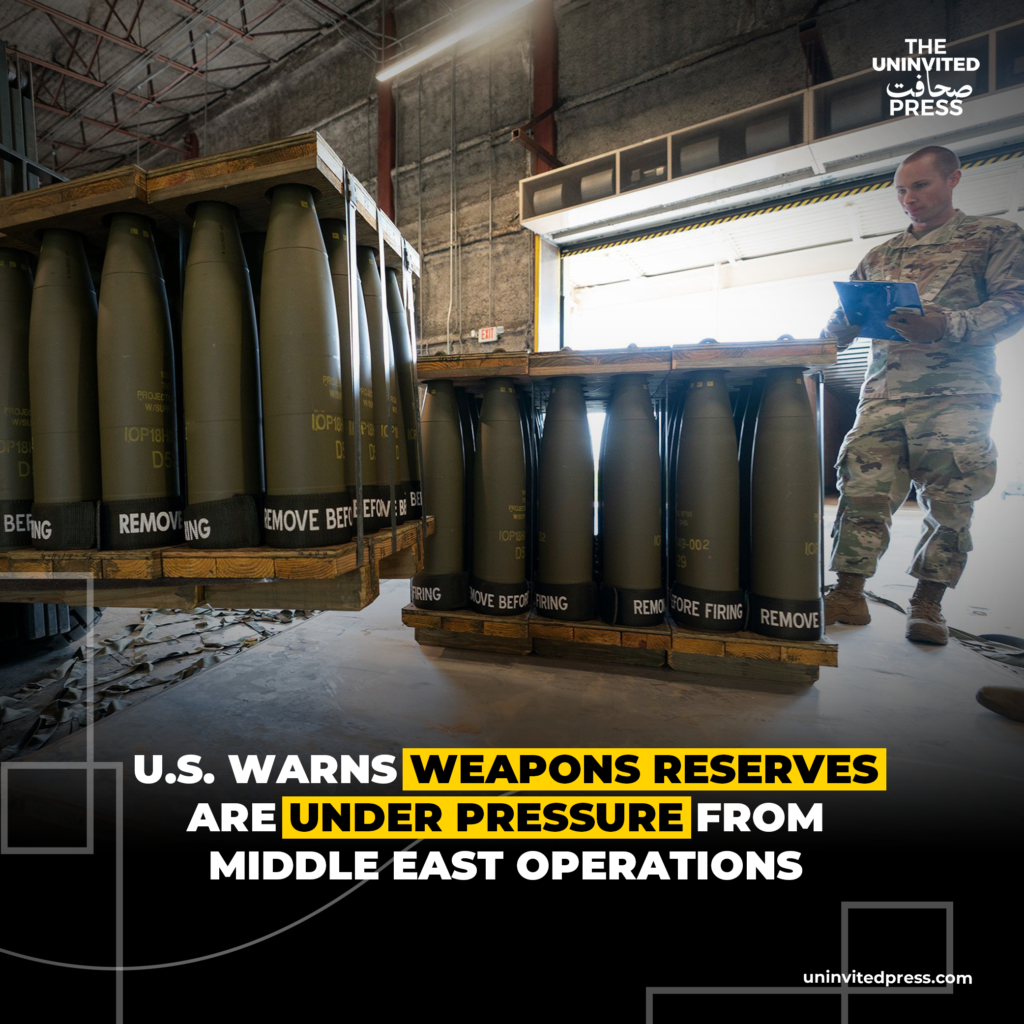
Pentagon officials warn that sustained operations supporting Israel in Gaza, Lebanon and against Iran are depleting critical munitions faster than anticipated.
The United States has issued a stark warning that its weapons reserves are coming under severe pressure due to ongoing military operations and arms transfers to Israel amid the escalating conflicts across the Middle East, according to Pentagon sources and defence analysts.
The disclosure comes as the US continues to supply Israel with large quantities of munitions, including precision-guided bombs, artillery shells and other equipment, to support its military campaigns in Gaza, along the Lebanon border and in direct confrontations with Iran and its allies.
US Weapons Stockpiles Strained by Ongoing Middle East Conflicts:
US officials told lawmakers and media outlets that repeated resupply efforts, particularly since the intensification of hostilities in early 2026, have significantly drawn down American stockpiles of key weapons systems. Images from US military facilities show rows of artillery shells and bombs being inspected and prepared for shipment, highlighting the scale of the logistics involved.
Defence experts note that the US has already transferred thousands of munitions originally earmarked for its own forces or other allies, raising concerns about readiness for potential contingencies elsewhere, such as in the Indo-Pacific region.
A senior US defence official, speaking on condition of anonymity, acknowledged that “sustained high-intensity operations in the Middle East are testing the limits of our current production capacity and existing inventories.”
US Arms Transfers to Israel Raise Strategic and Political Concerns:
Since October 2023, and particularly following the major escalation involving Iran in February 2026, the US has approved multiple emergency arms packages to Israel totalling several billion dollars. These include Joint Direct Attack Munitions (JDAMs), Hellfire missiles, and 155mm artillery shells-many of which are now visibly being moved from storage facilities.
Critics in Washington and the region argue that unconditional US military support has enabled prolonged Israeli operations, contributing to high civilian casualties in Gaza, Lebanon and Iran while simultaneously weakening America’s own strategic posture.
Regional repercussions and calls for restraint:
The strain on US reserves coincides with mounting international criticism of the scale of destruction in the region. Palestinian, Lebanese and Iranian officials have repeatedly accused Washington of complicity in what they describe as “aggressive wars” that have killed tens of thousands and displaced millions.
Human rights groups and UN officials continue to call for an immediate ceasefire and restrictions on arms transfers that fuel the violence.
“Pouring more weapons into an already volatile conflict is not a path to peace-it is a recipe for wider regional war,” said a spokesperson for a prominent international humanitarian organisation.
As production lines in the US struggle to keep pace with demand, questions are growing about how long America can maintain its role as the primary weapons supplier without compromising its global military commitments.