

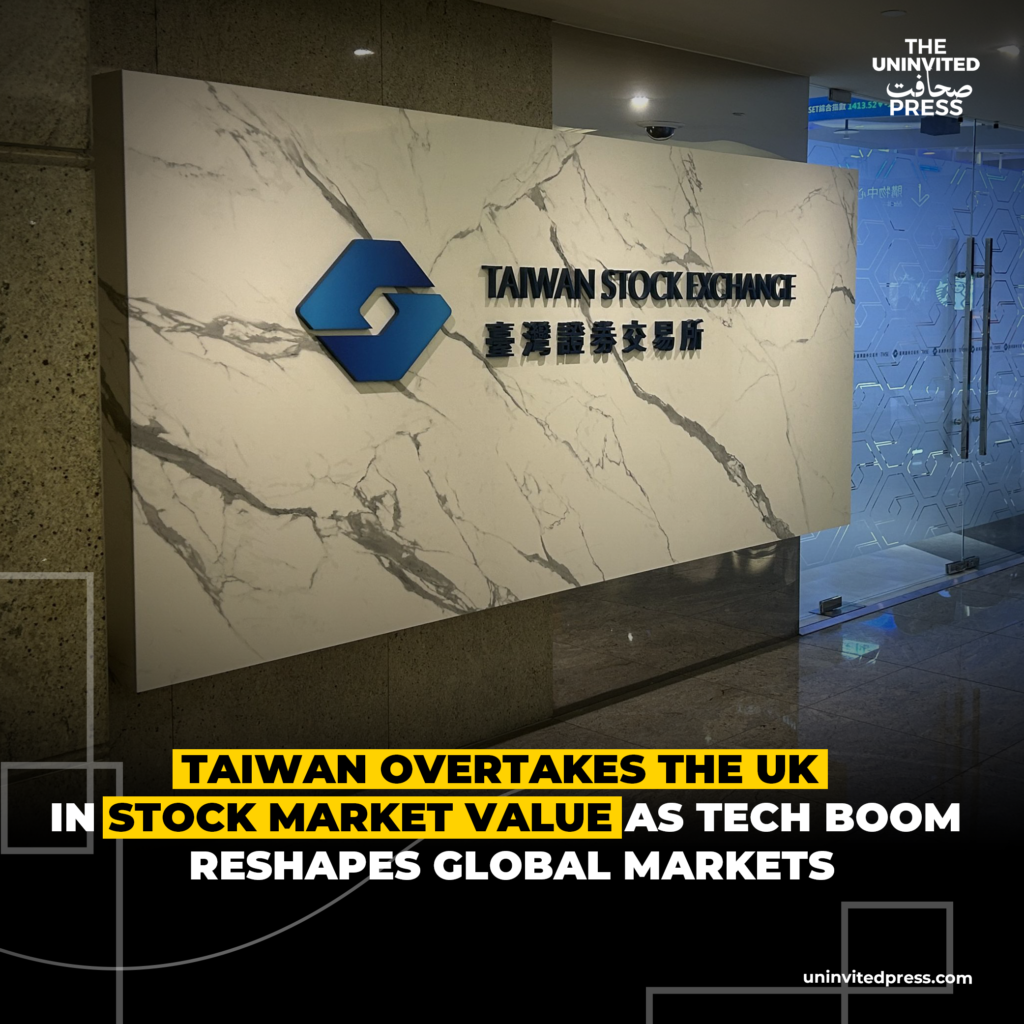
AI-driven semiconductor rally propels Taiwan ahead of London, highlighting a major shift in global financial power.
The stock market of Taiwan has surpassed that of the United Kingdom in total market capitalization, marking a symbolic but significant shift in global financial rankings as the worldwide technology boom continues to accelerate. The milestone reflects the growing dominance of Asia’s high-tech manufacturing hubs, particularly those tied to semiconductors and artificial intelligence supply chains.
Semiconductor Boom Drives Taiwan’s Market Surge:
The surge in Taiwan’s market value has been driven primarily by its semiconductor industry, which plays a central role in global technology production.
Companies linked to advanced chip manufacturing have seen strong investor inflows as demand rises for AI processors, data center hardware, and next-generation computing infrastructure.
This wave of investment has pushed valuations sharply higher, with Taiwan’s tech-heavy stock index benefiting disproportionately compared to more diversified but slower-growing markets.
Analysts say the rally is not purely speculative but anchored in long-term expectations that AI expansion will continue to fuel global chip demand for years, keeping Taiwan at the center of the digital economy.
UK Market Slows Amid Global Shift in Capital Flows:
The UK equity market has struggled to keep pace, weighed down by lower exposure to fast-growing technology sectors and broader economic challenges, including slower growth and investor caution in traditional industries.
Financial observers note that London’s market remains strong in banking, energy, and consumer sectors, but lacks the concentrated tech momentum seen in Asia and the United States.
The shift in rankings is therefore being interpreted as part of a larger realignment in global capital flows, where investors increasingly favor innovation-driven economies.
However, experts also warn that such leadership changes in market capitalization can be fluid, influenced by currency fluctuations, interest rates, and geopolitical developments that could quickly reshape the global financial landscape again.